| TROVIEW INTELLIGENCE | Japan Life Sciences Campus Market | Q2 2026 |
| TROVIEW INTELLIGENCE · COUNTRY INTELLIGENCE REPORT |
By Campus · By Asset Type · By Tenant Segment · By Region
Campus Profiles: Shonan Health Innovation Park · King Skyfront · Tokyo Nihonbashi · Kobe Biomedical Cluster · Osaka-Kyoto
Japan's life sciences campus market is anchored by Shonan Health Innovation Park in Fujisawa established by Takeda Pharmaceutical Company in 2018 as Japan's first science park from a pharmaceutical company with approximately 220 companies and 3,500 people across next-generation medicine, AI, and cellular agriculture King Skyfront in Kawasaki with more than 70 institutions and 5,200 people on a 40-hectare Tokyo Bay hub, AN Venture Partners closing Japan's first fund at USD 200 million in July 2025 as one of the largest Japan-focused biotech funds to date, University of Tokyo Edge Capital Partners closing its sixth fund at ¥47 billion (USD 326 million) in July 2025 bringing its AUM above USD 1 billion, CBRE recording Japanese commercial real estate investment increasing 68% year-on-year to JPY 2.092 trillion in Q3 2025 establishing a new quarterly record, Mitsui Fudosan partnering with BioLabs and Life Science Innovation Network Japan to launch LINK-BioBAY TOKYO, and METI expanding tax incentives and direct subsidies for biotech under the government's drug discovery strategy with KPIs to 2028 confirming Japan as Asia's emerging life sciences campus market with the most active government policy support and the most concentrated pharmaceutical company heritage of any major APAC economy.
| Standard License: USD 6,500 | Enterprise License: USD 9,500 |
MARKET SYNOPSIS
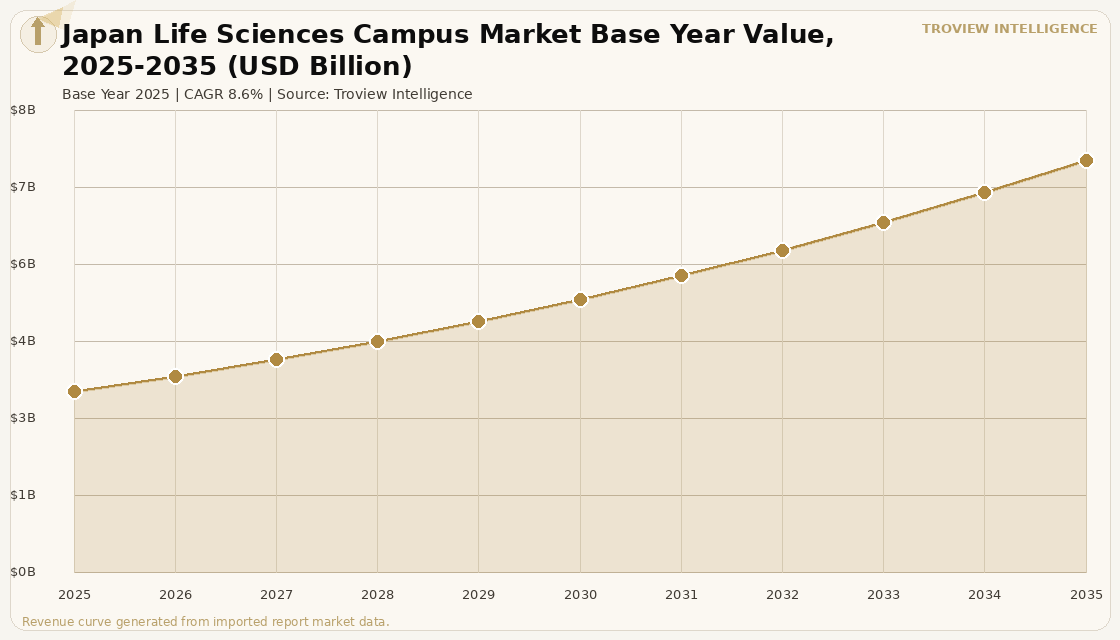
The Japan life sciences campus market size was USD 3.24 Billion in 2025 and is expected to register a revenue CAGR of 8.6% during the forecast period, reaching USD 7.38 Billion by 2035. Japan's life sciences campus market encompasses purpose-built laboratory research facilities, open innovation campus complexes, co-working life sciences incubators, pharmaceutical company research and development facilities, and biomanufacturing campuses across the Greater Tokyo, Kanagawa, Kobe, and Osaka-Kyoto cluster markets. Market revenue growth is supported by Japan's Ministry of Economy, Trade and Industry expanding tax incentives and direct subsidies for firms investing in biotech alongside semiconductors, AI, and robotics, with the government's drug discovery strategy establishing strategic goals and action plans with timelines and key performance indicators to 2028 per government policy documentation and academic policy review analysis of August 2025. Japan's commercial real estate investment market recorded a new quarterly record of JPY 2.092 trillion in Q3 2025, an increase of 68% year-on-year per CBRE Japan Investment MarketView of November 2025, with large transactions in excess of JPY 10 billion doubling in volume, demonstrating the depth of institutional capital available for deployment into life sciences and specialist real estate assets within Japan's record-breaking investment market. In July 2025, AN Venture Partners, Japan, closed its first fund at USD 200 million, one of the largest Japan-focused biotech venture funds to date, with a mandate to invest globally while strengthening Japan's biopharma ecosystem, confirming that domestic institutional capital is beginning to match the scale of ambition required to sustain life sciences campus demand through early-stage company formation per BioSpectrum Asia reporting. For instance, in July 2025, University of Tokyo Edge Capital Partners, Japan, closed its sixth fund at ¥47 billion approximately USD 326 million bringing its assets under management above USD 1 billion, the fund backing seed and early-stage startups across healthcare, life sciences, information technology, and engineering with notable successes including PeptiDream, a publicly listed peptide drug discovery company with a market capitalisation above USD 1.4 billion, and OriCiro Genomics, acquired by Moderna in 2023 per BioSpectrum Asia reporting. These are some of the key factors driving revenue growth of the market.
Shonan Health Innovation Park, established in 2018 by Takeda Pharmaceutical Company by opening its own research laboratory to outside partners, has grown into one of Japan's largest life science campuses with approximately 220 companies and approximately 3,500 people engaged in fields including next-generation medicine, AI, and cellular agriculture per iPark Institute company and Kanagawa Prefecture information. The campus is operated by iPark Institute Co., Ltd., which achieved full independence from Takeda in 2023 to maintain neutrality within the pharmaceutical industry, providing an environment where pharmaceutical companies, research equipment manufacturers, universities, and startups participate without barriers per Kanagawa Prefecture success story documentation. King Skyfront formally Kawasaki INnovation Gateway at SKYFRONT, a 40-hectare hub for R&D in health, medicine, and biotechnology located in Tonomachi, Kawasaki, beside Haneda Airport hosts more than 70 institutions and approximately 5,200 people per King Skyfront official information, including the Innovation Center for NanoMedicine operating in collaboration with BioLabs to provide co-working laboratory space for early-stage biotech startups. Mitsui Fudosan Co., Ltd., Japan, partnered with BioLabs, United States, and Life Science Innovation Network Japan in the LINK-BioBAY TOKYO initiative, launched as part of the Tokyo Metropolitan Government's TIB CATAPULT initiative, providing incubation cluster space supporting Japanese life sciences startups in scaling globally per BioSpectrum Asia reporting. These are some of the key factors driving revenue growth of the market.
However, the Japan life sciences campus market faces structural constraints that temper the pace of revenue growth through the forecast period. The domestic IPO ceiling for Japanese biotech companies commonly around ¥10 billion to ¥11 billion starves later clinical stages of capital relative to the US NASDAQ environment, compelling sophisticated founders to plan dual tracks including US and EU capital market participation from the outset and limiting the domestic funding cycle that sustains sustained campus occupancy growth in Japan's life sciences clusters. Iran-US geopolitical tensions and LNG price volatility through the Strait of Hormuz, as confirmed by IMF March 2026 analysis, directly affect Japan's electricity generation costs given the country's near-total dependence on LNG-fired generation following the 2011 Fukushima nuclear shutdown, with laboratory and biomanufacturing facilities requiring continuous 24-hour power for controlled environment rooms, cold chain storage, and biosafety cabinet ventilation generating four to eight times the energy consumption per square metre of conventional office space and directly exposing life sciences campus operators to Japan's LNG spot price volatility. The specialised design and construction requirements of life sciences campuses biosafety level-2 and level-3 laboratory spaces, cGMP production clean rooms, controlled temperature storage, and specialist exhaust ventilation create development cost premiums of 40% to 60% above conventional office space in Tokyo's already expensive construction market, limiting the pipeline of new life sciences campus supply that can be economically developed outside of government-supported cluster zones. These factors substantially limit Japan life sciences campus market growth over the forecast period.
Japan's life sciences campus market has a structural advantage that the US market does not: government policy that explicitly identifies life sciences cluster development as a national priority and backs it with direct subsidies, tax incentives, and regulatory acceleration. METI's drug discovery strategy with KPIs to 2028 is not a grant programme. It is a manufacturing and innovation roadmap that uses public infrastructure investment cluster zones, shared equipment, regulatory sandboxes to compensate for the venture capital ecosystem gap that makes Japan's early-stage biotech market smaller than Boston's. The campus operators who understand this are not waiting for Japanese biotech VC to catch up with Cambridge, Massachusetts. They are using the government infrastructure to attract international pharmaceutical companies who want Japan's regulatory relationships, Japan's patient data, and Japan's ageing-population disease burden as a commercial and clinical asset. Shonan iPark's South Korean biotech tenants are not there because Japan is cheap. They are there because the iPark Institute gives them a direct line to major Japanese pharmaceutical companies and a pathway to Japan's healthcare market that they cannot get from Seoul. That is the value proposition of the Japanese life sciences campus. It is not R&D real estate. It is a market access platform." Troview Intelligence Head of Japan Life Sciences Campus Research
SEGMENT INSIGHTS
| 03 | CAMPUS PROFILE ANALYSIS |
Five Cluster Markets Defining Japan Life Sciences Campus Geography
SHONAN HEALTH INNOVATION PARK (FUJISAWA, KANAGAWA) JAPAN'S FIRST PHARMACEUTICAL-ORIGIN SCIENCE PARK
| Founded | Current Tenants | Operator | International Focus |
| 2018 by Takeda Pharmaceutical Company | ~220 companies and ~3,500 people | iPark Institute Co., Ltd. (independent from Takeda since 2023) | South Korean biotech tenants via MoSME partnerships |
Shonan Health Innovation Park, commonly known as Shonan iPark, was established in 2018 when Takeda Pharmaceutical Company opened its existing research laboratory to external partners, becoming Japan's first science park originating from a pharmaceutical company per iPark Institute and Kanagawa Prefecture documentation. The campus has grown to approximately 220 companies and approximately 3,500 people engaged in next-generation medicine, AI, and cellular agriculture, with the operator iPark Institute achieving full independence from Takeda in 2023 to maintain neutrality within the pharmaceutical industry and provide an environment where pharmaceutical companies, research equipment manufacturers, universities, and startups participate without barriers. In recent years, Shonan iPark has attracted South Korean biotech startup tenants through connections with South Korean Ministry of SMEs and Startups, with those relationships developing from local networks formed during study visits to Boston an illustrative example of the campus's role as an international biotech gateway to Japan's pharmaceutical industry per Kanagawa Prefecture documentation. LabCentral, in partnership with Shonan iPark, has launched a Cambridge-based educational programme for Japanese life sciences entrepreneurs, giving selected teams access to mentors, investors, and the US biotech ecosystem, creating a direct institutional bridge between Fujisawa and Cambridge, Massachusetts.
KING SKYFRONT (KAWASAKI, KANAGAWA) 40-HECTARE OPEN INNOVATION HUB BESIDE HANEDA AIRPORT
| Site Size | Tenants | Key Operator | International Gateway |
| 40 hectares at Tonomachi, Kawasaki beside Haneda Airport | 70+ institutions, ~5,200 people | iCONM (Innovation Center for NanoMedicine) + BioLabs | Minutes from Haneda logistics for cell therapy |
King Skyfront Kawasaki INnovation Gateway at SKYFRONT is a 40-hectare open innovation hub for R&D in health, medicine, and biotechnology located in Tonomachi, Kawasaki, beside Haneda Airport, hosting more than 70 institutions and approximately 5,200 people per official King Skyfront information, with tenants including Nitto, Shimadzu, and more than 60 life science companies whose proximity creates collaborative opportunities described as the cluster's primary competitive advantage per BioLabs iCONM site director Hiroshi Atsumi. The proximity to Haneda Airport Japan's primary international gateway provides cell therapy logistics advantages for time-sensitive fresh biological products, with researchers at King Skyfront able to utilise same-week global release cycles for fresh cell products that depend on rapid international transit, making the campus a strategically superior location for cell therapy manufacturing and clinical trial operations relative to inland campus locations. The Innovation Center for NanoMedicine, in collaboration with BioLabs, provides co-working laboratory space with access to over 300 shared pieces of equipment and BSL-2 laboratory space, connecting Tokyo-area startups to the global BioLabs network of 14 co-working facilities worldwide per BioLabs location information, creating a direct pathway for early-stage Japanese biotech startups to access international co-working laboratory facilities and investor networks.
NIHONBASHI AND TOKYO METROPOLITAN BIOTECH CLUSTER LIFE SCIENCE INNOVATION NETWORK JAPAN (LINK-J) CORE
| LINK-J Base | LINK-BioBAY TOKYO | LiSH Lab | SakuLab |
| Nihonbashi, Tokyo medical enterprise concentration | BioLabs + Mitsui Fudosan + LINK-J incubation cluster | Takanawa Gateway startup-researcher-investor hub | Astellas Pharma + BioLabs + Mitsui Fudosan, chemistry/biology |
Nihonbashi in central Tokyo serves as the administrative and networking hub for Life Science Innovation Network Japan, a corporation based in Nihonbashi where medical-related enterprises gather to promote open innovation and support new industry creation, maintaining a memorandum of understanding on mutual collaboration with King Skyfront and providing UNIKORN, its global expansion support programme for Japanese life science startups per King Skyfront business support documentation. LINK-BioBAY TOKYO, the incubation cluster co-operated by BioLabs, LINK-J, and Mitsui Fudosan, was launched as part of the Tokyo Metropolitan Government's TIB CATAPULT initiative and supports early-stage companies through the BioLabs Education Program, hosting investor days and matching events to connect founders with partners and capital per BioSpectrum Asia reporting. LiSH Lab at Takanawa Gateway has opened as a hub linking startups with researchers, investors, and corporate partners under one roof, and SakuLab created by Astellas Pharma in partnership with BioLabs and Mitsui Fudosan provides chemistry and biology bench space alongside mentoring from Astellas scientists, establishing Mitsui Fudosan as the primary Japanese real estate developer systematically building the life sciences campus infrastructure that the Nihonbashi-Takanawa Gateway Tokyo cluster requires.
| Kobe Cluster | Academic Anchors | Focus | Bavaria Partnership |
| Established by 21 private companies and Osaka Prefecture | Kyoto University, Osaka University, Kobe University | Biopharmaceuticals, regenerative medicine, cell/gene therapy | King Skyfront-BioM MoU for international collaboration |
The Kobe Biomedical Innovation Cluster in the Kansai region targeting a wide range of life science businesses including healthcare delivery, biopharmaceuticals, regenerative medicine, cell therapy, gene therapy, and digital health per government documentation is anchored by the academic and research excellence of Kyoto University, Osaka University, and Kobe University, whose life sciences and medical research outputs provide the translational research pipeline that biotech company formation in the cluster depends on. The Kansai region's academic depth, combined with the Kobe cluster's focus on advanced biopharmaceutical and regenerative medicine, complements the Tokyo-Kanagawa cluster's pharmaceutical company-anchored open innovation model, with biosector analysis confirming that Kansai functions as the deep science node in Japan's nationally distributed life sciences ecosystem, providing assay and method development expertise that Tokyo-based startups access for specific research requirements. King Skyfront has formalised its international collaboration framework with BioM Biotech Cluster Development GmbH, the Munich-based biotech cluster development organisation, through a cooperation agreement aimed at creating a hub for life science businesses in both regions through regular information exchange and promotion of international collaborative R&D projects, confirming the international ambition of Japan's major life sciences campus operators.
MAJOR COMPANIES
STRATEGIC DEVELOPMENTS
Ordered 2026 first. All developments sourced from verified company announcements, Japanese government policy documentation, BioSpectrum Asia reporting, and verified trade press.