| TROVIEW INTELLIGENCE | Tokyo Film Studio and Media Production Real Estate Market | Q2 2026 |
| TROVIEW INTELLIGENCE · CITY INTELLIGENCE REPORT |
By District Cluster · By Facility Type · By Studio Group · By Content Category
Cluster Profiles: Setagaya and Seijo (Toho) · Nerima Oizumi (Toei/Anime) · Suginami (Anime Cluster) · Shibuya NHK Corridor · Bunkyo and Chiyoda
Tokyo is the world's most concentrated anime and film studio production real estate city, housing Toho Studios in Seijo Setagaya, Toei Studio in Oizumi Nerima, the Suginami anime studio cluster hosting MAPPA and more than 60 production companies, Toei Animation in Nerima, Studio Ghibli's historic facilities in Koganei (adjacent to western Tokyo), NHK's broadcasting and production centre in Shibuya, Nikkatsu Corporation in Bunkyo, the dominant share of Japan's 300-plus anime studios across Suginami, Nerima, Setagaya, Musashino, and Mitaka, Japan's domestic box office at USD 1.35 billion in 2024 with 75%-plus market share for Japanese films, the anime market at JPY 1.3 trillion (USD 8.7 billion) with overseas revenue approaching 50%, streaming platforms investing USD 2.5 billion in anime acquisition in 2025, and Toei committing USD 14 million to virtual production infrastructure over five years from 2023 confirming Tokyo's role as the single most strategically important city for global anime production real estate investment and the primary location for Japan's film and television studio infrastructure.
| Standard License: USD 2,200 | Enterprise License: USD 9,500 |
MARKET SYNOPSIS
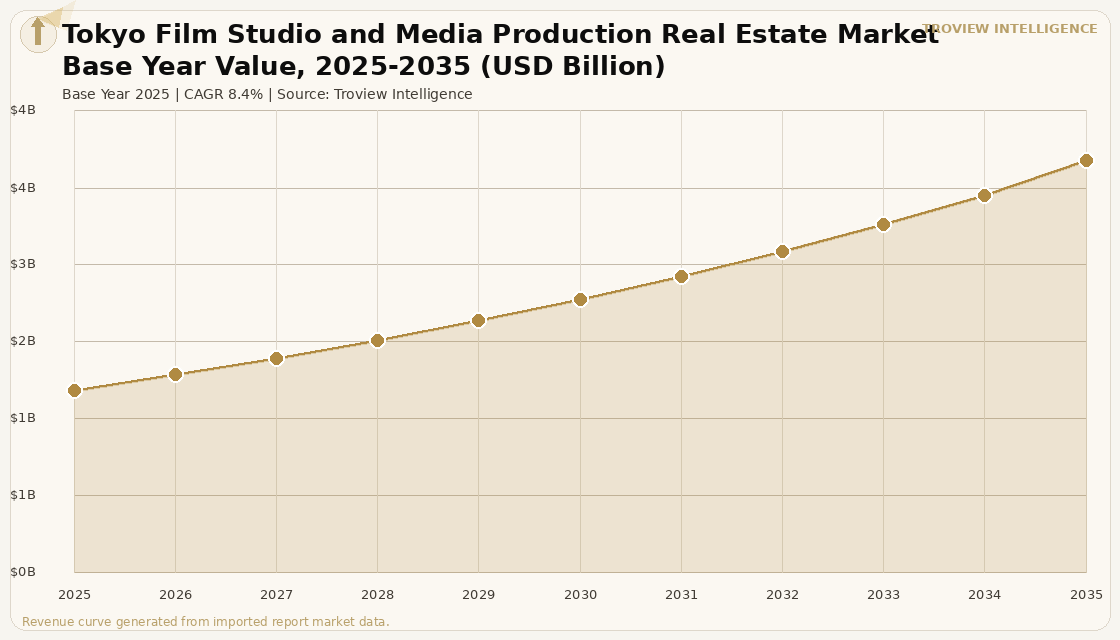
The Tokyo film studio and media production real estate market size was USD 1.72 Billion in 2025 and is expected to register a revenue CAGR of 8.4% during the forecast period, reaching USD 3.88 Billion by 2035. The market encompasses approximately 60% of Japan's total film studio and media production real estate value, reflecting Tokyo's status as the location of the majority of Japan's Big Four studio major campus facilities, the world's most geographically concentrated anime studio cluster, NHK's primary broadcasting and production infrastructure in Shibuya, major broadcast network production facilities across Minato, Shibuya, Bunkyo, and the surrounding inner wards, and the supporting ecosystem of post-production houses, visual effects studios, casting agencies, talent management companies, and specialist production service facilities that collectively constitute the most comprehensive media production real estate ecosystem in Asia Pacific. Market revenue growth is anchored in the structural supply constraint at Tokyo's anime studio cluster where MAPPA's capacity is committed 18 to 24 months in advance and global streaming platforms invested USD 2.5 billion in anime acquisition in 2025 combined with the government's expanded location incentive programme that attracted international productions including Apple TV+ and Skydance Television to use Tokyo as a production base in 2024 and 2025. Toho Studios in Seijo, Setagaya the flagship production campus of Japan's largest studio group serves as the physical anchor of the Tokyo film studio real estate market, providing soundstage facilities, production offices, and the technical support infrastructure for both domestic Toho productions and an increasing number of international co-productions that use the Toho campus as a Japan base. For instance, in 2023, Toei Company, Japan, announced the USD 14 million (JPY 2 billion) five-year investment in virtual production LED volume stage infrastructure at its Oizumi Nerima campus, making Toei Studio the first Tokyo-based major to commit capital at this scale to in-camera visual effects capability, and positioning the Oizumi campus to attract the growing cohort of international productions seeking LED volume virtual production in combination with access to Japan's unique locations and production expertise per Screen Daily and Screen Global Production reporting. These are some of the key factors driving revenue growth of the market.
The Suginami district's anime studio cluster housing MAPPA in Suginami alongside Toei Animation in Nerima, Bones, and multiple others is the world's most commercially productive concentration of animation production facilities, generating above-national-average real estate demand from anime studios whose international acquisition values have escalated dramatically as global streaming platforms including Netflix, Prime Video, Disney+, and Crunchyroll compete for the output of Japan's most commercially recognised production houses. MAPPA, headquartered in Suginami and producing Jujutsu Kaisen, Chainsaw Man, and Attack on Titan Final, commands production facility space that is committed almost entirely 18 to 24 months in advance per Vitrina.ai 2026 analysis, creating a scenario where the physical studio real estate supporting MAPPA's production schedule is effectively unable to accommodate incremental demand at any price, establishing a supply-constrained creative real estate dynamic unique in global media production markets. NHK, Japan's public broadcaster, operates its primary broadcasting and production centre in Shibuya, Tokyo, representing one of the most strategically significant media production facility campuses in Japan with NHK's production capabilities in drama, documentary, animation, and news generating sustained demand for studio time that anchors a significant portion of the Shibuya media district's production real estate utilisation. These are some of the key factors driving revenue growth of the market.
However, the Tokyo film studio and media production real estate market faces structural constraints that temper the pace of facility expansion and international production uptake through the forecast period. The geographic concentration of Tokyo's anime studio cluster in the western wards creates a physical constraint on cluster expansion, as land costs in Suginami, Nerima, and Setagaya have been elevated by residential and commercial competition for the limited developable land parcels available near the established studio addresses where animators, voice actors, and specialist production vendors have built working relationships over decades, making new studio campus development significantly more expensive in these districts than equivalent facility builds in outer Tokyo or regional cities. Studio space in Tokyo is scarce for international productions, which are typically given lower booking priority than domestic productions per Screen Daily's Japan production guide, limiting the revenue diversification that Tokyo studio operators can generate from international bookings even as Japan's government location incentive specifically attempts to increase international production activity in Japan. Iran-US geopolitical tensions and LNG price volatility through the Strait of Hormuz, as confirmed by IMF March 2026 analysis, affect Tokyo media production real estate operating costs through the electricity cost transmission that makes 24-hour animation production, LED volume stages, server-intensive post-production rendering farms, and broadcasting infrastructure sensitive to LNG spot price movements in Japan's near-totally LNG-dependent electricity generation system. These factors substantially limit Tokyo film studio and media production real estate market growth over the forecast period.
In most creative industries, geographic cluster concentration is a historical accident that persists through inertia. The Silicon Valley technology cluster, the Holborn legal cluster in London, the Midtown advertising cluster in New York all were created by historical accidents of real estate, relationships, and regulatory environment, and all face centrifugal pressure from talent that increasingly works remotely. Tokyo's anime studio cluster is different. You cannot make Jujutsu Kaisen or Chainsaw Man remotely. Animation is a collaborative craft that requires animators, directors, composers, voice actors, sound engineers, and production coordinators to interact continuously throughout the production cycle in ways that remote work platforms cannot replicate for the quality level that MAPPA or Ufotable productions demand. The cluster in Suginami, Nerima, and Setagaya is not held together by inertia. It is held together by the technical and creative interdependencies of a craft that requires physical proximity. That makes the real estate supporting the cluster genuinely irreplaceable not in the sense that any individual building cannot be rebuilt, but in the sense that the ecosystem of relationships, talent, and specialist vendors that gives the cluster its creative productivity cannot be relocated to any other geography without permanently reducing the output quality that generates the USD 2.5 billion in international streaming acquisition that made the cluster commercially relevant to institutional real estate investors in the first place." Troview Intelligence Head of Tokyo Film Studio and Media Production Real Estate Research
SEGMENT INSIGHTS
| 03 | DISTRICT CLUSTER ANALYSIS |
Five District Clusters Defining Tokyo's Film Studio and Media Production Real Estate Geography
SETAGAYA AND SEIJO TOHO STUDIOS CAMPUS TOKYO'S LARGEST LIVE-ACTION STUDIO CAMPUS TOHO FLAGSHIP
| Primary Operator | Toho Distribution Share | Key Production | Business Breadth |
| Toho Co., Ltd. Toho Studios Seijo | 33.7% Japan's largest film distributor | Godzilla franchise, live-action features, streaming originals | Toho Cinema, Theatrical, Real Estate, Anime divisions |
The Setagaya and Seijo district cluster is anchored by Toho Studios, the flagship production campus of Toho Co., Ltd. located in the Seijo neighbourhood of Setagaya ward, which constitutes the most commercially significant live-action film production facility in Tokyo and the real estate anchor for Japan's dominant studio group. Toho Studios Seijo provides the soundstage facilities, production offices, equipment workshops, and technical infrastructure for both the Godzilla franchise the highest-grossing Japanese film franchise globally and the domestic film productions that Toho distributes through its 33.7% market-leading theatrical distribution network. The Seijo campus is also the location of Cine Bazar Co., Ltd., a Japanese film and entertainment studio headquartered at Toho Studios per Wikipedia, illustrating the cluster concentration of production companies around the Toho Studios anchor that is characteristic of the Seijo production ecosystem. Setagaya ward more broadly houses a significant proportion of Tokyo's professional entertainment workforce talent agencies, production service companies, voice actors, directors, and the craft talent that supports both live-action and animation production creating the labour market ecosystem that makes Setagaya attractive to production companies beyond the immediate Toho Studios campus boundary.
| Toei Studio Location | Virtual Production | Toei Animation | Legacy |
| Oizumi, Nerima live-action and tokusatsu | USD 14M LED volume investment over 5 years from 2023 | One Piece, Dragon Ball, Sailor Moon, Digimon | One of Japan's oldest and largest studio campuses |
The Nerima and Oizumi district cluster hosts Toei Studio in the Oizumi neighbourhood of Nerima ward, one of Japan's oldest and most historically significant live-action studio campuses, alongside Toei Animation Co., Ltd. whose Nerima facilities produce some of the most globally recognised anime franchises including One Piece, Dragon Ball, and Sailor Moon. Toei's USD 14 million (JPY 2 billion) five-year virtual production studio investment, announced in 2023 and being progressively implemented at the Oizumi campus per Screen Daily and Screen Global Production reporting, is converting Toei Studio into a hybrid traditional-virtual production facility that can accommodate both the tokusatsu live-action special effects productions that defined Toei's identity (Kamen Rider, Super Sentai) and the LED volume virtual production requirements of international co-productions that seek Japan studio capability with in-camera VFX technology. Nerima ward hosts more anime production companies than any other single ward in Tokyo per Japanese media industry analysis, making the Nerima real estate market particularly sensitive to the demand dynamics of the global anime acquisition cycle, with Toei Animation's facility expansion needs and those of independent studios in Nerima creating sustained demand for anime-specific studio real estate across the ward's mixed residential and light industrial land use zones.
SUGINAMI THE WORLD'S MOST CONCENTRATED ANIME STUDIO CLUSTER MAPPA HQ, 60+ STUDIOS, FULLY COMMITTED PRODUCTION CALENDARS
| MAPPA Location | Studio Concentration | Key Titles from Cluster | Real Estate Character |
| Suginami committed 18-24 months in advance | 60+ animation companies in Suginami ward | Jujutsu Kaisen, Chainsaw Man, Attack on Titan Final | Mix of converted residential and purpose-built studio floors |
Suginami ward constitutes the world's most concentrated anime studio production real estate cluster, housing MAPPA Co., Ltd. alongside more than 60 animation production companies within a single ward boundary, generating a creative ecosystem density that combines easy walking and commuting access between studios with the shared knowledge networks, freelancer communities, voice acting talent, and specialist vendor relationships that make Suginami the most productive single-ward animation production geography in Japan. MAPPA's Suginami headquarters supports the production of the highest-commercial-value anime titles in the global market Jujutsu Kaisen, Chainsaw Man, and Attack on Titan Final whose international acquisition by Crunchyroll and streaming platforms commands the highest per-title values in the anime industry per Vitrina.ai 2026 analysis, with MAPPA's production schedule committed almost entirely 18 to 24 months in advance confirming the extent to which the Suginami cluster's physical production capacity is the binding constraint on the anime content available for global streaming acquisition. Real estate in Suginami's anime studio concentration zone consists primarily of converted multi-floor office buildings and purpose-built studio floors within mixed-use commercial-residential buildings, creating a building stock that differs materially from conventional commercial office or industrial warehouse real estate in its layout requirements and operational use, and that commands above-ward-average rent premiums from animation studios willing to pay for proximity to the cluster's talent network.
SHIBUYA NHK BROADCASTING CENTRE AND MEDIA DISTRICT JAPAN'S PRIMARY BROADCASTING PRODUCTION INFRASTRUCTURE
| Primary Tenant | NHK Campus | Adjacent Broadcasters | Content Output |
| NHK Japan Broadcasting Corporation | NHK Broadcasting Centre drama, news, education | TV Tokyo (Minato), Fuji TV (Odaiba), TBS (Akasaka) | NHK drama, documentary, education, streaming NHK+ |
Shibuya ward hosts the NHK Japan Broadcasting Corporation's primary broadcasting and production centre, the largest and most technically sophisticated broadcast production campus in Japan, whose drama production studio facilities, news gathering infrastructure, and educational content production capabilities constitute the anchor of the Shibuya media district's production real estate value. NHK's streaming platform NHK+ and its expanding investment in original drama production for both broadcast and streaming distribution generate sustained demand for NHK Broadcasting Centre studio facilities and the associated post-production and content management infrastructure on the Shibuya campus. The broader Shibuya media district benefiting from the ward's position at the intersection of multiple major railway lines and its established reputation as Tokyo's technology and creative industry hub hosts production companies, talent agencies, streaming platform offices, and the creative economy infrastructure that supports Tokyo's entertainment industry at the district level, with the Shibuya Hikarie tower and surrounding Shibuya redevelopment zone providing new commercial space that houses media industry tenants alongside the established NHK campus.
BUNKYO AND CHIYODA NIKKATSU, POST-PRODUCTION, AND HERITAGE STUDIOS JAPAN'S OLDEST STUDIO, POST-PRODUCTION PRECINCT
| Nikkatsu | Post-Production | Broadcast Adjacent | Heritage Value |
| Japan's oldest film studio (1912) Bunkyo | Chiyoda and surrounding districts audio, VFX, grading | NHK proximity supports post-production demand | Nikkatsu 1912 oldest surviving film studio infrastructure |
The Bunkyo and Chiyoda district cluster hosts Nikkatsu Corporation, Japan's oldest film studio founded in 1912 and headquartered in Bunkyo ward per Screen Global Production and Wikipedia information, whose longevity as Japan's first film production company establishes Nikkatsu as the most historically significant studio real estate tenant in Tokyo's media production ecosystem. Nikkatsu's Bunkyo headquarters and production facilities represent both operational studio space and a heritage media production real estate asset whose 110-plus years of continuous film production activity makes it unique in global studio real estate. The Chiyoda and Chuo ward areas adjacent to central Tokyo host a significant concentration of post-production facilities audio mixing studios, VFX rendering houses, colour grading suites, and content management infrastructure that serve the productions generating at the Toho, Toei, and anime studio campuses in western Tokyo, creating the post-production services cluster that completes Tokyo's end-to-end media production ecosystem from development through delivery.
MAJOR COMPANIES
STRATEGIC DEVELOPMENTS
Ordered 2026 first. All developments sourced from Screen Daily, Screen Global Production, Association of Japanese Animations, Vitrina.ai, Toho company information, and verified trade press.