By Use Case · By District · By Delivery Model · By Operator
The City of Toronto committed to 1,000 new modular homes under the HousingTO 2020-2030 Action Plan and in December 2025 partnered with Ontario and Habitat for Humanity GTA on a 33-unit modular condominium at 355 Coxwell Avenue as Assembly Corp. and Element5 build the production base and Assembly Corp.'s project manager described prefabricated homes as 'a piece of the puzzle' for transforming unused urban land in one of North America's least affordable cities.
MARKET SYNOPSIS
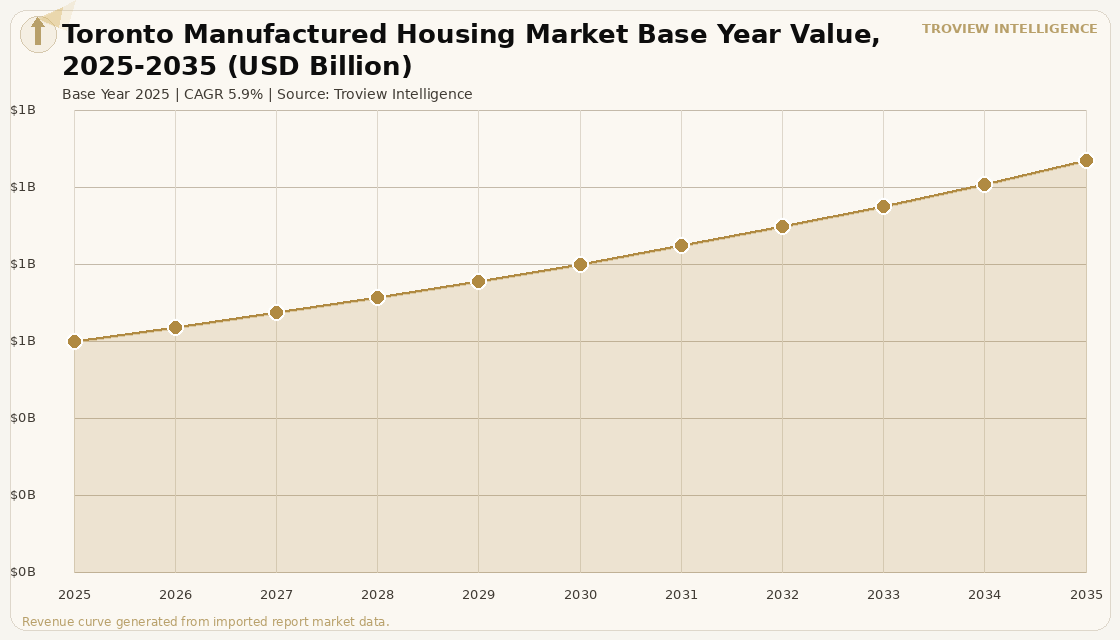
The Toronto manufactured housing market size was USD 618.4 Million in 2025 and is expected to register a revenue CAGR of 5.9% during the forecast period, reaching USD 1.10 Billion by 2035. Market revenue growth is supported by the City of Toronto's formal adoption of modular and manufactured construction as a core delivery mechanism under the HousingTO 2020-2030 Action Plan, which committed to approving 65,000 rent-controlled homes by 2030, including 18,000 supportive homes that the City has explicitly targeted for modular delivery. The modular format's ability to be assembled on City-owned infill land in existing residential neighbourhoods without the disruption timeline of conventional construction has made it the preferred format for rapid affordable housing delivery in a city where 80,000 people experienced homelessness in 2024 per the Association of Municipalities of Ontario. The Government of Ontario, the City of Toronto, and Habitat for Humanity GTA announced a partnership in December 2025 to deliver 33 modular condominium homes at 355 Coxwell Avenue, with Ontario investing CAD 10 million and the City contributing CAD 4.8 million, targeting households at the 60th to 70th income percentile per official government press releases of December 2025.
Toronto's manufactured housing market is structurally different from the land-lease community model that defines manufactured housing in Alberta and rural Canada. In Toronto, factory-built construction is primarily a delivery mechanism for the City's affordable and supportive housing pipeline, using modular units stacked into three-to-six-storey buildings on small City-owned sites in established neighbourhoods. Assembly Corp., a mass timber modular builder, has become the City's principal construction partner for this programme, delivering buildings on sites including Ossington Avenue through the CMHC Rapid Housing Initiative per CBC News reporting of May 2025. Element5, a mass timber manufacturer based in Toronto, expanded its production capacity by CAD 107 million in October 2025, doubling its output specifically to meet increasing Ontario government procurement demand for affordable modular housing. For instance, in December 2025, the Ontario government, the City of Toronto, and Habitat for Humanity GTA jointly announced the 355 Coxwell Avenue project, a six-storey modular condominium of 33 units priced with a maximum purchaser contribution of CAD 500,000, with preparations for construction underway and occupancy expected by mid-2027, per Government of Ontario and City of Toronto press releases. These are some of the key factors driving revenue growth of the market.
However, the Toronto manufactured housing market faces structural constraints. The majority of Toronto's residential land is zoned for single-family use, limiting modular multi-unit delivery to City-owned parcels and sites that can be individually rezoned or exempted. The pace of the HousingTO programme's modular delivery has been slower than initial targets, with 216 homes completed across four buildings as of early 2026 against a 1,000-unit commitment per City of Toronto tracking data, reflecting site selection complexity, servicing requirements, and community consultation processes that extend timelines even for City-owned land. Toronto's high land values make the manufactured home's price advantage relative to site-built construction less decisive than in lower-cost markets, because land acquisition represents the dominant cost in most Toronto residential projects regardless of construction method. Private market appetite for manufactured housing outside the government-subsidised channel remains limited in Toronto's prestige-sensitive condo market. These factors substantially limit Toronto manufactured housing market growth over the forecast period.
Toronto is not a conventional manufactured housing market. There are no land-lease communities with hundreds of units serving retirees in Scarborough or North York. What Toronto has is a city government that has made modular construction the delivery vehicle for its most urgent housing obligation supportive housing for people experiencing homelessness and is building the procurement relationship with Assembly Corp. and Element5 that will eventually translate into a much larger pipeline. The 355 Coxwell Avenue partnership with Habitat for Humanity at CAD 500,000 is the first test of whether modular construction can serve a broader market income cohort than the deepest-subsidy end. If it lands on time and at cost, the pipeline grows substantially." Troview Intelligence Senior Analyst, Toronto Housing Markets
SEGMENT INSIGHTS
By Use Case
Affordable and supportive housing delivery is expected to account for a significantly large revenue share in the Toronto manufactured housing market during the forecast period.
Based on use case, the Toronto manufactured housing market is segmented into government-backed affordable and supportive housing, attainable ownership programmes, and private market modular development. Affordable and supportive housing delivery dominates current market activity, driven by the City of Toronto's HousingTO programme commitment and the CMHC Rapid Housing Initiative that provided federal funding for rapid-delivery modular projects on City-owned sites. The attainable ownership segment is expected to register the fastest growth, as the 355 Coxwell Avenue partnership demonstrates a replicable model where modular construction reduces per-unit cost sufficiently to price ownership at CAD 500,000 in a city where average condominium prices significantly exceed that threshold. Private market modular development remains nascent in Toronto, as the prestige requirements of the private condo market and the complexity of securing development approvals on privately-owned land outside the City-owned site programme have limited uptake among private residential developers.
By Delivery Model
City-owned infill site modular delivery is expected to account for a significantly large revenue share in the Toronto manufactured housing market during the forecast period.
Based on delivery model, the Toronto manufactured housing market is segmented into City-owned infill site delivery, federal rapid housing initiative projects, provincial-municipal partnership programmes, and private developer modular projects. City-owned infill site delivery dominates current programme volumes, as CreateTO's mandate to unlock City-owned land for affordable housing has identified sites across Toronto's established neighbourhoods where modular construction can deliver units on land that is too small or constrained for conventional condominium development. The provincial-municipal partnership model is the fastest-growing delivery segment, with the December 2025 Ontario-Toronto-Habitat for Humanity GTA partnership at 355 Coxwell Avenue establishing a tripartite funding and delivery structure that can be replicated across multiple sites using the same modular contractor relationships and procurement documentation.
By Operator Type
Non-profit developers and government housing agencies are expected to account for a significantly large revenue share in the Toronto manufactured housing market during the forecast period.
Based on operator type, the Toronto manufactured housing market is segmented into non-profit housing developers, government housing agencies, private developers, and community land trusts. Non-profit developers including St. Clare's Multifaith Housing Society and Toronto Community Housing drive the largest volume of modular housing completions in the city, partnering with Assembly Corp. as contractor and accessing CMHC and City capital grants that make the economics viable at below-market rents. Toronto Community Housing Corporation, Canada's largest social housing provider with over 58,000 units across 2,100 buildings, is the largest single potential client for modular construction in the city, and its capital repair and new development pipeline represents the most significant future revenue opportunity for Toronto-based modular manufacturers. Private developers are the fastest-growing operator segment, attracted by the faster construction timeline that modular delivery offers in a city where site preparation and factory fabrication occur simultaneously, reducing the carrying cost of land while construction is underway.
Key Districts Shaping Toronto's Manufactured Housing Market
WEST END (OSSINGTON / PARKDALE / RONCESVALLES) MODULAR PIONEER DISTRICTS
| Notable Project | St. Clare's Ossington Ave modular via Assembly Corp. / CMHC RHI | Site Type | Converted church yard, City-owned infill |
| Unit Format | Mass timber modular, 3-storey, supportive housing | Delivery Partner | Assembly Corp. (mass timber modular) |
Toronto's west end has become the primary demonstration zone for the City's modular housing programme. The Ossington Avenue project, delivered by Assembly Corp. for St. Clare's Multifaith Housing Society through the CMHC Rapid Housing Initiative, converted a church yard into a mass timber modular building that serves as the reference model for the broader HousingTO modular pipeline. Luke Moir, Assembly Corp.'s project manager, described the Ossington project to CBC News as 'a great example of how unused land in urban centres could be transformed.' The west end's mix of City-owned lots, non-profit landholdings, and church properties provides a higher density of deployable infill sites than other Toronto districts. Parkdale and Roncesvalles have established non-profit housing development communities that are active clients for rapid, affordable housing formats.
EAST END (COXWELL / BEACHES / EAST YORK) ATTAINABLE OWNERSHIP CORRIDOR
| Key Project | 355 Coxwell Avenue, 33 modular homes, 6-storey | Partners | Ontario, City of Toronto, Habitat for Humanity GTA |
| Target Buyers | 60th-70th income percentile, max CAD 500,000 purchase | Occupancy | Mid-2027 target per Government of Ontario |
The east end is the location of Toronto's most consequential manufactured housing project in the attainable ownership segment. The December 2025 partnership between the Government of Ontario, the City of Toronto, and Habitat for Humanity GTA for 33 modular homes at 355 Coxwell Avenue represents the first City-led modular programme explicitly targeting market-rate buyers at the 60th to 70th income percentile rather than the deepest-subsidy supportive housing cohort. Ontario invested CAD 10 million and the City contributed CAD 4.8 million per official press releases. Mayor Olivia Chow described the project as demonstrating 'what we can achieve when we work together.' Preparations for construction were underway as of December 2025 with sales expected to begin in early 2026 and occupancy by mid-2027. If the model is proven at 355 Coxwell, it provides a replicable template for City-owned sites across multiple Toronto districts.
INNER SUBURBS (SCARBOROUGH / NORTH YORK / ETOBICOKE) SCALE OPPORTUNITY FOR MODULAR
| CreateTO Role | Unlocking City-owned sites for affordable housing | Site Density | Lower land cost than inner city; larger lot availability |
| Priority Need | Rapid affordable housing for families and seniors | Potential | Multiple large City-owned parcels suitable for modular multi-unit |
Toronto's inner suburbs hold the City's largest concentration of underutilised and surplus City-owned land, creating the physical opportunity for manufactured housing delivery at a scale that the constrained inner-city lots cannot support. CreateTO, the City's real estate arm, has been mandated to identify and activate City-owned parcels for affordable housing, with a portfolio lens that prioritises transit-accessible sites in Scarborough, North York, and Etobicoke. The Toronto Builds framework, adopted by Toronto City Council in 2025, guides development of new rental homes within mixed-income communities on City land and explicitly includes modular delivery as an eligible construction format. The concentration of lower-income families and seniors in Toronto's inner suburbs creates the greatest density of demand for the supportive and deeply affordable housing that modular construction delivers fastest.
DOWNTOWN CORE (CITY HALL AREA / REGENT PARK) INTENSIFICATION AND PARTNERSHIP ZONE
| Toronto Community Housing | 58,000+ units, primary modular renovation candidate | Regent Park | Canada's largest urban revitalisation project, modular potential |
| Density Constraint | High land values limit modular cost advantage vs conventional | Non-Profit Activity | Multiple active non-profit housing developers in core |
The downtown core and adjacent neighbourhoods including Regent Park host Toronto Community Housing's highest-concentration portfolio and the most active non-profit housing development community in Canada. Toronto Community Housing, with over 58,000 units and a CAD 10 billion public asset base, manages a capital repair backlog that represents the largest single future procurement opportunity for modular construction in Toronto. Regent Park, Canada's largest urban revitalisation project underway since 2005, has demonstrated that mixed-income modular and prefabricated construction can operate successfully in downtown Toronto's density environment. The high land values in the downtown core limit the cost advantage of manufactured construction relative to conventional high-rise, meaning modular delivery in this district works primarily where the speed-to-occupancy benefit drives the procurement decision rather than the unit cost.