| TROVIEW INTELLIGENCE | Tokyo Life Sciences Campus Market | Q2 2026 |
| TROVIEW INTELLIGENCE · CITY INTELLIGENCE REPORT |
By Campus Zone · By Asset Type · By Tenant Stage · By Operator Model
Zone Profiles: King Skyfront (Kawasaki) · Nihonbashi LINK-J · Takanawa Gateway LiSH · Bunkyo and Science Tokyo · Greater Tokyo Bay
Tokyo's life sciences campus market is anchored by King Skyfront in Kawasaki a 40-hectare R&D hub beside Haneda Airport with 70-plus institutions, approximately 5,200 people, and BioLabs co-operating iCONM with 300-plus shared equipment pieces LINK-BioBAY TOKYO operated by BioLabs, Mitsui Fudosan, and LINK-J at Nihonbashi as an incubation cluster for startups scaling globally, LiSH Lab at Takanawa Gateway opening as a startup-researcher-investor hub in the Takanawa Gateway development zone, SakuLab created by Astellas Pharma with BioLabs and Mitsui Fudosan providing chemistry and biology bench space with Astellas mentoring, Science Tokyo established on October 1 2024 through the merger of Tokyo Medical and Dental University and Tokyo Institute of Technology creating a combined research institution, AN Venture Partners closing Japan's first biotech fund at USD 200 million in July 2025, UTEC closing its sixth fund at approximately USD 326 million in July 2025 bringing AUM above USD 1 billion, and CBRE recording Japanese commercial real estate investment at a record JPY 2.092 trillion in Q3 2025 confirming Tokyo and its Kawasaki-Kanagawa periphery as the highest-density life sciences campus investment zone in Asia Pacific.
| Standard License: USD 2,200 | Enterprise License: USD 9,500 |
MARKET SYNOPSIS
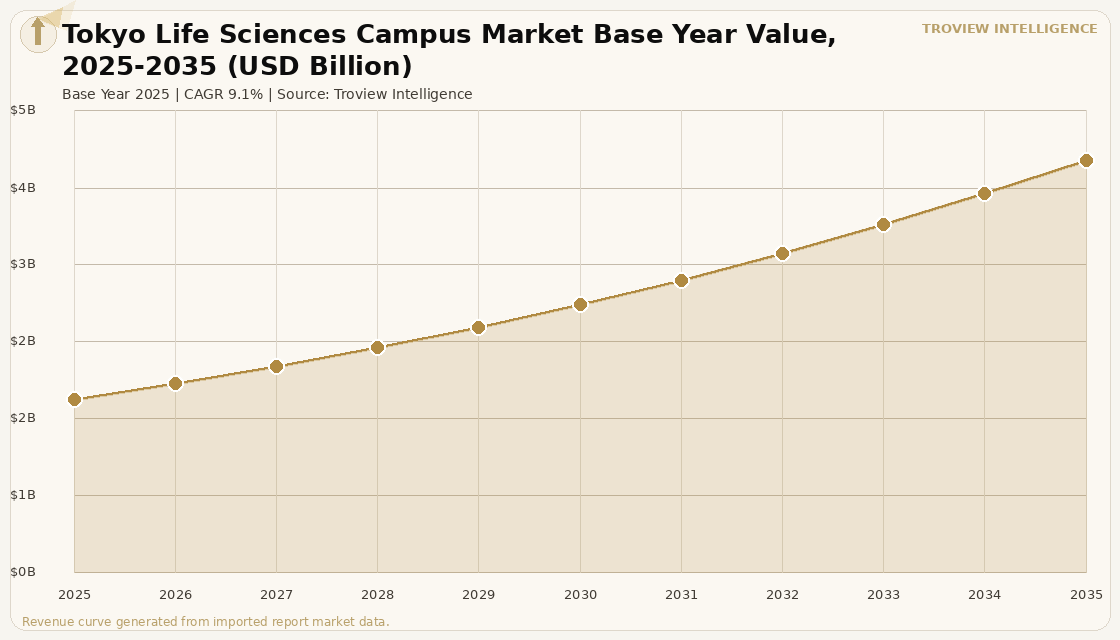
The Tokyo life sciences campus market size was USD 1.72 Billion in 2025 and is expected to register a revenue CAGR of 9.1% during the forecast period, reaching USD 4.09 Billion by 2035. The market encompasses the Greater Tokyo metropolitan area's institutionally managed life sciences campus facilities including King Skyfront in Kawasaki, the Nihonbashi life sciences district anchored by Life Science Innovation Network Japan, the Takanawa Gateway life sciences development zone, and the Bunkyo district's academic research complex anchored by the University of Tokyo and the newly formed Science Tokyo with the combined Greater Tokyo zone accounting for approximately 52% of Japan's life sciences campus market by real estate value. The Tokyo life sciences campus market benefits from the convergence of Japan's highest concentration of pharmaceutical company headquarters, the most active domestic biotechnology venture capital ecosystem in the country, direct Haneda and Narita airport connectivity for international clinical trial and cell therapy logistics, and the Tokyo Metropolitan Government's active support for biotech startup development through the TIB CATAPULT initiative and the Rising Biotech Challenge 2025 programme. Science Tokyo was established on October 1, 2024, following the merger between Tokyo Medical and Dental University and Tokyo Institute of Technology, creating a combined institution that unites the traditional strengths of medical science with engineering, with Science Tokyo hosting a university campus at King Skyfront that advances fusion research in life sciences through partnerships with companies and research institutions converging in the Tonomachi area per King Skyfront official information. In July 2025, University of Tokyo Edge Capital Partners, Japan, closed its sixth fund at approximately USD 326 million bringing its assets under management above USD 1 billion backing seed and early-stage startups across healthcare, life sciences, information technology, and engineering, with notable successes including PeptiDream with market capitalisation above USD 1.4 billion and OriCiro Genomics acquired by Moderna in 2023 per BioSpectrum Asia reporting. These are some of the key factors driving revenue growth of the market.
Mitsui Fudosan Co., Ltd., Japan, has emerged as the primary institutional Japanese real estate developer systematically building the Greater Tokyo life sciences campus infrastructure, with the company holding positions in LINK-BioBAY TOKYO in partnership with BioLabs and LINK-J, SakuLab created in partnership with Astellas Pharma and BioLabs providing chemistry and biology bench space with Astellas mentoring at the Takanawa Gateway zone, and the Nihonbashi Life Science Building referenced in LINK-J partnership documentation as a primary location for life sciences network meetings and incubation activities. Plug and Play Japan, in collaboration with the Tokyo Metropolitan Government, ran the Rising Biotech Challenge 2025, selecting 12 biotech startups and research projects for mentorship and support targeted at accelerating entry into global markets per BioSpectrum Asia reporting, with the programme complementing the broader TIB CATAPULT initiative through which the Tokyo Metropolitan Government selected LINK-J, BioLabs, and Mitsui Fudosan to operate LINK-BioBAY TOKYO as the primary incubation cluster for the Tokyo biotech startup ecosystem. ABVC BioPharma announced a strategy with its joint venture partner BioLite Japan to connect Japanese biotech with Taiwan's capital markets and AI-driven development capabilities, illustrating the cross-border capital market collaboration that is supplementing domestic venture capital and enabling Tokyo-based biotechs to access non-domestic funding pathways before the domestic TSE Growth Market IPO ceiling constrains late-stage capital per BioSpectrum Asia reporting. These are some of the key factors driving revenue growth of the market.
However, the Tokyo life sciences campus market faces structural constraints that temper the pace of revenue growth through the forecast period. Tokyo's exceptional commercial real estate cost environment with the city's central ward average office rents among the highest in Asia Pacific and construction costs 40% to 60% above European and North American comparators for specialist laboratory and cGMP space creates a development economics constraint that limits new life sciences campus supply to government-supported special zones including King Skyfront and government-facilitated development districts including Takanawa Gateway, where infrastructure subsidies and zone-specific incentives make the economics of laboratory campus development viable at Tokyo land values. The domestic Japanese biotech funding cycle, while improving with the 2025 fund closes, remains materially smaller than the US venture capital ecosystem that supports Boston-Cambridge and San Francisco Mission Bay's life sciences campus occupancy, with the IPO ceiling of approximately ¥10 billion to ¥11 billion on the TSE Growth Market starving later-stage companies of the capital required to occupy large-format laboratory spaces and driving sophisticated founders to plan for dual US-Japan capital market tracks from company formation. Iran-US geopolitical tensions and LNG price volatility through the Strait of Hormuz, as confirmed by IMF March 2026 analysis, directly affect Tokyo's life sciences campus operating costs as Japan's near-total dependence on LNG-fired electricity generation makes all 24-hour laboratory and biomanufacturing facilities exposed to international LNG spot price movements that fall outside campus operator hedging capabilities. These factors substantially limit Tokyo life sciences campus market growth over the forecast period.
Tokyo's life sciences campus market is being built by three actors who are not competing but are creating different layers of the same ecosystem. Mitsui Fudosan is building the real estate LINK-BioBAY TOKYO, SakuLab, Takanawa Gateway. BioLabs is importing the co-working lab model from Cambridge and San Francisco and adapting it to the Tokyo startup pipeline. LINK-J is building the community network the investor days, the UNIKORN programme, the international MOUs with LabCentral and BioM Munich. No single actor can build a life sciences cluster alone. Boston took 30 years and a combination of MIT, Harvard, the NIH, Kendall Square landlords, and thousands of venture capitalists to create. Tokyo is attempting to compress that timeline through deliberate government coordination and institutional capital commitment. Whether it works depends on whether the venture capital ecosystem improving in 2025 with the UTEC and AN Venture fund closes can sustain enough early-stage company formation to fill the incubator and co-working laboratory spaces that are being created faster than the startups are being funded. The answer to that question in 2030 will determine whether Tokyo becomes Asia's second life sciences campus market or Asia's most organised laboratory vacancy problem." Troview Intelligence Head of Tokyo Life Sciences Campus Research
SEGMENT INSIGHTS
| 03 | ZONE ANALYSIS |
Five Zones Defining Tokyo's Life Sciences Campus Geography
KING SKYFRONT (TONOMACHI, KAWASAKI) GREATER TOKYO'S PRIMARY INSTITUTIONAL LIFE SCIENCES CAMPUS
| Site | Tenants | Shared Equipment | Science Tokyo Link |
| 40 hectares, Tonomachi, Kawasaki beside Haneda Airport | 70+ institutions, ~5,200 people | 300+ pieces via iCONM + BioLabs | University campus for fusion research in life sciences |
King Skyfront in Tonomachi, Kawasaki represents Greater Tokyo's primary institutional life sciences campus, combining government-backed infrastructure at the scale of a 40-hectare National Strategic Special Zone with the operational expertise of international co-working laboratory operators and the industry connectivity of Japan's leading life sciences networking organisations. The campus's proximity to Haneda Airport minutes by road from the terminal provides logistics advantages for cell therapy and other time-sensitive biological product supply chains that are structurally irreplaceable for clinical trial operations requiring same-week international release cycles per biosector.jp analysis, creating a campus location advantage that no inland Tokyo or Yokohama campus can replicate. Science Tokyo, established October 1, 2024 through the merger of Tokyo Medical and Dental University and Tokyo Institute of Technology, hosts a university campus at King Skyfront advancing fusion research in life sciences through partnerships with companies and research institutions converging in the Tonomachi area, creating the academic anchor that distinguishes King Skyfront from pure industrial incubator campuses by connecting commercial biotech activity directly to graduate-level medical and engineering research per King Skyfront official information.
| LINK-J Base | Nihonbashi Life Science Building | Financial District Access | Key Programme |
| Nihonbashi medical enterprise concentration zone | Meeting rooms, co-operation space with King Skyfront | Tokyo Stock Exchange proximity for investor events | UNIKORN global expansion support for Japanese startups |
Nihonbashi in central Tokyo serves as the primary administrative and financial networking hub for Japan's life sciences startup ecosystem, concentrating Life Science Innovation Network Japan's operations in a central business district location where proximity to the Tokyo Stock Exchange and Japan's institutional financial community including the fund managers of UTEC, AN Venture Partners, and the major Japanese life sciences venture funds provides biotech companies with direct access to the investor community that determines their capital raising prospects. The Nihonbashi Life Science Building provides co-working and meeting room facilities that connect the Nihonbashi network to King Skyfront's laboratory operations through LINK-J's partnership agreements, enabling early-stage companies to maintain a central Tokyo presence for investor and corporate partner meetings while conducting laboratory work at King Skyfront or Shonan iPark. LINK-J's UNIKORN global expansion support programme, which prepares Japanese life science startups for overseas growth through mentoring, networking, and targeted training, is operated from the Nihonbashi hub and creates the international orientation that distinguishes Nihonbashi-based startups from those confined to domestic market planning.
| LiSH Lab | SakuLab | Development Zone | Operator |
| Startup-researcher-investor hub, Takanawa Gateway | Astellas + BioLabs + Mitsui Fudosan chemistry + biology benches | Takanawa Gateway station redevelopment, Minato Ward | Mitsui Fudosan as primary real estate developer |
Takanawa Gateway in Minato Ward represents Tokyo's newest life sciences campus development zone, created within the large-scale urban redevelopment centred on the Takanawa Gateway railway station that opened in 2020 and is being progressively developed by Mitsui Fudosan into a mixed-use urban innovation district. LiSH Lab, opened at Takanawa Gateway as a hub linking startups with researchers, investors, and corporate partners under one roof per BioSpectrum Asia reporting, provides the community infrastructure for early-stage life sciences companies in the district. SakuLab, created by Astellas Pharma Inc. in partnership with BioLabs and Mitsui Fudosan, provides chemistry and biology bench space alongside mentoring from Astellas scientists at the Takanawa Gateway zone, enabling early-stage chemistry-biology companies to access pharmaceutical-grade laboratory facilities and direct mentoring relationships with Astellas's scientific staff a combination of real estate access and knowledge transfer that no standalone property developer can offer without a pharmaceutical company co-investor. Mitsui Fudosan's simultaneous presence in LINK-BioBAY TOKYO at Nihonbashi, SakuLab at Takanawa Gateway, and the Takanawa Gateway LiSH Lab makes the company the primary institutional Japanese life sciences campus real estate developer at the 2025 to 2026 frontier of Tokyo's campus expansion.
BUNKYO AND SCIENCE TOKYO (HONGO/SURUGADAI) UNIVERSITY OF TOKYO AND SCIENCE TOKYO ACADEMIC CLUSTER
| University of Tokyo | Science Tokyo | UTEC AUM | Key Portfolio |
| Primary source of UTEC portfolio companies (150+) | Established Oct 2024 (TMDU + Tokyo Tech merger) | Above USD 1 Billion after Fund 6 close | PeptiDream (USD 1.4B+ mkt cap), OriCiro (Moderna 2023) |
The Bunkyo and Hongo district hosting the University of Tokyo's main campus is the primary academic source of Greater Tokyo's life sciences startup formation, with University of Tokyo Edge Capital Partners having built a portfolio of more than 150 companies originating largely from academic research across the university's faculties of medicine, pharmacy, and engineering, including notable exits and listings such as PeptiDream with a market capitalisation above USD 1.4 billion and OriCiro Genomics acquired by Moderna in 2023 per UTEC company information. Science Tokyo, established on October 1, 2024 through the merger of Tokyo Medical and Dental University and the Tokyo Institute of Technology, creates a new combined research institution that unites the traditional clinical medicine strength of TMDU with the engineering and computational capabilities of Tokyo Tech, producing interdisciplinary research outputs in areas including bioinformatics, medical robotics, and computational drug discovery that are directly relevant to the AI-native drug discovery company formation trend documented by JLL's 2025 global life sciences analysis. The Bunkyo academic cluster's proximity to Nihonbashi's LINK-J network and the express rail connection to Kawasaki's King Skyfront creates a functional academic-to-commercialisation-to-manufacturing corridor within the Greater Tokyo metropolitan life sciences ecosystem that replaces the need for researchers to relocate from the university to a suburban laboratory campus before accessing pharma industry connections and co-working laboratory infrastructure.
| LINK-BioBAY TOKYO | BioLabs Network | BioLabs Education Program | Cross-Border Link |
| BioLabs + Mitsui Fudosan + LINK-J, TIB CATAPULT selected | 14 co-working labs worldwide global startup network | Helps startups expand toward US market | LabCentral (Cambridge) and BioM Munich international bridges |
LINK-BioBAY TOKYO, operated by BioLabs, Life Science Innovation Network Japan, and Mitsui Fudosan, constitutes Greater Tokyo's primary startup internationalisation gateway for life sciences companies, selected by the Tokyo Metropolitan Government for the TIB CATAPULT initiative and designed specifically to support Japanese life science startups in scaling globally by providing direct access to the BioLabs network of 14 co-working laboratory locations worldwide, investor days, and matching events connecting founders with international partners and capital per BioSpectrum Asia reporting. The BioLabs Education Program at LINK-BioBAY TOKYO specifically helps startups expand toward the US market acknowledging the structural reality that Japanese biotech companies must access US venture capital and US regulatory pathways to overcome the domestic IPO ceiling and access the international markets where their drug development programmes require validation. Shonan iPark's partnership with LabCentral in Cambridge and King Skyfront's cooperation agreement with BioM Munich create two independent international bridges that complement LINK-BioBAY TOKYO's US market orientation, collectively providing Greater Tokyo's life sciences campus ecosystem with formalized access to the Boston-Cambridge, San Francisco-Bay Area, and Munich biotech ecosystems that represent the three most important international cluster relationships for Japanese biotechs pursuing global validation and dual-track capital market strategies.
MAJOR COMPANIES
STRATEGIC DEVELOPMENTS
Ordered 2026 first. All developments sourced from verified company announcements, BioSpectrum Asia reporting, King Skyfront official records, and verified trade press.