By City - By Venue Type - By Revenue Model - By Technology
City Spotlights: Paris - Lyon - Marseille
France hosted the Paris 2024 Summer Olympics within a USD 4.74 Billion budget using existing and renovated venues, the Stade de France with 80,000 seats was the primary Olympic venue hosting athletics and rugby sevens and hosting the NFL's first France regular-season game in 2026, Paris 2024 was estimated to draw 15.3 million Olympic and Paralympic visitors, the Stade de France LED renovation reduced energy requirements by 80% and enabled 100% renewable electricity from EDF, property prices in Saint-Denis increased by 15 to 20% over five years following the Olympics urban development, and France held FIFA World Cup 1998 and Euro 2016 finals at the Stade de France confirming the venue's global marquee event credentials.
MARKET SYNOPSIS
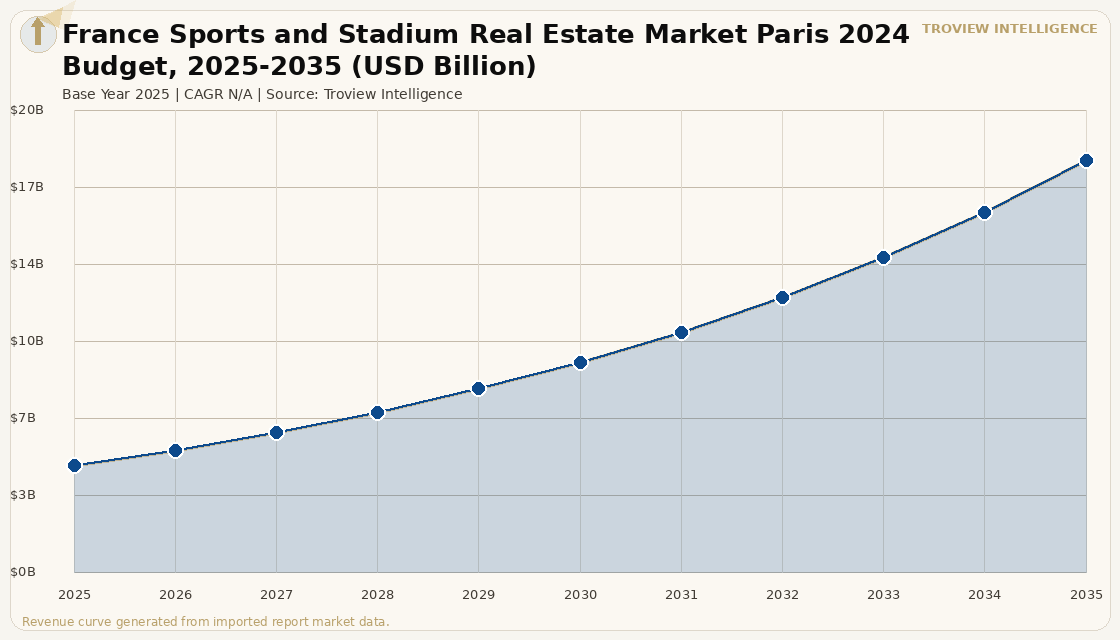
The France sports and stadium real estate market is one of the most strategically significant in Europe, anchored by the Paris 2024 Summer Olympics that demonstrated France's ability to deliver a major international sporting event infrastructure programme within a USD 4.74 Billion budget through the strategy of building less, better, and usefully relying on existing infrastructure, renovation of historic venues, and temporary pavilions designed for deconstruction rather than the greenfield stadium construction model that incurred multibillion-dollar debt for previous host cities. France hosted the 2024 Summer Olympics and Paralympics with the Stade de France in Saint-Denis as the primary athletics and rugby sevens venue, with the event drawing an estimated 15.3 million Olympic and Paralympic visitors to the Paris metropolitan area and generating widespread urban regeneration across the Saint-Denis and Saint-Ouen districts of the northern Paris banlieues. The Stade de France France's largest capacity stadium at 80,000 seats, built for the 1998 FIFA World Cup which France won with a 3-0 final against Brazil underwent a comprehensive Olympic renovation including the installation of 650 LED lights reducing energy requirements by almost 80%, full 5G coverage provided by Orange as an Olympic infrastructure partner, exclusive connection to the electricity grid through Enedis enabling 100% renewable electricity from EDF for Games events and their legacy, and a new 14,000 square metre purple athletics track to World Athletics Type 1 classification the highest standard in international track and field per Paris 2024 official Olympics reporting. Property prices in the Saint-Denis neighbourhood increased by 15 to 20% over five years as a direct consequence of the Olympic urban development programme that included the Olympic Village conversion to housing, extension of Metro line 14, and renovation of public spaces per HomeSelect Paris verified sports venue analysis. For instance, in 2026, the National Football League confirmed hosting its first regular-season game in France at the Stade de France with the New Orleans Saints as the home team and the Pittsburgh Steelers as the visiting team, per Wikipedia Stade de France verified data, confirming France as a permanent NFL International Series market and extending the Stade de France's premium event calendar beyond domestic rugby and football fixtures. These are some of the key factors driving revenue growth of the market.
France's sports and stadium real estate market encompasses the Stade de France and its surrounding Plaine Saint-Denis urban regeneration zone, the Parc des Princes at Porte d'Auteuil in the 16th arrondissement which serves as Paris Saint-Germain's home with 48,500 seats, Roland-Garros at Porte d'Auteuil which hosts the annual French Open and served as Paris 2024 Olympics tennis and boxing venue, the Accor Arena in Bercy serving as Paris's primary indoor arena for concerts, basketball, and martial arts events, and a network of regional stadiums across France's major cities including the Groupama Stadium in Lyon with 59,186 seats and the Stade Vélodrome in Marseille with 67,394 seats the second-largest club stadium in France after the Stade de France. The Paris 2024 Aquatics Centre, located in Saint-Denis connected to the Stade de France by a new footbridge over the A1 motorway, is among the few new constructions of the Games: its 295-foot-span wave-form CLT roof constitutes the largest urban solar-energy farm in France with 54,000 square feet of photovoltaic panels, and the facility will be used by local clubs and the French Swimming Federation following the Games per Architectural Record verified Paris 2024 venue reporting. The French state remains the owner of the Stade de France, with the Consortium Stade de France majority held by Vinci with a second shareholder Bouygues whose concession ran to 2025 managing the venue under a concession arrangement whose post-2025 structure was subject to government decision following the Olympics per StadiumDB verified reporting.
However, the France sports and stadium real estate market faces structural constraints that limit the revenue performance and investment return of stadium assets in the French market. The Iran-US geopolitical tensions and resulting Strait of Hormuz disruptions, confirmed by the IMF in March 2026 to affect approximately 20% of global seaborne oil and LNG flows, are generating energy cost inflation that increases stadium operating costs in France, where the Paris 2024 commitment to 100% renewable energy supply and the post-Olympic transition of venues to sustainable energy management creates ongoing procurement costs for green energy certification that smaller regional stadiums cannot absorb as efficiently as the Stade de France. France's club football stadium ownership model where French Ligue 1 clubs historically operate in municipally owned stadiums on long-term rental agreements rather than owning their venue assets limits the revenue diversification and facility investment that privately owned stadium models enable, as municipal owners face political constraints on tariff increases and facility transformation investments that are not constrained by club commercial objectives. The USD 600 Million proposed acquisition price for the Stade de France which attracted interest from PSG and multiple parties following the 2023 government sale process, with Paris Mayor Anne Hidalgo stating the venue is not for sale reflects the unresolved ownership structure that leaves France's flagship stadium asset in a governmental holding that may limit the commercial innovation and private capital investment available to maximise the venue's revenue potential. These factors substantially limit France sports and stadium real estate market growth over the forecast period.
TROVIEW ANALYST PERSPECTIVE "France's approach to the Paris 2024 Olympics was a deliberate counter-narrative to the stadiums-as-white-elephants story that has defined post-Games infrastructure in Beijing, Athens, and Rio. The USD 4.74 Billion budget discipline, the renovation-first strategy, the Olympic Village converted to housing, the Aquatics Centre with solar panels doubling as urban infrastructure these were not accidents. They were the outcome of a national decision to use the Olympics to accelerate pre-existing urban regeneration rather than build prestige infrastructure for a three-week event. The result is that Saint-Denis property prices rose 15 to 20% over five years. The Grand Paris Express delivered a new Pleyel station adjacent to the Stade de France. A neighbourhood that was considered inaccessible became connected. The NFL's decision to bring its first France regular-season game to the Stade de France in 2026 is the commercial proof that this strategy works: an 80,000-seat venue that has hosted a World Cup final, three Champions League finals, three Rugby World Cups, and now an Olympic Games and an NFL international regular-season game is the most versatile major event venue in Europe. The question for French sports real estate investors is what happens to the Stade de France's ownership and concession post-2025. A fully privatised stadium with PSG or another anchor tenant and commercial operator would transform the asset's investment return profile." Troview Intelligence Head of France Sports and Stadium Real Estate Research
SEGMENT INSIGHTS
Three Cities Defining France's Stadium Investment Market
| Primary Venue | Capacity | Olympic Legacy Projects | Property Impact |
| Stade de France, Saint-Denis | 80,000 seats France's largest | Aquatics Centre, Olympic Village housing, Grand Paris Express | Saint-Denis property +15-20% over 5 years |
Paris is France's dominant sports and stadium real estate market, hosting the Stade de France in Saint-Denis as the country's flagship national stadium with 80,000 seats and a documented record of hosting the 1998 World Cup final, Champions League finals in 2000, 2006, and 2022, the 1999, 2007, and 2023 Rugby World Cups, the Paris 2024 Olympic athletics and rugby sevens events, and from 2026 the NFL's first France regular-season game with the New Orleans Saints as the home team per Wikipedia Stade de France verified data. Paris also hosts the Parc des Princes in the 16th arrondissement as PSG's home stadium with 48,500 seats, situated in close proximity to Roland-Garros and the Bois de Boulogne, with the surrounding residential neighbourhood representing some of Paris's most expensive real estate at prices exceeding EUR 12,000 per square metre in the southern 16th arrondissement per HomeSelect Paris stadium neighbourhood analysis. The Paris 2024 Aquatics Centre in Saint-Denis connected to the Stade de France by a new footbridge crossing the A1 motorway features a 295-foot wave-form CLT roof and 54,000 square feet of photovoltaic panels constituting the largest urban solar energy farm in France, which will serve local swimming clubs and the French Swimming Federation in the post-Games legacy period. The new Pleyel station on the Grand Paris Express opened in 2024 in direct connectivity to the Stade de France, materially improving the stadium's public transport accessibility and reducing car-dependent attendance that had historically been a logistical constraint for non-event-day visitor activity in Saint-Denis.
| Primary Venue | Capacity | Club | Stadium Ownership Model |
| Groupama Stadium (Parc Olympique Lyonnais) | 59,186 seats | Olympique Lyonnais (OL) | Club-owned rare private ownership in French football |
Lyon hosts the Groupama Stadium officially named the Parc Olympique Lyonnais which with 59,186 seats is the largest club-owned stadium in France and one of the most financially sophisticated French football stadium assets, distinguished from the majority of French club stadiums by Olympique Lyonnais' direct ownership of the venue rather than the municipal rental arrangement that most French Ligue 1 clubs operate under. Club ownership of the Groupama Stadium allows OL to capture naming rights revenue, premium hospitality and VIP suite income, non-match event hosting revenue from concerts and cultural events, and the commercial sponsorship of the facility independent of the municipal approval processes that constrain revenue diversification at publicly owned French stadiums. The Groupama Stadium has served as a key venue for international football events including UEFA Champions League group and knockout matches, France national team friendlies and qualifiers, and preparatory events in the lead-up to Euro 2016 when Lyon hosted multiple group stage matches. Lyon's position as France's third-largest city with a strong European business services, biotech, and luxury goods industry base provides a premium corporate hospitality audience that supports the Groupama Stadium's premium VIP and suite inventory at occupancy rates and pricing that reflect Lyon's significant business event volume.
Marseille STADE VÉLODROME 67,394 SEATS, SECOND-LARGEST CLUB STADIUM, COASTAL REGENERATION
| Primary Venue | Capacity | Club | Recent Investment |
| Stade Vélodrome (Orange Vélodrome) | 67,394 seats 2nd largest club stadium in France | Olympique de Marseille (OM) | Major renovation 2014 for UEFA Euro 2016 |
Marseille hosts the Stade Vélodrome commercially branded the Orange Vélodrome which with 67,394 seats is the second-largest club stadium in France after the Stade de France by overall capacity and the largest club stadium by club-specific primary tenant use, serving as the historic home of Olympique de Marseille, one of France's most passionate and consistently supported football clubs with a supporter base that generates among the highest average attendance figures in French Ligue 1. The stadium underwent a major renovation in 2014 in preparation for the UEFA Euro 2016 tournament, with the addition of a partial roof covering the stands and the modernisation of hospitality, concession, and media infrastructure that brought the facility to a standard capable of hosting elite international fixtures including Euro 2016 group matches and knockout rounds. Marseille's coastal location and established tourism infrastructure as France's second-largest city and major Mediterranean port provides the stadium with an attractive destination context for international sports events that attract both domestic travelling supporters and international visitors, contributing to the sports tourism revenue ecosystem that makes Marseille a viable host for major European football club competitions, France national team matches, and potentially future Rugby World Cup fixtures following the Stade de France's proven capability in this format.