Troview
Intelligence
Intent
Services
Report Sectors
Global Report Alternative Assets Report ID: TRV-RD-233 Published June 2026

Life Sciences Campus Market

TROVIEW INTELLIGENCE | Life Sciences Campus Market | Q2 2026 TROVIEW INTELLIGENCE · GLOBAL INTELLIGENCE REPORT By Geography · By Asset Type · By Tenant Segment · By Campus Model Global R&D investment sales in life sciences real estate climbed to USD 13.5 billion in 2025, up 28% year-on-year per Cushman and Wakefield Life Sciences Update February 2026, venture capital funding held steady at USD 49 billion globally wit...
Base Year Value
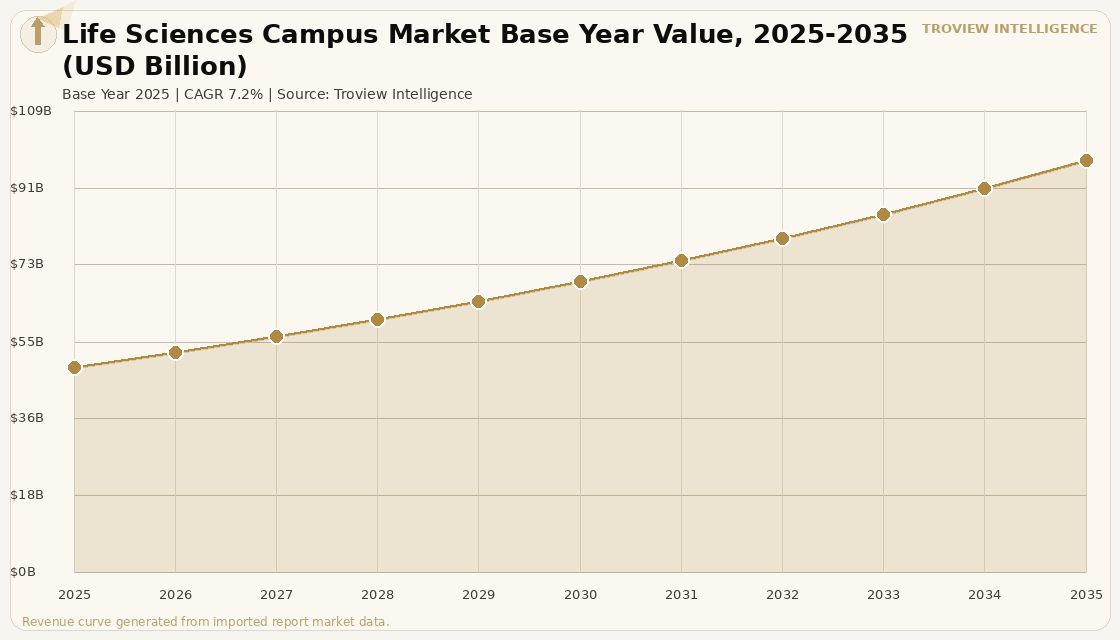
USD 48.62 Billion
Forecast Value (2035)
USD 97.54 Billion
CAGR
7.2%
Report ID
TRV-HC-006
Base Year
2025
Pages
285+
Purchase This Report
Standard License
PDF + Excel delivery
$7,500
Enterprise License
Unlimited users · Raw data export
$10,500
Purchase Now Request Preview Summary
TROVIEW INTELLIGENCE | Life Sciences Campus Market | Q2 2026
TROVIEW INTELLIGENCE · GLOBAL INTELLIGENCE REPORT

By Geography · By Asset Type · By Tenant Segment · By Campus Model

Global R&D investment sales in life sciences real estate climbed to USD 13.5 billion in 2025, up 28% year-on-year per Cushman and Wakefield Life Sciences Update February 2026, venture capital funding held steady at USD 49 billion globally with strong momentum in APAC, JLL's 2025 Life Sciences Real Estate Perspective documented 61 million square feet of available lab space in the US alone with vacancy at 27% and predicted 18.7 million square feet will shift to alternative uses by 2030, global pharmaceutical companies pledged USD 475 billion year-to-date in US manufacturing and R&D investments per JLL October 2025, Alexandria Real Estate Equities and Blackstone collectively controlled approximately 30% of life sciences campus market share in 2024, record 76 innovative drug approvals were recorded in 2025 per Cushman and Wakefield, and AI-native biotechs grew to account for one-sixth of all biotech venture capital deals year-to-date per JLL confirming that the life sciences campus real estate market is simultaneously navigating the most significant supply correction in its history and the most compelling long-term demand narrative of any specialised real estate asset class globally.

Standard License: USD 7,500Enterprise License: USD 10,500

MARKET SYNOPSIS

The global life sciences campus market size was USD 48.62 Billion in 2025 and is expected to register a revenue CAGR of 7.2% during the forecast period, reaching USD 97.54 Billion by 2035. The market encompasses institutionally owned and managed life sciences campuses defined as purpose-built or purpose-converted real estate assets dedicated to laboratory research, bioprocessing and biomanufacturing, clinical development, and AI-driven drug discovery for pharmaceutical, biotechnology, medical device, and academic research tenants across all major global biopharma and research cluster markets. Market revenue growth is supported by the structural decentralisation of pharmaceutical R&D spending toward campus-format real estate that co-locates multiple tenants in shared-infrastructure environments offering wet lab space, biomanufacturing clean rooms, office space, and collaborative amenity in integrated campus settings that individual companies cannot replicate efficiently on standalone leases. Global R&D investment sales in life sciences real estate climbed to USD 13.5 billion in 2025, up 28% year-on-year per Cushman and Wakefield Life Sciences Update of February 2026, with the US leading the rebound and rising activity confirmed in APAC and EMEA. Global pharmaceutical companies pledged USD 475 billion year-to-date in US manufacturing and R&D investments per JLL reporting of October 2025, with one-third of midsize and large R&D leases signed year-to-date by global pharma companies the highest share in recent history as trade policy volatility and pharmaceutical reshoring discussions accelerate the conversion of pledged investment into facility demand. For instance, in early 2024, BioMed Realty, United States, acquired a 1.4 million square foot development site in South San Francisco aimed at constructing four state-of-the-art life sciences towers scheduled for delivery by 2026, with the acquisition representing the systematic portfolio expansion of institutional life sciences campus developers into the world's most established biotech cluster markets per verified company and industry reporting. These are some of the key factors driving revenue growth of the market.

Alexandria Real Estate Equities, Inc., United States, began construction of a 550,000 square foot life sciences campus in San Diego's Torrey Pines featuring fully integrated AI lab monitoring and a rooftop solar grid projected to offset 35% of total energy consumption, building on its completion of USD 2.5 billion worth of acquisitions and development projects across Cambridge, Seattle, and San Diego in 2023 per verified company reporting. Blackstone Real Estate, United States, invested over USD 20 billion in life sciences properties by 2023, holding a significant share in biotech hubs including Cambridge, Massachusetts and San Diego per US Securities and Exchange Commission filings, collectively controlling approximately 30% of life sciences campus market share alongside Alexandria. Genentech, United States, is undergoing a major multiyear buildout of its global headquarters campus in Basel, Switzerland, investing more than 3 billion Swiss francs approximately USD 3.82 billion in site development including a new 72-metre research building scheduled for completion in 2029 per parent company Roche, aiming to modernise research facilities and consolidate R&D functions per CNBC reporting of April 2026. Venture capital funding in life sciences held steady at USD 49 billion globally in 2025, supported by strong momentum in APAC, with VC investment in life sciences in the second half of 2025 the strongest since 2022 per CBRE analysis, confirming that the funding pipeline supporting future life sciences campus demand is recovering from the 2023 to 2024 trough period. These are some of the key factors driving revenue growth of the market.

However, the global life sciences campus market faces structural constraints that temper the pace of revenue growth across the forecast period. The US life sciences campus market in particular faces an unprecedented supply correction, with JLL's 2025 Life Sciences Real Estate Perspective documenting vacancy rates at 27% across the 10 largest US life sciences markets up 20.4 percentage points in three years as newly delivered space outpaced demand from the venture capital-funded biotech leasing that drove the 2020 to 2022 market peak. JLL predicts approximately 18.7 million square feet of the current 61 million square feet of available US life sciences space will likely shift to alternative uses during the remainder of the decade, as the cost of maintaining lab-grade infrastructure for properties that cannot achieve occupancy makes conversion to office or residential use the economically rational outcome for non-strategic assets. AI-native biotechs, which now account for one-sixth of all biotech venture capital deals per JLL analysis, demonstrate a lower lab-to-office ratio of 45-to-55 and lease roughly one-third less space per employee than traditional biotechs, permanently altering the space requirements per dollar of venture funding deployed and reducing the lab absorption per unit of venture investment that historically anchored life sciences campus market demand growth. Iran-US geopolitical tensions and LNG price volatility through the Strait of Hormuz, as confirmed by IMF March 2026 analysis, create upward pressure on energy costs for life sciences campus operators, as laboratory and biomanufacturing environments require 24-hour continuous power for equipment, controlled environment rooms, and cold storage at four to eight times the energy intensity per square metre of conventional office space. These factors substantially limit global life sciences campus market growth over the forecast period.

Troview Analyst Perspective

The life sciences campus market in 2025 is in the same structural position that the US office market was in 2012: recovering from a supply correction driven by speculative construction during a pandemic-era demand spike, with a structural demand shift AI-native biotechs using one-third less space per employee reducing the absorption per unit of venture capital deployed. But the office market analogy breaks down in one critical way. The demand for pharmaceutical R&D is driven by demographic ageing and the patent cliff, not by corporate location decisions or remote work preferences. Every pharmaceutical company with a drug going off patent between 2025 and 2030 and there are dozens needs to replace that revenue with new drug discovery, and new drug discovery requires laboratory space. Global pharma pledging USD 475 billion in US manufacturing and R&D investment is not a capital allocation choice. It is an operational necessity. The campus operators who survive the 2025 to 2027 correction with their premier cluster assets intact Cambridge, Mission Bay, San Diego's Torrey Pines, Basel, Singapore's Biopolis, Tokyo's King Skyfront will control the most strategically positioned science real estate in the world when the next biotech investment cycle begins. The vacancy rate does not change that geography." Troview Intelligence Head of Global Life Sciences Campus Research

SEGMENT INSIGHTS

By Asset Type
Laboratory and R&D research facility campus segment is expected to account for a significantly large revenue share in the global life sciences campus market during the forecast period.Based on asset type, the global life sciences campus market is segmented into laboratory and R&D research facility campuses, biomanufacturing and cGMP production facility campuses, mixed-use science and technology campuses, and incubator and co-working life sciences campuses. Laboratory and R&D research facility campuses account for approximately 35% of global life sciences real estate per JLL Life Sciences Real Estate Outlook 2025 segmentation, anchored by the major US biotech cluster campuses in Boston, San Francisco, and San Diego that dominated the market peak and currently host the highest vacancy rates as the sector corrects from speculative oversupply.Biomanufacturing and cGMP production facility campuses are expected to register the fastest CAGR during the forecast period, as the pharma reshoring trend with global pharmaceutical companies pledging USD 475 billion in US manufacturing and R&D investment per JLL October 2025 creates demand for purpose-built biomanufacturing and GMP production facilities that require highly specialised clean room, cleanroom HVAC, and biosafety infrastructure not available in converted office or laboratory space. New Jersey leads US biomanufacturing capabilities per JLL analysis, followed by Raleigh-Durham and Boston, with the biomanufacturing campus segment benefiting from the reshoring investment cycle that is less correlated to venture capital deployment patterns than laboratory R&D leasing.
By Tenant Segment
Large pharmaceutical company tenant segment is expected to account for a significantly large revenue share in the global life sciences campus market during the forecast period.Based on tenant segment, the global life sciences campus market is segmented into large pharmaceutical and multinational biopharmaceutical companies, venture-backed biotech and early-stage companies, academic and government research institutions, and AI-native drug discovery and medical technology companies. Large pharmaceutical companies accounted for one-third of midsize and large R&D leases year-to-date per JLL October 2025 reporting their highest share of R&D leasing activity in recent history as venture-backed leasing has receded from the 2021 to 2022 peak, with pharma companies using campus-format real estate to consolidate multiple R&D functions into single cluster locations that benefit from the proximity to talent, academic partners, and venture capital ecosystems that established life sciences campus hubs provide.AI-native drug discovery companies are the fastest-growing tenant category in global life sciences campuses, having grown to account for one-sixth of all biotech venture capital deals per JLL analysis. These companies differ fundamentally from traditional biotech tenants in their space requirements lower lab-to-office ratio of 45-to-55 versus the traditional lab-heavy ratio, and roughly one-third less space per employee creating demand for hybrid computation-lab campus formats that differ from the purely wet laboratory campus model that dominated life sciences real estate development from 2018 to 2022.
By Campus Model
Open innovation campus model is expected to account for a significantly large revenue share in the global life sciences campus market during the forecast period.Based on campus model, the global life sciences campus market is segmented into anchor-tenant single-company campuses, multi-tenant open innovation campuses, incubator and co-working flex lab campuses, and mixed-use science and residential campuses. Multi-tenant open innovation campuses account for the largest and growing share of global life sciences campus investment, as the pharmaceutical industry's shift from internal R&D toward open innovation models sharing laboratories, equipment, and expertise across multiple tenants creates demand for purposefully designed collaborative campus environments that academic medical centres, life sciences REITs, and government-backed cluster initiatives are best positioned to develop and operate.Incubator and co-working flex lab campuses are the fastest-growing campus model by number of new openings globally, as operators including BioLabs with 14 co-working locations worldwide including iCONM at King Skyfront in Kawasaki and LINK-BioBAY TOKYO in partnership with Mitsui Fudosan and LINK-J expand the early-stage life sciences real estate model into Asia Pacific markets where the venture capital ecosystem supporting standalone company lab space is less developed than in Boston or San Francisco.

Four Regions Defining Global Life Sciences Campus Investment

NORTH AMERICA LARGEST MARKET, SUPPLY CORRECTION UNDERWAY, PHARMA RESHORING DRIVER
US Lab Vacancy 2025Global R&D Inv. Sales 2025Pharma Reshoring PledgeSpace to Convert by 2030
27% across top-10 markets (JLL Oct 2025)USD 13.5 Billion (+28% YoY) US leading (C&W)USD 475 Billion in US mfg + R&D (JLL Oct 2025)~18.7M sqft shifting away from lab (JLL)

North America is the world's largest life sciences campus market but is in the midst of an unprecedented correction, with vacancy rates at 27% across the 10 largest US markets per JLL's 2025 analysis the result of speculative laboratory supply additions during the 2020 to 2022 venture capital-driven demand peak that have outpaced the subsequent normalisation of biotech leasing activity. Despite near-term vacancy headwinds, the long-term structural demand anchors for North American life sciences campuses remain intact: global pharmaceutical companies pledged USD 475 billion year-to-date in US manufacturing and R&D investments per JLL October 2025 and accounted for one-third of midsize and large R&D leases as the strongest-demand tenant category in recent history, with major US biotech cluster markets including Boston-Cambridge, San Francisco Mission Bay, and San Diego Torrey Pines retaining the talent density, academic infrastructure, and VC ecosystem proximity that make them structurally irreplaceable life sciences campus locations regardless of short-term vacancy levels. Global R&D investment sales in life sciences reached USD 13.5 billion in 2025, up 28% year-on-year per Cushman and Wakefield, with the US leading the rebound, confirming that institutional investors are maintaining and expanding positions in core US life sciences campus assets while taking a more selective approach to secondary markets.

EUROPE GENENTECH BASEL USD 3.82B CAMPUS, IMPROVING DEBT MARKETS
Genentech Basel CampusEuropean VC TrendKey ClustersEuropean Lab Rents
CHF 3B+ (USD 3.82B) multiyear buildout, completion 2029Beginning to see early improvements (C&W Feb 2026)Basel-Novartis Campus, King's Cross London, Cambridge UKSoftened 1.7% YoY globally (C&W); still above office rents

Europe's life sciences campus market is characterised by a smaller speculative development overhang than the US and by the presence of the world's largest single-company pharmaceutical campus projects, most notably Genentech's more than USD 3.82 billion multiyear buildout of its Basel global headquarters campus including a new 72-metre research building scheduled for completion in 2029 per Roche disclosure, which is the largest single life sciences campus investment commitment globally in 2025 to 2026. Cushman and Wakefield's Life Sciences Update of February 2026 confirmed that Europe is beginning to see early improvements in debt markets, mergers and acquisitions activity, and public sector innovation funding, creating a more constructive capital markets environment for life sciences campus investment than existed in 2023 or 2024. The King's Cross life sciences campus in London, Cambridge Science Park, and the Basel pharmaceutical cluster anchored by Novartis and Roche are the primary European institutional campus investment destinations, with London's King's Cross cluster reporting space absorption rates above 85% within 12 months of delivery per verified market analysis.

ASIA PACIFIC FASTEST CAGR, VC USD 49B STEADY WITH STRONG APAC MOMENTUM
Global VC Funding 2025China 2025 Drug ApprovalsKey APAC ClustersAPAC R&D Sales 2025
USD 49 Billion strong APAC momentum (C&W Feb 2026)Record 76 innovative drug approvals per C&WTokyo, Singapore Biopolis, Shanghai Zhangjiang, KobeRising activity per C&W February 2026 global update

Asia Pacific is the fastest-growing life sciences campus real estate region, supported by strong VC momentum per Cushman and Wakefield's global life sciences update, China's record 76 innovative drug approvals in 2025 elevating its influence in the global biopharma ecosystem, and the expansion of Japan's life sciences campus infrastructure through Shonan Health Innovation Park, King Skyfront in Kawasaki, and the emerging cluster at Takanawa Gateway in Tokyo. Singapore's Biopolis cluster the government-developed life sciences campus in one-north remains the region's most institutionally developed life sciences campus real estate destination, with GlaxoSmithKline, Procter and Gamble, and multiple pharmaceutical and biotech companies anchoring the campus. Chinese biotechs now account for four times the in-licensing deals for US biopharma compared to 2021 levels per JLL analysis, creating indirect demand for life sciences campus real estate in both Shanghai Zhangjiang and in US and European cluster markets where Chinese biotech companies establish US licensing and development presences.

MAJOR COMPANIES

Alexandria Real Estate Equities, Inc
United States
Blackstone Real Estate (life sciences portfolio)
United States
BioMed Realty (Blackstone subsidiary)
United States
Healthpeak Properties Inc
United States
Welltower Inc. (life sciences JV)
United States
IQHQ Inc
United States
Wexford Science and Technology
United States
Mitsui Fudosan Co., Ltd
Japan
BioLabs (co-working lab global operator)
United States
Genentech / Roche (Basel campus)
Switzerland / United States
Novartis AG (Basel Innovation District)
Switzerland
iPark Institute (Shonan / Japan campus ops)
Japan

STRATEGIC DEVELOPMENTS

Feb 2026
Cushman and Wakefield published its Life Sciences Update February 2026 confirming that global R&D investment sales climbed to USD 13.5 billion in 2025, up 28% year-on-year, venture capital funding held steady at USD 49 billion globally with strong APAC momentum, vacancy climbed to 23.1% across tracked global markets as newly delivered space outpaced demand, global lab and cGMP rents softened 1.7% year-on-year, and a record 76 innovative drug approvals in 2025 are reinforcing R&D momentum and elevating China's influence in the global life sciences ecosystem, with Europe beginning to see early improvements in debt markets, M&A activity, and public sector innovation funding per Cushman and Wakefield Life Sciences Update February 2026.
Oct 2025
JLL published its 2025 Life Sciences Real Estate Perspective and Cluster Analysis documenting global pharmaceutical companies pledging USD 475 billion year-to-date in US manufacturing and R&D investments, with one-third of midsize and large R&D leases signed by global pharma companies their highest share of R&D leasing in recent history vacancy across the top 10 US life sciences markets at 27%, AI-native biotechs growing to account for one-sixth of all biotech VC deals while leasing roughly one-third less space per employee, and JLL predicting 18.7 million square feet of current US lab space will shift to alternative uses by 2030, potentially reducing the US availability rate from 29% to 20% per JLL Life Sciences Real Estate Perspective October 2025.
Apr 2026
Genentech, United States, subsidiary of Roche, Switzerland, disclosed it is undergoing a major multiyear buildout of its global headquarters campus in Basel, Switzerland, investing more than 3 billion Swiss francs approximately USD 3.82 billion in site development including a new 72-metre research building scheduled for completion in 2029, aimed at modernising research facilities and consolidating R&D functions at a single integrated campus the largest single life sciences campus investment commitment globally in the 2025 to 2026 period per Roche disclosure cited in CNBC reporting of April 2026.
Early 2024
BioMed Realty, United States, a Blackstone subsidiary, acquired a 1.4 million square foot development site in South San Francisco aimed at constructing four state-of-the-art life sciences towers scheduled for delivery by 2026, with the acquisition adding to the more than USD 20 billion that Blackstone Real Estate invested in life sciences properties by 2023, maintaining its position alongside Alexandria Real Estate Equities as a collective holder of approximately 30% of life sciences campus market share in 2024 per US Securities and Exchange Commission filings and market analysis.
Oct 2024
IQHQ Inc., United States, completed Phase 1 of its Research and Development District in San Diego, opening 500,000 square feet of flexible R&D and biomanufacturing space that achieved 90% pre-leased status within three months of delivery per verified company reporting, demonstrating that best-in-class, mixed-use life sciences campus formats combining R&D laboratory space with biomanufacturing capability in waterfront locations can achieve rapid occupancy even in the most supply-burdened US life sciences market, as the quality and location premium of the RaDD campus attracted tenants that bypassed the broader San Diego lab vacancy environment to secure integrated R&D-manufacturing space in the market's premier new development.

Ordered 2026 first. All developments sourced from verified company announcements, JLL and Cushman and Wakefield life sciences research, and verified trade press.

KEY QUESTIONS ANSWERED

01
What is the total size of the global life sciences campus market in 2025 and what revenue is projected by 2035 at the forecast CAGR of 7.2%?
02
With JLL documenting 27% vacancy in US life sciences markets the result of speculative construction during the 2020 to 2022 venture capital peak and predicting 18.7 million square feet of current lab space shifting to alternative uses by 2030, how should institutional investors differentiate between premier cluster campus assets in Boston-Cambridge, San Francisco Mission Bay, and San Diego Torrey Pines that will sustain occupancy regardless of vacancy averages, and secondary or suburban life sciences space that faces permanent demand loss?
03
How is the structural shift of AI-native biotechs accounting for one-sixth of all biotech VC deals while leasing one-third less space per employee than traditional biotechs permanently altering the space requirements per dollar of venture funding deployed, and what life sciences campus design and lease structure adaptations are necessary for campus operators to capture AI-native tenant demand without over-building traditional wet lab space that these tenants do not require?
04
With global pharma companies accounting for one-third of midsize and large R&D leases in 2025 their highest share in recent history and pledging USD 475 billion in US manufacturing and R&D investment, how does pharmaceutical reshoring create demand for biomanufacturing campus real estate in New Jersey, Raleigh-Durham, and Boston that is structurally different from the venture-backed R&D lab demand that drove the 2020 to 2022 peak and is less affected by the AI-driven space efficiency trend?
05
What is the investment thesis for Genentech's USD 3.82 billion Basel campus buildout through 2029 in the context of a global life sciences real estate market where labs are sitting vacant at 27% in the US, and what does Roche's capital commitment to a single-site campus consolidation strategy reveal about how major pharmaceutical companies value the productivity benefits of concentrated campus R&D environments relative to the capital efficiency of leasing from third-party campus operators?
06
How does the APAC life sciences campus market where VC funding holds strong momentum, China recorded 76 innovative drug approvals in 2025, and Japan's King Skyfront and Shonan iPark are establishing open innovation campus models at international quality standards offer a different risk-return profile for life sciences campus investment than the oversupplied US market, and which APAC cluster markets offer the most compelling combination of government support, talent depth, and institutional-grade campus supply scarcity?

TABLE OF CONTENTS

01
Global Life Sciences Campus Market Overview and Scope
02
Market Size, Growth, and Forecast 2025 to 2035
03
Market Drivers Pharma Reshoring, Patent Cliff M&A, AI Drug Discovery, Demographic Demand
04
Market Restraints US Vacancy Correction, AI Space Efficiency Shift, Energy Cost, NIH Funding
05
Segment Analysis By Asset Type, Tenant Segment, and Campus Model
06
Regional Analysis North America (US Vacancy 27%, Pharma Reshoring USD 475B)
07
Regional Analysis Europe (Genentech Basel USD 3.82B, Cambridge, King's Cross)
08
Regional Analysis Asia Pacific (VC USD 49B Steady, China 76 Drug Approvals, Japan)
09
Regional Analysis Middle East and Africa (Abu Dhabi, Saudi Neom Health)
10
AI-Native Biotech Campus Requirements Lab-to-Office Ratio, Space Efficiency, Compute Infra
11
REIT and Capital Market Analysis Alexandria, Blackstone, R&D Investment Sales USD 13.5B
12
Biomanufacturing and cGMP Campus Reshoring Demand, New Jersey, Raleigh-Durham, Singapore
13
Competitive Landscape Alexandria, Blackstone/BioMed, IQHQ, Wexford, iPark, BioLabs
14
Strategic Developments and Investment Activity