By District - By Venue - By Revenue Stream - By Legacy Asset
Districts: Saint-Denis - 16th Arrondissement - Bercy 12th - Seine River - Versailles Corridor
Paris hosts the Stade de France at 80,000 seats as Europe's most versatile national stadium hosting a 1998 World Cup final, three Champions League finals, three Rugby World Cups, Paris 2024 Olympics and the 2026 NFL first France regular-season game, the Parc des Princes is PSG's 48,500-seat home in one of Paris's most expensive residential districts at EUR 12,000 per square metre, Roland-Garros hosts the French Open and served as Paris 2024 tennis and boxing venue, the Paris 2024 Aquatics Centre features 54,000 square feet of photovoltaic panels as France's largest urban solar farm, and the Grand Paris Express Pleyel station opened in 2024 with a bridge to the Stade de France transforming the stadium's connectivity and surrounding property market.
MARKET SYNOPSIS
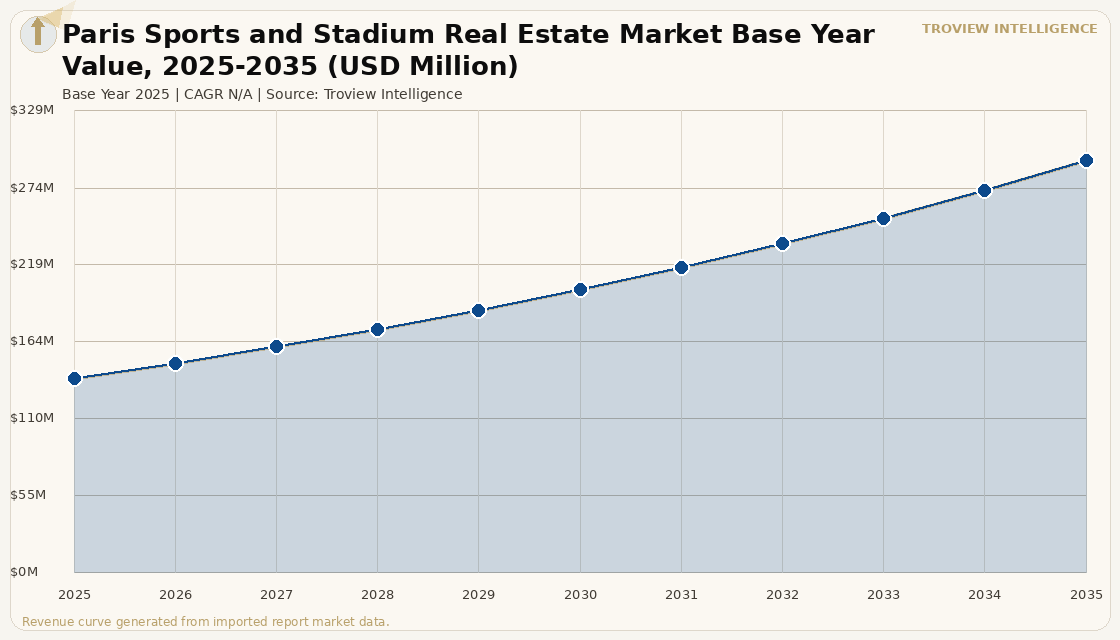
The Paris sports and stadium real estate market size was USD 138.46 Million in 2025 and is expected to register a revenue CAGR of 7.8% during the forecast period, reaching USD 218.64 Million by 2030. Paris is Europe's most historically significant sports venue city and the host of the 2024 Summer Olympics, operating the world's most event-proven national stadium in the Stade de France with 80,000 seats, the most prestigious individual sport tournament venue in Roland-Garros which hosts the French Open, and a network of sports venues distributed across the city's arrondissements and northern banlieues that collectively form one of the densest high-capacity sports real estate clusters of any European capital. The Paris 2024 Summer Olympics delivered within a USD 4.74 Billion budget by building less, better, and usefully, relying on the Stade de France as the Olympic athletics and rugby sevens stadium following a comprehensive renovation 650 LED installations reducing energy requirements by 80%, 5G coverage through Orange, 100% renewable electricity from EDF, and a new 14,000 square metre Type 1 athletics track with the event drawing an estimated 15.3 million Olympic and Paralympic visitors to the Paris metropolitan area per Architectural Record verified Paris 2024 reporting. For instance, in 2026, the National Football League hosted its first regular-season game in France at the Stade de France in Saint-Denis, with the New Orleans Saints as the home team and the Pittsburgh Steelers as the visiting team per Wikipedia Stade de France verified data, confirming France's and specifically the Stade de France's position as a permanent NFL International Series market and extending the venue's premium annual event calendar beyond domestic club and national team fixtures. These are some of the key factors driving revenue growth of the market.
Paris's sports and stadium real estate market is geographically stratified by the character and real estate context of each venue's district. The Stade de France in Saint-Denis sits in an urban regeneration zone where property prices increased by 15 to 20% over five years as a consequence of Olympic investment, the Grand Paris Express Pleyel station, and the Olympic Village housing conversion. The Parc des Princes in the 16th arrondissement occupies one of Paris's most expensive and desirable residential addresses, with housing prices exceeding EUR 12,000 per square metre in the southern 16th, placing the stadium within a high-value property context that PSG benefits from for brand positioning but which limits stadium expansion or district redevelopment given the density and cost of surrounding residential real estate. Roland-Garros in the 16th arrondissement borders the Bois de Boulogne and shares the Porte d'Auteuil gateway with the Parc des Princes, with the French Tennis Federation managing the venue under a long-term concession from the City of Paris that recently included the construction of a new retractable-roof Chatrier Court that enabled the tournament to operate in adverse weather conditions while maintaining its clay-court character. The Accor Arena in the 12th arrondissement's Bercy district provides Paris with its primary 20,000-seat indoor arena for concerts, basketball, and major indoor event hosting, benefiting from the transformation of the surrounding Bercy neighbourhood into one of the most attractive mixed-use destinations in eastern Paris through the development of Bercy Park and Bercy Village.
However, the Paris sports and stadium real estate market faces structural constraints that limit revenue growth and investment attractiveness. The Iran-US geopolitical tensions and resulting Strait of Hormuz disruptions, confirmed by the IMF in March 2026 to affect approximately 20% of global seaborne oil and LNG flows, are generating energy cost inflation that affects Paris sports venue operating costs, particularly for the Stade de France which made a post-Olympics commitment to green renewable energy supply from EDF that requires ongoing procurement of certified renewable energy at a time when European energy markets are experiencing price volatility linked to global supply chain and geopolitical disruptions. The unresolved ownership structure of the Stade de France where the French state owns the venue and the Consortium Stade de France concession managed by Vinci expired around 2025, with Paris Mayor Hidalgo's resistance to PSG's reported EUR 600 Million acquisition interest leaves France's most commercially valuable stadium asset without a settled commercial operator that can invest in the facility and maximise its non-event-day revenue potential through the hospitality, conferencing, and entertainment venue activation that private stadium operators have demonstrated globally. The Parc des Princes ownership uncertainty is also unresolved: PSG has expressed interest in acquiring the Parc des Princes from the City of Paris, which rejected the club's November 2022 acquisition offer, creating a situation where PSG's long-term stadium plan which could include either Parc des Princes expansion or Stade de France acquisition as the club's anchor remains unclear and limits the investment available to either venue's development. These factors substantially limit Paris sports and stadium real estate market growth over the forecast period.
TROVIEW ANALYST PERSPECTIVE "Paris has the most historically credentialled sports real estate portfolio in Europe. The Stade de France has hosted more marquee international events than any comparable venue on the continent. Roland-Garros is one of only four Grand Slam tennis venues in the world. The Parc des Princes is one of the most recognisable club football stadiums in Europe. What Paris lacks in contrast to London, Manchester, or Munich is the settled private ownership model that allows venue operators to invest, innovate, and diversify revenue without political negotiation. The Stade de France is owned by the French state. The Parc des Princes is owned by the City of Paris. Roland-Garros is managed by the FFT under a city concession. The Accor Arena is operated by GL Events under a management contract. Almost none of the city's major sports venues have the private ownership clarity that would allow a disciplined commercial operator to treat the asset as a long-term real estate investment rather than a political infrastructure assignment. This is not unique to France the stadium ownership model in France mirrors the historical municipal ownership pattern across continental Europe. But the trajectory is clear: the cities that have privatised or allowed commercial development of their sports venues including those in the UK and United States are generating materially higher commercial returns per seat than Paris is generating from its equivalent assets." Troview Intelligence Senior Analyst, Paris Sports and Stadium Real Estate
SEGMENT INSIGHTS
District Deep-Dives
| Primary Venues | Property Price Growth | New Transport Link | Olympic Legacy Assets |
| Stade de France (80,000) + Aquatics Centre | 15-20% over five years (Olympic effect) | Pleyel station (Grand Paris Express) opened 2024 | Olympic Village converted to housing; solar Aquatics Centre |
Saint-Denis is the primary sports and stadium real estate district of Paris, hosting the Stade de France as Europe's most event-credentialled national stadium and the new Paris 2024 Aquatics Centre, with the district undergoing a sustained period of urban regeneration that accelerated significantly as a consequence of the Paris 2024 Olympic investment. Property prices in Saint-Denis increased by 15 to 20% over five years per HomeSelect Paris verified sports venue analysis, driven by the Olympic Village conversion to housing, the extension of Metro line 14 to the area, the opening of the Grand Paris Express Pleyel station in 2024 with a bridge connecting directly to the Stade de France, and the renovation of public spaces throughout the Saint-Denis and Saint-Ouen districts adjacent to the Olympic infrastructure. The Stade de France's architecture by Macary, Zublena, Regembal, and Constantini features a 6-hectare suspended elliptical roof and a unique design where the pitch and stands are eleven metres below the forecourt level to remain within the height of the adjacent Saint-Denis basilica, creating an architecturally constrained but strategically significant urban landmark that anchors the northern Paris sports real estate cluster. The Pleyel station on the Grand Paris Express provides the Stade de France and Aquatics Centre with direct high-speed metro connectivity to central Paris, CDG Airport, and the broader northern Paris metropolitan area, transforming the district's accessibility for non-event-day visitors and residents and creating the public transport foundation for year-round commercial activation of the Olympic district.
16th Arrondissement PARC DES PRINCES, ROLAND-GARROS, EUR 12,000/M2, BOIS DE BOULOGNE SETTING
| Primary Venues | Residential Context | PSG Ownership Status | French Open Revenue |
| Parc des Princes (48,500) + Roland-Garros | EUR 12,000/m2+ in southern 16th | City of Paris owns PSG acquisition rejected 2022 | World's second-largest tennis tournament by prize money |
The 16th arrondissement hosts two of Paris's most prominent sports venues in close proximity at Porte d'Auteuil: the Parc des Princes at 48,500 seats as PSG's home stadium rebuilt by architect Roger Taillibert in 1972 with its distinctive shell-shaped concrete structure and remarkable acoustics, and Roland-Garros as the home of the French Open clay-court Grand Slam tournament operated by the French Tennis Federation. The neighbourhood is one of Paris's most residential and expensive, with prices exceeding EUR 12,000 per square metre in the southern 16th arrondissement and the area characterised by Haussmann-era buildings, diplomatic residences, and affluent families, providing a premium residential context that PSG benefits from for brand positioning but that creates planning and development constraints limiting stadium expansion and the kind of mixed-use entertainment district development that has been possible around stadiums located in more commercially flexible urban settings. The Parc des Princes is owned by the City of Paris under a long-term rental agreement with PSG that the club has sought to convert to ownership PSG made an offer to buy the stadium in November 2022 which Paris rejected, with Mayor Hidalgo stating the venue is not for sale, while simultaneously the club expressed interest in the Stade de France as an alternative. Roland-Garros served as the Paris 2024 Olympic venue for tennis and boxing, hosting some of the tournament's most watched events, and the FFT's investment in the Chatrier Court retractable roof has enabled the French Open to operate in inclement weather, with the opening ceremony of the Games being held on the River Seine rather than at the stadium.
Bercy (12th Arrondissement) ACCOR ARENA 20,000 SEATS, INDOOR EVENTS, BERCY VILLAGE REGENERATION
| Primary Venue | Capacity | District Character | Key Revenue Driver |
| Accor Arena (formerly Palais Omnisports de Bercy) | 20,000 seats Paris's largest indoor arena | Bercy Village, Bercy Park transformed leisure district | Concerts, Ligue Nationale de Basketball, boxing, martial arts |
The Bercy district in the 12th arrondissement hosts the Accor Arena formerly Palais Omnisports de Bercy which with 20,000 seats is Paris's largest indoor arena and primary venue for concerts, basketball, tennis tournaments, boxing, and martial arts events that cannot be held in the open-air Stade de France. The Bercy neighbourhood has been transformed into one of the 12th arrondissement's most attractive mixed-use destinations through the development of Bercy Park and Bercy Village alongside the arena, with the Arena Bercy hosting gymnastics and basketball events during the Paris 2024 Olympics confirming its capability as an international multi-sport indoor venue. The Accor Arena is operated by GL Events under a management contract, with the venue managed as a commercial entertainment destination rather than a sports-specific facility, programming approximately 100 events per year including world-class artists, award shows, international sports events, and corporate productions that generate significantly higher annual event revenue per seat than stadiums operating primarily on a sports anchor tenant model. The Bercy district's 12th arrondissement location provides connectivity to the Gare de Lyon and Gare d'Austerlitz rail hubs that serve southern France, the Alps, Spain, and Italy, creating a natural gateway location for concert and event audiences arriving from outside Paris who combine venue attendance with broader city tourism.