| TROVIEW INTELLIGENCE | Sports and Stadium Real Estate Market | Q2 2026 |
By Geography - By Facility Type - By Revenue Model - By Technology
The global sports buildings market size was valued at USD 182.91 Billion in 2024 and grew to USD 194.37 Billion in 2025 at a CAGR of 6.3%, the global stadium construction market was valued at USD 20 Billion in 2025 growing at a CAGR of 8% to USD 32 Billion by 2033, the global smart stadium market was estimated at USD 18.09 Billion in 2024 growing at a CAGR of 14.4% to USD 39.55 Billion by 2030, the Kansas City Chiefs announced a USD 3 Billion domed stadium in Kansas City Kansas in April 2026, Kiewit Corporation won the bid for the Kansas City Royals new USD 2 Billion ballpark in September 2024, the Paris 2024 Olympics was delivered within a USD 4.74 Billion budget anchored by the Stade de France renovation and the new Aquatics Centre, and the Stade de France hosted the NFL's first regular-season game in France with the New Orleans Saints in 2026.
MARKET SYNOPSIS
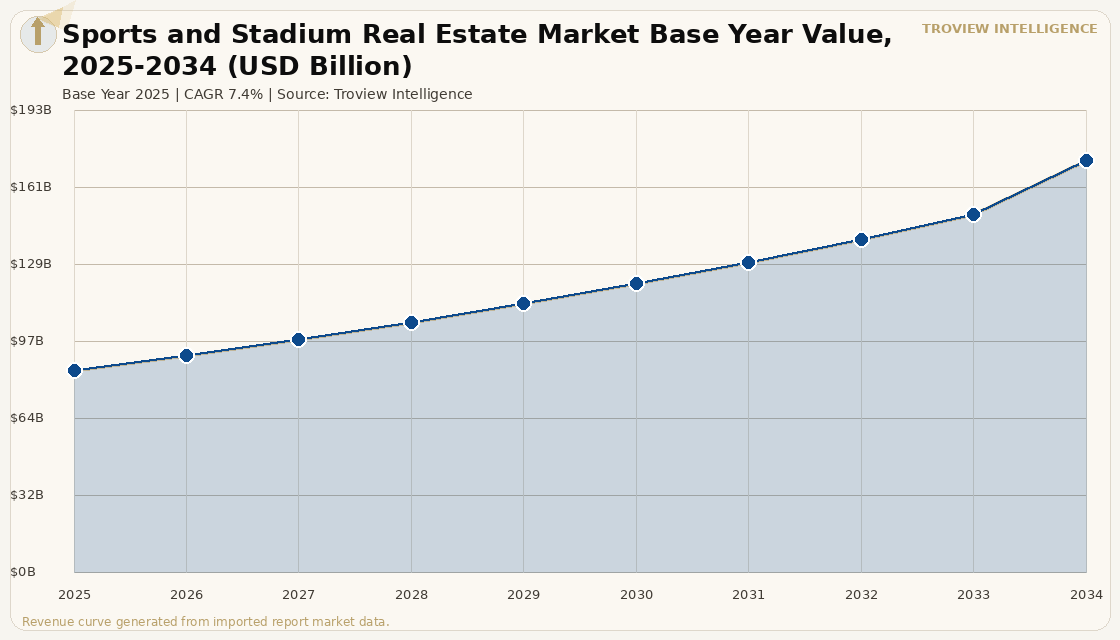
The global sports and stadium real estate market size was USD 84.62 Billion in 2025 and is expected to register a revenue CAGR of 7.4% during the forecast period, reaching USD 172.38 Billion by 2034. The global sports and stadium real estate market encompasses the construction, ownership, management, renovation, and investment in stadium venues, multi-purpose arena complexes, professional sports training facilities, stadium-anchored mixed-use real estate developments, and the smart technology infrastructure that enables next-generation fan experiences and revenue optimisation across major sports venues worldwide. The global sports buildings market was valued at USD 182.91 Billion in 2024 and grew to USD 194.37 Billion in 2025 at a CAGR of 6.3%, projected to grow to USD 246.04 Billion by 2029 at a 6.1% CAGR per verified sports buildings market data, driven by increasing sports tourism, emphasis on health and wellness, public-private partnerships in stadium development, and the growing popularity of professional sports leagues that demand state-of-the-art venues for broadcast, sponsorship, and premium hospitality revenue generation. The global stadium construction market was valued at USD 20 Billion in 2025 and is projected to expand at a CAGR of 8% to reach USD 32 Billion by 2033 per Future Data Stats verified market data. The global smart stadium market was estimated at USD 18.09 Billion in 2024 and is projected to reach USD 39.55 Billion by 2030 at a CAGR of 14.4% per verified smart stadium market data, with North America dominating with over 33% revenue share in 2024. The 2025 market estimate is grounded in verified project and transaction data: Kiewit Corporation won the bid for the Kansas City Royals' new USD 2 Billion ballpark in September 2024, AECOM sold its sports venue division to WSP Global for USD 250 Million in August 2024, and in April 2026 the Kansas City Chiefs announced a USD 3 Billion domed stadium in Kansas City, Kansas, with Kansas lawmakers approving USD 2.40 Billion in state bonds covering approximately 60% of stadium, training facility, and retail and entertainment space costs per verified ESPN reporting. These are some of the key factors driving revenue growth of the market.
North America dominated the global sports and stadium real estate market in 2025, with the United States hosting the most concentrated pipeline of large-scale stadium development of any global region: Buffalo Bills' New Highmark Stadium in Orchard Park New York slated to open for the 2026 NFL season, the new Tennessee Titans Nissan Stadium in Nashville with a 70,000-seat capacity and retractable roof targeting a 2028 opening, the Cleveland Browns' USD 2.40 Billion domed stadium in Brook Park targeting 2029, the new Washington Commanders Stadium planned for 2030, and the Oakland Athletics' Las Vegas ballpark that broke ground in May 2025 with foundation and structural work progressing toward a 2028 completion per Stadium Sport US and Wikipedia verified data. The Sports Events and Tourism Association, a US-based non-profit trade association, reported a 7% increase in sports tourism traveller volume in 2023 versus 2022, confirming the sustainable demand-side driver for stadium real estate investment that extends beyond single-team franchise economics to the broader sports tourism and event hosting opportunity per verified sports buildings market data. Europe's smart stadium market was valued at USD 4.0 Billion in 2025, with Europe dominating the global smart stadium market with a 41.9% share per verified smart stadium market analysis, supported by stadium technology investment driven by UEFA Champions League, FIFA World Cup 2026 preparation, and the Olympic infrastructure legacy cycles including Paris 2024.
However, the global sports and stadium real estate market faces structural constraints that limit the pace of project delivery and revenue realisation. The Iran-US geopolitical tensions and resulting Strait of Hormuz disruptions, confirmed by the IMF in March 2026 to affect approximately 20% of global seaborne oil and LNG flows, are generating materials and energy cost inflation that increases stadium construction and renovation costs at a time when multiple large-scale North American and European stadium projects are in active construction phases with fixed-price contracts that expose developers to materials cost overruns. High initial construction costs are a structural barrier to stadium real estate development at scale: with North American professional sports stadiums routinely exceeding USD 2 Billion in total project cost, the financing structures required combining public bond issuance, private team owner equity, naming rights, seat licence sales, and stadium district tax increment financing are complex, politically contentious, and frequently the subject of public ballot referendum challenges, as the Kansas City Royals' proposal demonstrated when its Jackson County funding referendum was rejected by voters on 2 April 2024 per Wikipedia verified New Kansas City Royals Stadium data. The integration of smart stadium technologies including IoT sensor networks, 5G-enabled distributed antenna systems, AI-powered crowd analytics, and augmented reality fan experience platforms involves substantial capital investment that must be amortised against annual event day revenue at stadiums that operate at full capacity for only 8 to 16 NFL or soccer matches per year, limiting the revenue available to service smart technology capital costs. These factors substantially limit global sports and stadium real estate market growth over the forecast period.
The sports and stadium real estate market in 2025 is experiencing a capital investment wave that has not been seen since the stadium construction boom of the 1990s. The difference this time is scale, sophistication, and the revenue model: modern stadiums are no longer built to host 10 NFL games per year. They are built to be 365-day-per-year entertainment destinations that host concerts, corporate events, esports tournaments, religious gatherings, and political conventions in the same facility that hosts Sunday football. Allegiant Stadium in Las Vegas which maintains its position as the top-grossing US stadium for two consecutive years according to Billboard Magazine 2025 data is the proof of concept for this model: a USD 1.97 Billion investment that generates revenue year-round from the Las Vegas Strip entertainment ecosystem rather than depending solely on Raiders game days. The Kansas City Chiefs' USD 3 Billion domed stadium announcement with Kansas state bond financing confirms that the public-private partnership model for elite stadium development is not going away. The smart technology integration 5G DAS systems, 1,700 Wi-Fi access points, AI crowd analytics is becoming the table stakes for new stadium construction at professional league standard because these systems directly enable premium pricing through enhanced experiences and real-time dynamic pricing of parking, concessions, and seat upgrades that add material incremental revenue to each event day." Troview Intelligence Head of Global Sports and Stadium Real Estate Research
SEGMENT INSIGHTS
By Facility Type
Multi-purpose stadium and arena facility type is expected to account for a significantly large revenue share in the global sports and stadium real estate market during the forecast period.
Based on facility type, the global sports and stadium real estate market is segmented into multi-purpose stadiums and arenas hosting sports and entertainment events, single-sport dedicated stadiums including NFL domes and baseball parks, indoor arenas and pavilions for basketball, hockey, and esports, training facility complexes and performance centres, stadium-anchored mixed-use real estate developments with residential, hotel, and retail components, and minor and community-level sports facility complexes. Multi-purpose venues dominate the stadium real estate market by investment scale, with modern NFL and soccer stadiums routinely designed to accommodate concerts, award shows, religious events, and corporate meetings that collectively generate more event-day revenue days than the sport anchor tenant alone. Stadium-anchored mixed-use real estate developments are expected to register a rapid revenue growth rate in the global market over the forecast period, as stadium districts increasingly incorporate residential, hotel, office, and retail components that generate year-round real estate value independent of stadium occupancy and provide the financial returns that justify the USD 2 Billion to USD 3 Billion total project costs of next-generation professional sports venues.
By Revenue Model
Premium hospitality and naming rights revenue model is expected to account for a significantly large revenue share in the global sports and stadium real estate market during the forecast period.
Based on revenue model, the global sports and stadium real estate market is segmented into premium hospitality through luxury suites, club seats, and VIP event packages; naming rights and venue sponsorship; broadcast and media rights venue hosting fees; general admission ticketing and concession revenue; parking and ancillary services; and mixed-use real estate rental income from adjacent development. Premium hospitality and naming rights dominate stadium revenue generation per event day, with Allegiant Stadium's 140 luxury suites and comprehensive premium space offering enabling its position as Billboard Magazine's highest-grossing US stadium for two consecutive years per HNTB verified project data. Smart technology concession and parking optimisation is expected to register a rapid revenue growth rate in the global market over the forecast period, as AI-powered dynamic pricing platforms integrating demand forecasting, weather data, team performance, and competitor event schedules optimise concession and parking revenue per attendee in real time, generating incremental annual revenue per stadium that can reach USD 5 Million to USD 15 Million at large-capacity venues.
By Technology
5G and distributed antenna system connectivity technology is expected to account for a significantly large revenue share in the global sports and stadium real estate market during the forecast period.
Based on technology, the global sports and stadium real estate market is segmented into 5G and distributed antenna system connectivity infrastructure, IoT-enabled sensor networks for crowd management and energy efficiency, AI-powered analytics for operations and fan personalisation, cashless and contactless payment systems, AR and VR fan experience platforms, and biometric security and access systems. 5G DAS connectivity dominates smart stadium infrastructure investment by capital expenditure, with Allegiant Stadium deploying 1,700 Wi-Fi access points, 227 miles of fibre and copper connectivity, and 5G coverage throughout its 1.8 million square foot facility per Mortenson verified project data. AI-powered analytics is expected to register a rapid revenue growth rate in the global market over the forecast period, with stadiums deploying AI-driven platforms that enable personalised notifications, real-time seat upgrade offers, predictive crowd management, and automated operations scheduling that reduce labour costs and increase per-visitor revenue simultaneously.
REGIONAL ANALYSIS
NORTH AMERICA
| Active NFL Stadium Projects | Chiefs Dome Cost (Kansas) | Las Vegas Athletics Stadium | Sports Tourism Growth (2023 vs 2022) |
| 4+ projects underway or approved | USD 3 Billion USD 2.4B Kansas state bonds | Broke ground May 2025 2028 target opening | 7% increase in traveller volume (SETA) |
North America is the global sports and stadium real estate market leader, hosting the world's most intensive professional sports stadium investment pipeline across the NFL, MLB, NBA, and NHL. The Kansas City Chiefs announced a USD 3 Billion domed stadium in Kansas City, Kansas in April 2026, with Kansas lawmakers approving more than USD 2.40 Billion in state bonds covering approximately 60% of stadium, training facility, and retail and entertainment space costs, with the facility designed as an enclosed dome targeting Super Bowl, Final Four, College Football Playoff, and bowl game hosting per ESPN verified reporting of 24 April 2026. Buffalo Bills' New Highmark Stadium in Orchard Park, New York is under active construction by Populous for a 2026 NFL season opening. The Tennessee Titans' new Nissan Stadium in Nashville designed by Manica targets a 70,000-seat capacity with a retractable roof and mixed-use development, beginning construction in 2025 targeting 2028 opening. The Oakland Athletics' Las Vegas ballpark broke ground in May 2025 on the former Tropicana Hotel site, with foundation, elevator cores, and structural work progressing toward a 2028 completion, co-developed with three 495-foot hotel towers and adjacent casino resort per Wikipedia New Las Vegas Stadium verified data. In September 2024, Kiewit Corporation won the bid for the Kansas City Royals' new USD 2 Billion ballpark, with the project subsequently pivoting to a Crown Center location per New Kansas City Royals Stadium verified Wikipedia data.
EUROPE
| Europe Smart Stadium Share (2025) | Europe Smart Stadium Market Value | Paris 2024 Budget | Stade de France NFL 2026 Game |
| 41.9% of global smart stadium market | USD 4.0 Billion in 2025 | USD 4.74 Billion 'build less, better, usefully' | First NFL regular-season game in France 2026 (New Orleans Saints vs Pittsburgh Steelers) |
Europe dominates the global smart stadium technology market with a 41.9% share valued at USD 4.0 Billion in 2025 per verified smart stadium market data, reflecting the continent's extensive soccer stadium modernisation investment driven by UEFA Champions League, Europa League, and national federation requirements. The Paris 2024 Summer Olympics delivered within a USD 4.74 Billion budget by adopting a strategy of building less, better, and usefully relying on existing structures, temporary pavilions, and urban interventions tied to pre-existing development plans rather than the greenfield stadium construction that generated multibillion-dollar debt for Beijing, Sochi, and Tokyo per Metropolis Magazine verified reporting. France's Stade de France the largest capacity stadium in France at 80,000 seats underwent Olympic renovation including 650 LED installations reducing energy requirements by 80%, 5G connectivity through Orange infrastructure, renewable electricity supply through EDF exclusively for Games and legacy events, and a new 14,000 square metre athletics track to World Athletics Type 1 classification standard per Paris 2024 official Olympics reporting. In 2026, the National Football League will host the first regular-season game in France at the Stade de France with the New Orleans Saints as the home team and the Pittsburgh Steelers as the visiting team per Wikipedia Stade de France verified data, extending the venue's major event calendar and confirming France as a priority NFL international series market.
ASIA PACIFIC HIGHEST SMART STADIUM CAGR
| APAC Smart Stadium CAGR (to 2030) | FIFA World Cup 2034 | China Investment | Japan Innovation |
| Over 15% highest global CAGR | Saudi Arabia new installation smart tech demand | Government investing in smart stadium technology | Robotics, automation, cashless, sustainability |
Asia Pacific is expected to grow at the highest CAGR of over 15% in the global smart stadium market from 2025 to 2030 per verified smart stadium market data, driven by increasing government investments in digital infrastructure, the adoption of advanced technologies including facial recognition, cashless payments, interactive displays, and high-speed 5G networks that are being applied to stadium environments ahead of major events including the FIFA World Cup 2034 in Saudi Arabia. China's government is investing in sports infrastructure including smart stadium technologies to promote sports tourism and host international events, with the Tokyo 2020 Olympics held in Japan having accelerated the adoption of smart technologies across Japanese sports venues including robotics for cleaning and maintenance, cashless payment and digital ticketing systems, and smart energy systems with eco-friendly materials that are now being adopted as standard specifications for new stadium construction in Japan and South Korea. The FIFA World Cup 2034 in Saudi Arabia is generating one of the largest single-cycle stadium construction investment pipelines in global sporting history, requiring multiple new stadium constructions across the Kingdom that represent a combined multi-billion-dollar smart venue investment anchoring Asia Pacific's smart stadium market growth per verified market data.