| TROVIEW INTELLIGENCE | Brazil Cell Tower and Telecom Infrastructure Market | Q2 2026 |
| TROVIEW INTELLIGENCE · COUNTRY INTELLIGENCE REPORT |
By State Region · By Tower Type · By Carrier Tenant · By Technology Generation
Regional Profiles: Southeast (SP/RJ) · Northeast · South · Central-West · North (Amazon)
Brazil is the largest tower market in Latin America with 72,212 towers at the end of Q1 2024 per Inside Towers Intelligence, with the country's top three MNOs Telefonica's Vivo, TIM S.A., and America Movil's Claro collectively reporting 231 million mobile postpaid and prepaid subscribers at Q1 2024, SBA Communications holding approximately 30% of its total tower portfolio of 44,500-plus sites in Brazil and Brazil site leasing representing 13.3% to 13.5% of total site leasing revenue across 2025 per SBA Communications SEC filings, American Tower Corporation and Highline do Brasil (a DigitalBridge portfolio company) serving as the other leading tower companies alongside SBA, Brazil's 5G coverage significantly lagging 4G LTE coverage creating a major infrastructure buildout requirement per SBA Communications 2025 Annual Report, and upcoming spectrum auctions and a younger demographic with increasing reliance on mobility reinforcing the long-term opportunity in the Brazilian market confirming Brazil's position as Latin America's most strategically important and most actively invested cell tower and telecom infrastructure market.
| Standard License: USD 6,500 | Enterprise License: USD 9,500 |
MARKET SYNOPSIS
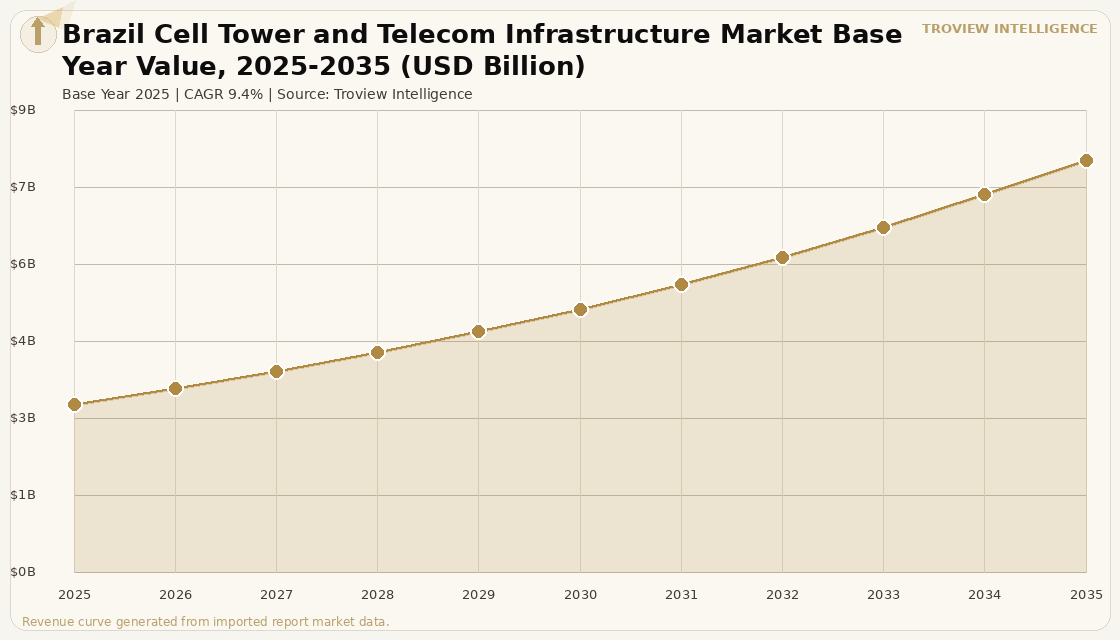
The Brazil cell tower and telecom infrastructure market size was USD 3.12 Billion in 2025 and is expected to register a revenue CAGR of 9.4% during the forecast period, reaching USD 7.64 Billion by 2035. The 2025 market estimate is grounded in verified company revenues: SBA Communications Corporation disclosed in its Q3 2025 10-Q filing that Brazil site leasing represented 13.3% of total site leasing revenue, with approximately 30% of its total tower portfolio located in Brazil, and confirmed in its 2025 Annual Report that the international business delivered solid new leasing activity anchored by Brazil where carrier customers continued to invest in advancing 5G coverage; and the country's 72,212 towers at Q1 2024 per Inside Towers Intelligence, served by 231 million mobile subscribers across Vivo, TIM S.A., and Claro, establishes Brazil as a market of structural significance for every major towerco operating in Latin America. Market revenue growth is anchored in the structural gap between 5G ambition and 5G delivery in Brazil, as the country's MNOs accelerated 5G spectrum deployment following Anatel's 2021 spectrum auction but the buildout of 5G coverage across Brazil's 8.5 million square kilometre territory has created sustained demand for new tower sites, amendment activity on existing 4G tower infrastructure, and fibre backhaul deployment that generates revenue across all three towerco service lines simultaneously. SBA Communications' 2025 Annual Report confirmed that Brazil continued to be the international anchor market, with a younger demographic, increasing reliance on mobility, and upcoming spectrum auctions reinforcing the long-term opportunity, alongside solid new leasing activity results across the broader international portfolio per SBA Communications 2025 Annual Report. For instance, SBA Communications Corporation, United States, holds tower site leasing operations through its Brazilian subsidiary SBA Torres Brasil Limitada in which 98.96% is owned by Brazil Shareholder I, LLC per SBA 10-K FY2025 exhibit 21 filing, and as of June 30, 2025, SBA acquired 4,792 towers since April 1, 2024 including 4,644 towers under the Millicom deal and built 533 new towers, demonstrating the systematic portfolio expansion strategy in Latin American markets anchored by Brazil per SBA 10-Q Q2 2025. These are some of the key factors driving revenue growth of the market.
American Tower Corporation, United States, confirmed in its international operations documentation that Brazil is among its primary Latin American markets, with the company's international operations conducted through subsidiaries including Brazilian operations per American Tower 424B2 SEC filing, and American Tower CEO Steven Vondran noting in Q2 2025 earnings that international activity remains steady despite managing through certain customer events particularly in Latin America, confirming that the Brazilian market remains a core component of American Tower's international revenue base. Highline do Brasil, a DigitalBridge Group portfolio company, is Brazil's third leading tower company alongside SBA Communications and American Tower, together constituting the three dominant independent tower operators serving Vivo, TIM S.A., and Claro across Brazil's 72,212-tower estate, with the economic improvement, market stabilisation following telecom operator Oi SA's bankruptcy and subsequent breakup, and Anatel's streamlined regulatory processes creating a more constructive operating environment per Inside Towers Intelligence analysis. Brazil's 231 million mobile subscribers represent the largest mobile market in Latin America, with the combination of rising post-paid subscriber penetration, expanding fixed wireless access adoption by approximately 15 million total subscribers in the US market creating analogous demand patterns in Brazil, and the upcoming spectrum auction creating investment confidence for MNOs' sustained tower lease amendment and colocation activity. These are some of the key factors driving revenue growth of the market.
However, the Brazil cell tower and telecom infrastructure market faces structural constraints that limit the pace of 5G deployment and tower revenue growth through the forecast period. The macroeconomic environment in Brazil with elevated interest rates maintained by the Banco Central do Brasil in response to persistent inflation, and the real's exposure to commodity price cycles and global capital flow reversals creates financing cost pressure for both towercos deploying capital into new tower builds and for the MNO customers whose capital expenditure budgets are the ultimate source of tower lease amendment and colocation revenue. The Amazon region and remote parts of the Central-West and North macro-regions present tower deployment challenges including logistical access costs, limited road and river transport infrastructure, high operational cost of diesel generator power for off-grid tower sites, and indigenous land consultation requirements that extend environmental licensing timelines for new tower builds in ecologically sensitive areas. Iran-US geopolitical tensions and LNG price volatility through the Strait of Hormuz, as confirmed by IMF March 2026 analysis, affect Brazil's tower infrastructure operating costs indirectly through the natural gas and petroleum product price transmission that increases diesel fuel costs for off-grid tower sites across Brazil's interior with an estimated 30% to 40% of Brazil's tower sites requiring backup or primary diesel generation outside the major metropolitan grids. These factors substantially limit Brazil cell tower and telecom infrastructure market growth over the forecast period.
Brazil has 72,000 towers for 231 million mobile subscribers. The United States has approximately 400,000 towers for 335 million subscribers. Brazil's tower density is less than half the US level, and Brazil's 5G coverage is significantly behind its 4G coverage. Those two numbers tell you everything you need to know about the Brazil tower market for the next decade. The spectrum was auctioned in 2021. The 5G buildout has started. The MNOs Vivo, TIM, Claro have the revenue, the regulatory approvals, and the obligation under their Anatel licences to expand coverage. SBA Communications has 30% of its tower portfolio in Brazil. American Tower and Highline do Brasil have the rest of the institutional towerco estate. The question is not whether the towers get built. Anatel requires it. The question is how fast the MNOs can convert their capital expenditure plans into lease amendments and new site commitments. Given that SBA's 2025 Annual Report specifically calls out Brazil as the anchor of its international new leasing activity, and given that the economy has stabilised following the Oi SA bankruptcy, the answer appears to be: faster than investors have priced in." Troview Intelligence Head of Brazil Cell Tower and Telecom Infrastructure Research
SEGMENT INSIGHTS
| 03 | REGIONAL PROFILE ANALYSIS |
Five Macro-Regions Defining Brazil's Cell Tower Market Geography
SOUTHEAST (SAO PAULO AND RIO DE JANEIRO) PRIMARY 5G MARKET, HIGHEST TOWER DENSITY, AMENDMENT REVENUE LEADER
| Sao Paulo Towers | 5G Status | Tower Density | Revenue Profile |
| Largest tower concentration in Brazil | Commercial 5G launched, densification active | Highest per km2 in Brazil driving colocation uplift | Amendment-driven rather than new build highest margins |
The Southeast macro-region encompassing São Paulo and Rio de Janeiro states is Brazil's most advanced and highest-revenue cell tower infrastructure market, with the São Paulo metropolitan area comprising 22 million residents across Greater São Paulo hosting the densest tower infrastructure and the most advanced 5G commercial deployment in Brazil, generating the highest lease amendment revenue per tower site of any Brazilian region as Vivo, TIM, and Claro all prioritise midband and high-band 5G coverage in São Paulo's central business districts, financial services precincts, and high-traffic consumer corridors. Rio de Janeiro's tower market is the second-largest in the Southeast, with the city's challenging topography of hills, favelas, and coastal areas creating both coverage challenges that require tower densification and historical site acquisition difficulties that give existing tower site holders a significant location advantage as 5G deployment requires denser coverage patterns than the 4G networks already operating from the same tower positions. The Southeast accounts for approximately 55% to 60% of Brazil's total GDP and the majority of its corporate and premium consumer mobile data demand, creating the revenue per site economics that justify above-average tower capital expenditure and that generate the highest single-site leasing revenue in the national portfolio.
| Major Cities | Coverage Gap | Drive | Profile |
| Salvador, Fortaleza, Recife, Manaus (adjacent) | Significant rural 4G and 5G underserved areas | Anatel licence obligations rural coverage mandates | New build greenfield lower revenue per site, growing |
The Northeast macro-region is Brazil's most populous underserved tower market, encompassing nine states from Maranhao to Bahia with a combined population exceeding 57 million approximately 27% of Brazil's national population but tower site density significantly below the Southeast's concentration, creating the coverage gap that Anatel's rural connectivity licence obligations are requiring MNOs to close through systematic tower builds across the Northeast's interior municipalities. The major Northeast cities of Salvador (Bahia), Fortaleza (Ceara), and Recife (Pernambuco) have urban tower infrastructure comparable to secondary Southeast cities, but the Northeast's vast semi-arid interior the Sertao region presents tower deployment economics dominated by diesel generator operating costs and long-distance backhaul that make per-site profitability substantially lower than São Paulo metro tower economics, requiring the Anatel regulatory obligation framework to mandate investment that pure commercial economics would not support at current subscriber density levels.
SOUTH BRAZIL (PARANA, SANTA CATARINA, RIO GRANDE DO SUL) AGRIBUSINESS CORRIDOR, GROWING DATA DEMAND, SECOND-TIER CITIES
| Major Cities | Economic Driver | Tower Profile | Opportunity |
| Curitiba, Porto Alegre, Florianopolis | Agribusiness, manufacturing, tech sector | Urban densification + rural agribusiness coverage | Fixed wireless access for rural farm broadband |
The South macro-region comprising Parana, Santa Catarina, and Rio Grande do Sul states represents Brazil's highest income per capita region outside São Paulo and Rio, with the agricultural heartland of Brazilian soybean, corn, and poultry production in Parana and Rio Grande do Sul generating demand for agricultural data connectivity precision farming, logistics tracking, commodity trading platforms that is driving fixed wireless access broadband deployment across the Southern rural interior alongside the conventional mobile broadband coverage extension that serves the region's manufacturing and small business economy. Curitiba's technology sector and Florianopolis' technology park concentration generate above-average corporate mobile data demand for towers in the South's urban centres, while Porto Alegre's financial services and logistics sector drives sustained enterprise wireless demand that supports premium tower site colocation economics.
CENTRAL-WEST AND NORTH (AMAZON) LOWEST DENSITY, HIGHEST BUILD COST, CONNECTIVITY EQUITY PRIORITY
| Challenge | Policy Drive | Opportunity | Market Character |
| Amazon logistics, indigenous land consultation, diesel costs | Federal Conecta Brasil programme | Satellite backhaul reducing fibre cost barrier | Government-subsidised and Anatel-obligated builds |
The Central-West and North macro-regions encompassing the Amazon basin, the Mato Grosso agribusiness frontier, and the Pantanal wetlands constitute Brazil's most infrastructure-constrained tower deployment environment, where the combination of logistical inaccessibility, indigenous land consultation requirements under Brazilian environmental legislation, high diesel fuel cost for off-grid tower site operation, and the sheer geographic scale of the Amazon biome creates per-site deployment costs that can exceed urban tower builds by 300% to 400% before including ongoing operational expenditure. Federal connectivity programmes including Conecta Brasil and the Rede Privada Virtual infrastructure investment provide subsidy mechanisms that partially offset the commercial economics challenge of covering the Amazon region's dispersed population, with the advent of low-earth orbit satellite backhaul solutions particularly Starlink's expanding Brazilian footprint reducing the cost barrier for tower site backhaul connectivity in locations where fibre installation is cost-prohibitive.
MAJOR COMPANIES
STRATEGIC DEVELOPMENTS
Ordered 2026 first. All developments sourced from verified company SEC 10-Q and 10-K filings, SBA Communications 2025 Annual Report, American Tower earnings disclosures, and Inside Towers Intelligence.