By Asset · By District · By Operator · By Tenant Mix
Mumbai houses India's two largest luxury retail destinations Jio World Plaza at 750,000 square feet in Bandra Kurla Complex with 66 brands including India's largest Louis Vuitton store, and Galeries Lafayette Fort Mumbai at 90,000 square feet housing over 250 luxury and designer brands, which opened in November 2025 as base rents at Palladium average INR 433 per square foot per month with effective rates above INR 600 for top performers, and global luxury brand executives describe Mumbai as the only Indian city capable of sustaining a world-class luxury retail environment at scale.
MARKET SYNOPSIS
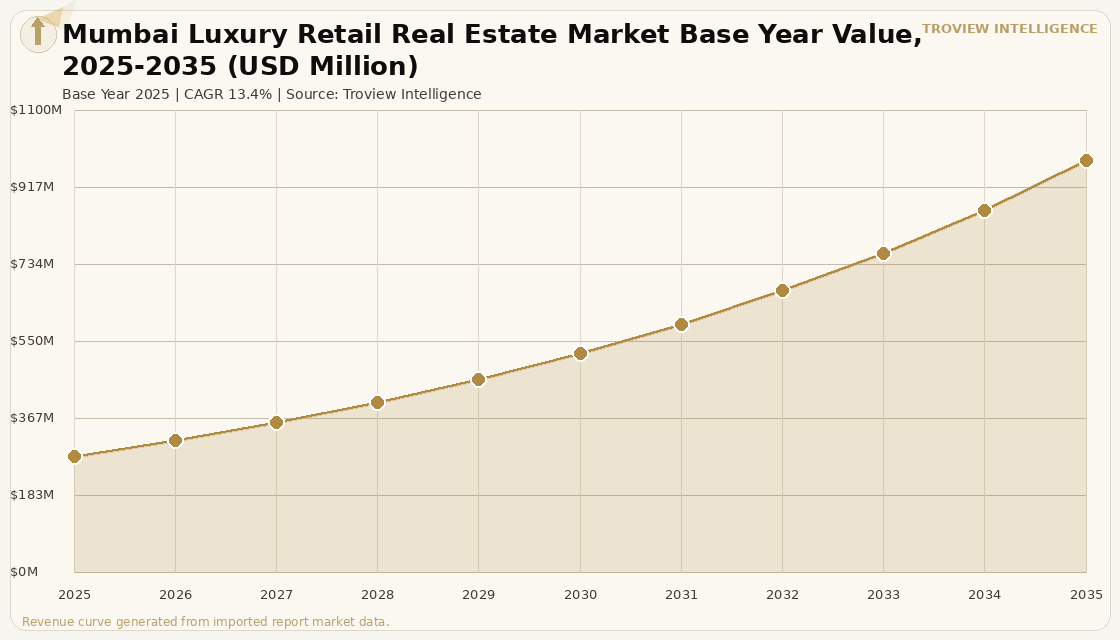
The Mumbai luxury retail real estate market size was USD 278.6 Million in 2025 and is expected to register a revenue CAGR of 13.4% during the forecast period, reaching USD 982.4 Million by 2035. Mumbai is India's primary luxury retail real estate market, housing the country's two largest luxury retail destinations and accounting for approximately 47% of India's total luxury retail real estate market revenue in 2025. Jio World Plaza, owned by Reliance Industries and located in the Bandra Kurla Complex, spans 750,000 square feet across four levels, houses 66 luxury brands including India's largest Louis Vuitton store and Dior's first Indian menswear outlet, and functions as the centrepiece of the Jio World Centre district alongside the Nita Mukesh Ambani Cultural Centre, Jio World Convention Centre, and Jio World Garden. Galeries Lafayette opened its first India flagship in Mumbai's historic Fort area in November 2025, a five-floor 90,000 square foot store housing over 250 luxury and designer brands in partnership with Aditya Birla Fashion and Retail Limited. Palladium at High Street Phoenix in Lower Parel operates with base rents averaging INR 433 per square foot per month, with effective rents above INR 600 per square foot per month for top-performing tenants per market data.
Mumbai's luxury retail real estate market is anchored by the intersection of the city's financial sector wealth India's largest concentration of private equity, investment banking, and corporate headquarters employment with the film and entertainment industry's celebrity consumption culture that creates visibility and aspiration for luxury brands across a national audience. Reliance Industries' decision to anchor Jio World Plaza with a cultural district the NMACC has hosted world-renowned productions including Mamma Mia and West Side Story creates the experiential context that global luxury brands require to sustain the dwell time and social occasion that premium retail needs. The historic Fort area, Mumbai's colonial-era commercial district near Chhatrapati Shivaji Maharaj Terminus, is emerging as a second luxury retail zone through the Galeries Lafayette opening, a pattern consistent with global luxury expansion into heritage commercial districts in other markets where premium rents on primary luxury streets have driven exploration of adjacent heritage corridors. For instance, in November 2025, Galeries Lafayette Group, France, opened its first India store in Mumbai Fort, housing over 250 luxury and designer brands across 90,000 square feet in partnership with Aditya Birla Fashion and Retail Limited, with Kumar Mangalam Birla, chairman of Aditya Birla Group, noting that the appetite for high-end experiences in India has never been stronger, per Reuters and AFP reporting of November 2025. These are some of the key factors driving revenue growth of the market.
However, the Mumbai luxury retail real estate market faces structural constraints. Market saturation risk at Mumbai's luxury retail in terms of the high-income consumer base that reliably converts luxury footfall into purchases is real, as the city's addressable luxury spending base while growing is concentrated among a relatively small number of ultra-high-net-worth families, corporate leaders, and entertainment sector figures whose spending can be impacted by broader economic sentiment. Elevated rental costs at Mumbai's premium luxury destinations, particularly Jio World Plaza's BKC location where commercial real estate rents are among the highest in India, may deter emerging or mid-tier luxury brands from entering and create a ceiling on the tenant mix diversity that a fully rounded luxury retail destination requires. Traffic congestion at both the BKC district and the Lower Parel Palladium location creates friction for casual luxury shoppers, though dedicated parking and valet services mitigate the impact for committed visits. These factors substantially limit Mumbai luxury retail real estate market growth over the forecast period.
Mumbai's luxury retail market has been waiting for Jio World Plaza for twenty years. Before it opened, the choice for a luxury brand wanting to be in India was either DLF Emporio in Delhi or a hotel boutique at the Taj Mahal Hotel. Now Mumbai has a genuine luxury destination but only one. Galeries Lafayette Fort is a different concept: a multi-brand department store in a heritage building, not a purpose-built luxury mall. Both are needed. The question for Mumbai's next decade is whether Reliance, Phoenix Mills, and potentially new developers will build the second and third genuine luxury malls that will unlock the next wave of brand entries the DLF management team says are waiting. The brands are there. The consumers are there. The infrastructure is not. Yet." Troview Intelligence Head of Mumbai Luxury Retail Research
SEGMENT INSIGHTS
By Asset Type
Purpose-built luxury malls are expected to account for a significantly large revenue share in the Mumbai luxury retail real estate market during the forecast period.
Based on asset type, the Mumbai luxury retail real estate market is segmented into purpose-built luxury malls, multi-brand luxury department stores in heritage buildings, premium mall luxury floors, five-star hotel boutique retail, and standalone brand flagship stores. Purpose-built luxury malls dominate market revenue, with Jio World Plaza at 750,000 square feet generating the highest per-asset luxury retail revenue in India. Multi-brand luxury department stores in heritage buildings represent a new segment launched by Galeries Lafayette's Fort Mumbai opening in November 2025, offering a different retail environment from the purpose-built luxury mall: older architecture, street-level access from a heritage commercial district, and a multi-brand department store curation model rather than a branded boutique-within-a-mall format. Five-star hotel boutique retail, historically the primary luxury access point in India before dedicated luxury malls were built, continues to serve the luxury tourism segment at properties including the Taj Mahal Palace, Four Seasons, and Trident.
By District
Bandra Kurla Complex is expected to account for a significantly large revenue share in the Mumbai luxury retail real estate market during the forecast period.
Based on district, the Mumbai luxury retail real estate market is segmented into Bandra Kurla Complex, Lower Parel-Worli, Fort-Churchgate heritage district, South Mumbai hotels and standalone luxury, and Juhu-Andheri-Santacruz premium retail. Bandra Kurla Complex dominates, housing Jio World Plaza and serving as Mumbai's primary corporate address for financial services, consulting, and multinational companies whose senior employees represent the primary sustained domestic luxury spending base. Lower Parel-Worli, anchored by the Palladium at High Street Phoenix, serves the South and Central Mumbai affluent catchment of high-income professionals, executives, and entertainment industry figures. Fort-Churchgate, historically Mumbai's most important commercial district, is re-emerging as a luxury retail zone through the Galeries Lafayette opening and the broader commercial regeneration of the heritage business district.
By Luxury Category
Fashion, accessories, and jewellery are expected to account for a significantly large revenue share in the Mumbai luxury retail real estate market during the forecast period.
Based on luxury category, the Mumbai luxury retail real estate market is segmented into fashion and accessories, jewellery and watches, beauty and fragrance, luxury hospitality and dining, and home and lifestyle luxury. Fashion and accessories dominates luxury real estate space allocation, with international brands including Louis Vuitton, Gucci, Dior, Saint Laurent, and Valentino anchoring the largest boutique footprints at Jio World Plaza and Palladium. Jewellery and watches is the fastest-growing segment in India's luxury market, as hard luxury categories are relatively less impacted by cultural competition from Indian wedding couture that affects the fashion category, with Cartier, Bulgari, and Tiffany having all established Mumbai presences. Indian designer fashion Sabyasachi, Manish Malhotra, Abu Jani Sandeep Khosla, and Rahul Mishra among the designers present at Jio World Plaza is a distinctive feature of India's luxury retail real estate mix that has no equivalent in any other major luxury market globally.
ASSET DEEP-DIVES
Mumbai's Luxury Retail Destinations
JIO WORLD PLAZA (BANDRA KURLA COMPLEX) INDIA'S LARGEST LUXURY MALL
| Scale | 750,000 sq ft, 4 levels, 66 luxury brands | Key Brands | India's largest LV store, Dior menswear, Balenciaga, Valentino, Cartier, Gucci |
| Cultural Integration | Nita Mukesh Ambani Cultural Centre, Jio World Convention Centre adjacent | Developer | Reliance Industries, USD 1 billion+ Jio World Centre total cost |
Jio World Plaza is India's largest luxury retail destination, spanning 750,000 square feet across four levels in Mumbai's Bandra Kurla Complex and housing 66 luxury brands including Louis Vuitton, Gucci, Cartier, Bally, Dior, and Bulgari alongside first-India market entries including Balenciaga, Valentino, Rimowa, YSL, Tory Burch, and Tiffany. The plaza features India's largest Louis Vuitton store and Dior's first Indian menswear outlet. It integrates seamlessly with the Nita Mukesh Ambani Cultural Centre, which has hosted productions including Mamma Mia and West Side Story, creating the cultural destination context that positions Jio World Plaza as an occasion-based luxury lifestyle visit rather than a routine shopping trip. Indian designer houses including Manish Malhotra, Abu Jani Sandeep Khosla, Rahul Mishra, Falguni and Shane Peacock, and Ri by Ritu Kumar are present alongside international luxury brands, creating a unique Indian luxury retail environment that reflects the domestic luxury fashion culture alongside global brand presence.
| Scale | 90,000 sq ft (8,300 m²), 5 floors, 250+ luxury and designer brands | Location | Historic Fort neighbourhood, Mumbai's colonial commercial district |
| Developer | Aditya Birla Fashion and Retail Limited (ABFRL) | Opening | November 2025 (first India, planned second in Delhi) |
Galeries Lafayette's November 2025 Fort Mumbai opening represents a structurally different luxury retail format from Jio World Plaza: a 130-year-old Parisian multi-brand luxury department store model adapted to a heritage building in Mumbai's historic Fort commercial district, housing over 250 luxury and designer brands across five floors with private lounges and concierge services. The partnership between Galeries Lafayette Group and Aditya Birla Fashion and Retail Limited India's largest fashion retail conglomerate provides the local market knowledge and regulatory navigation that international luxury entrants to India have historically required. The Fort location places the store within walking distance of Chhatrapati Shivaji Maharaj Terminus and the Mumbai High Court, in a neighbourhood that serves business district workers and tourists rather than the corporate and residential catchment of BKC. The store's opening was described by Comite Colbert CEO Benedicte Epinay as an important step for international luxury in India while characterising the market as promising but complicated.
PALLADIUM AT HIGH STREET PHOENIX (LOWER PAREL) PREMIUM ASPIRATIONAL ANCHOR
| Rents | Base INR 433/sq ft/month; effective INR 600+ for top performers | Catchment | South and Central Mumbai, Lower Parel-Worli corporate and residential |
| Format | Premium aspirational mall rather than pure luxury; broader brand mix | Position | Primary luxury access point prior to Jio World Plaza opening |
Palladium at High Street Phoenix in Lower Parel is Mumbai's original premium aspirational mall, historically serving as the primary access point for international luxury brands before Jio World Plaza raised the format standard. The mall draws from an affluent catchment encompassing South and Central Mumbai including high-income professionals from Lower Parel's corporate park cluster, executives from Worli and Bandra's residential areas, and entertainment industry figures. Base rents averaging INR 433 per square foot per month with effective rents above INR 600 for top-performing tenants confirm its position as a premium leasing environment. The opening of Jio World Plaza has intensified competitive pressure on Palladium for the top tier of international luxury brands, creating a bifurcation between the pure luxury formats that have migrated to Jio World Plaza and the premium aspirational brands that remain Palladium's core tenant mix.
FIVE-STAR HOTEL BOUTIQUES (TAJ, FOUR SEASONS, TRIDENT) LEGACY LUXURY ACCESS CHANNEL
| Taj Mahal Palace | India's most iconic hotel, luxury boutique retail since colonial era | Four Seasons Mumbai | Premium boutiques serving international business traveller demographic |
| Character | Brand presence for tourism and business travel; below mall scale | Role | Entry vehicle for luxury brands before dedicated malls; still relevant |
Five-star hotel boutique retail in Mumbai's South Mumbai luxury hotel cluster the Taj Mahal Palace at Apollo Bunder, the Trident Nariman Point, and the Four Seasons in Worli historically provided the only credible luxury brand presence in Mumbai before dedicated luxury malls existed. The hotel arcade model provides luxury brands with a captive high-net-worth audience among hotel guests and visiting business visitors, with high average transaction values that compensate for the smaller footprint and lower absolute visitor volumes compared to mall environments. The Taj Mahal Palace, a heritage property that has hosted international dignitaries since its 1903 opening, maintains luxury boutiques in its shopping arcade serving the South Mumbai residential and tourism catchment. While the significance of the hotel boutique channel has diminished relative to Jio World Plaza's scale, it remains relevant for brands that prioritise the high-conversion hotel guest demographic over the broader mall visitor base.