By Government Tier · By Property Grade · By City · By Occupier Function
City Spotlights: Seoul · Sejong City · Busan · Gwacheon
South Korea's Ministry of Land, Infrastructure and Transport has committed to developing Sejong City as the undisputed administrative capital under the Lee Jae Myung administration's Five Mega-Regions balanced development strategy, expediting the second phase of public institution relocation from Seoul to the provinces while Seoul's CBD office vacancy held at 5.0% and Grade A average rents across the three major business districts rose 4.3% in 2025, as 47% of Seoul's major business district buildings exceed 30 years of age and mandatory zero-energy building standards by 2030 are compelling government-owned property owners to undertake capital-intensive green refurbishments.
MARKET SYNOPSIS
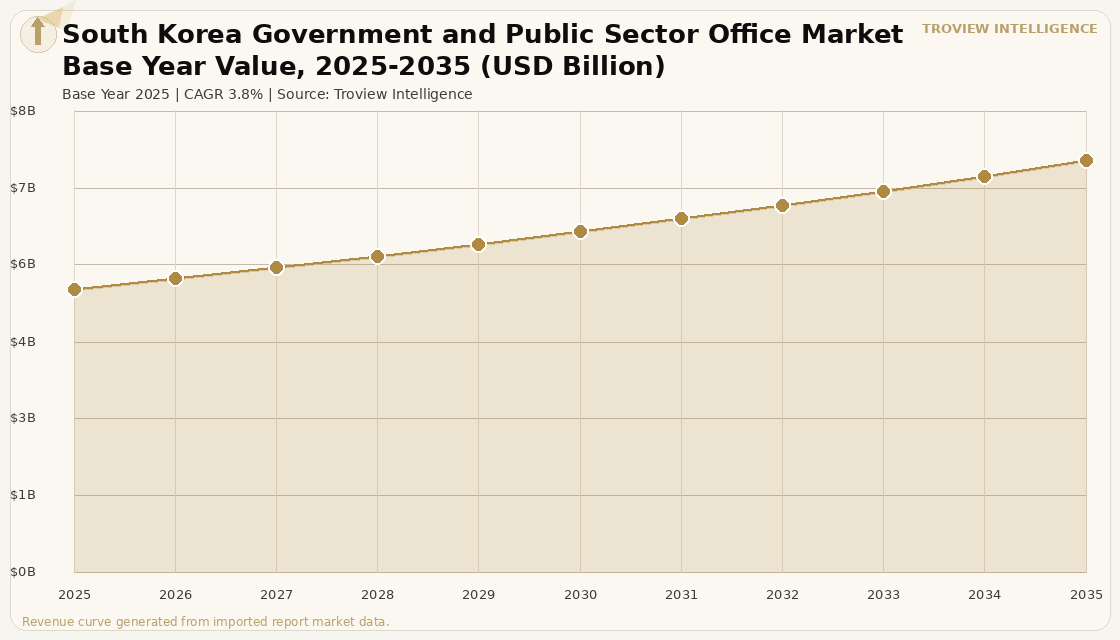
The South Korea government and public sector office market size was USD 5.18 Billion in 2025 and is expected to register a revenue CAGR of 3.8% during the forecast period, reaching USD 7.54 Billion by 2035. Market revenue growth is supported by the South Korean government's Five Mega-Regions balanced development strategy under the Lee Jae Myung administration, which commits to developing Sejong City as the undisputed administrative capital and expediting the second phase of public institution relocation from Seoul to provincial hubs, generating sustained demand for new government office construction and the refurbishment of existing public sector buildings outside Seoul. The Ministry of Land, Infrastructure and Transport, headquartered in Sejong City's Government Complex, oversees the country's building and land policy framework and operates the Seumter administrative platform that tracks building and housing management nationwide, confirming that 47% of office buildings with gross floor area of 16,500 square metres or more in Seoul's three major business districts the Central Business District, Gangnam, and Yeouido were built 30 years or more ago as of end-2024 per Seumter data. South Korea's total real estate market was valued at USD 12.6 trillion in 2025 per Korea Land and Housing Corporation data, with the office sector generating USD 27.32 billion in annual revenue across Seoul, Incheon, and provincial markets, and the government and public sector representing the largest single tenant category in the Central Business District Gwanghwamun submarket. Seoul's Grade A office rents rose 4.3% across the three major business districts in full-year 2025, with the Yeouido Business District recording the strongest growth at 5.0%, as limited new supply in prime locations sustained landlord pricing power despite corporate tenant consolidation by SK Group and LG Chem.
South Korea's government office market is shaped by the ongoing tension between the Seoul concentration of executive and legislative functions and the Sejong City concentration of ministerial and administrative operations. The South Korean government began relocating central agencies to Sejong City from 2012, with 42 central administrative agencies and 15 national policy research institutes including the Korea Development Institute completing their initial relocation, housing more than 10,000 central government civil servants in the purpose-built Government Complex. The National Agency for Administrative City Construction, under the Ministry of Land, Infrastructure and Transport, is managing the continued development of Sejong's government campus and planning the construction of regional branch offices under the second-phase relocation programme. The South Korean government has committed to approximately USD 190 billion in infrastructure investment focused on transportation, utilities, and public facilities, with government office construction forming a component of this broader capital programme across the Five Mega-Regions. For instance, in October 2024, Nuveen Real Estate, United States, acquired the Jeongdong Building in Seoul's Jung district for USD 250 million from IGIS Asset Management, marking Nuveen's first office investment in South Korea, with the building housing international law firms and embassy-adjacent government-related tenants and confirming sustained institutional investor demand for Seoul CBD office assets with government-proximate tenant profiles, per Korea real estate transaction records. These are some of the key factors driving revenue growth of the market.
However, the South Korea government and public sector office market faces structural constraints that moderate revenue growth. The continued decentralisation of government ministries from Seoul to Sejong City and provincial capitals is reducing the government occupier base in Seoul's Central Business District and Gwacheon Government Complex, creating structural vacancy in government-tenanted buildings in locations losing agencies to the provincial relocation programme. Seoul's Gwacheon Government Complex, previously housing the Ministry of Land, Infrastructure and Transport and other ministries before their Sejong relocation, faces the challenge of repositioning buildings that were designed specifically for government use into commercially viable spaces capable of attracting private sector tenants at market rents. The mandatory zero-energy building standard that South Korea's Ministry of Land, Infrastructure and Transport requires all new public buildings to meet by 2030 under the Act on the Promotion of Green Buildings is compelling government property owners to invest in energy system upgrades, renewable installation, and building envelope improvements that represent significant capital expenditure for the Ministry of the Interior and Safety's Government Facilities Management Service. Tenant fatigue from rent increases exceeding consumer price inflation over the past three years is constraining government office demand, with major government-related tenants in Seoul considering relocation to secondary offices or provincial locations to reduce costs. These factors substantially limit South Korea government and public sector office market growth over the forecast period.
South Korea's government office market is being reshaped by two simultaneous forces that are pulling in opposite directions geographically. Seoul's CBD and Gwanghwamun submarket are losing government ministries to Sejong City, which is a structural reduction in the most prestigious and historically stable government tenancy base in the country's prime office market. Simultaneously, Sejong City is building one of the most purpose-designed administrative capitals in the world, and the Five Mega-Regions strategy means this is not a one-cycle event it is a decade-long pipeline of government campus construction in Sejong, Busan, and the provincial hubs. The institutional investor who understands this dynamic should not be buying old Gwacheon government buildings. They should be looking at the long-lease, purpose-built government campus assets being delivered in Sejong and the Gangnam and Yeouido buildings that are attracting the private sector tenants replacing departing ministries." Troview Intelligence Senior Analyst, South Korea Government Office Markets
SEGMENT INSIGHTS
By Government Tier
National government ministry and central agency occupiers are expected to account for a significantly large revenue share in the South Korea government and public sector office market during the forecast period.
Based on government tier, the South Korea government and public sector office market is segmented into central government ministries and agencies, quasi-government and state-owned enterprise tenants, local government and metropolitan authority occupiers, and national policy research institutes and public corporations. Central government ministries dominate market revenue and define the Sejong City and Seoul CBD office markets, with 42 central administrative agencies and 15 national policy research institutes having completed their initial Sejong relocation while maintaining Seoul presence for National Assembly liaison and diplomatic functions. Quasi-government tenants including the Korea Development Institute, the Korea Institute for Industrial Economics and Trade, and the Korea Research Institute for Human Settlements occupy substantial floor areas in Sejong, Seoul, and provincial cities, providing a stable, long-tenure tenant base for both government-owned and privately leased buildings. Local government and Seoul Metropolitan Government operations represent the fastest-growing segment outside Seoul, as the Five Mega-Regions strategy directs public institution investment and workforce growth toward provincial metropolitan governments in Busan, Daejeon, Gwangju, and Daegu.
By Property Grade
Purpose-built government campuses and owned Grade A government office buildings are expected to account for a significantly large revenue share in the South Korea government and public sector office market during the forecast period.
Based on property grade, the South Korea government and public sector office market is segmented into purpose-built government campuses, Grade A leased commercial office buildings occupied by government agencies, legacy government buildings requiring refurbishment, and converted buildings housing government operations. Purpose-built government campuses dominate revenue and asset value, led by the Sejong City Government Complex developed by the National Agency for Administrative City Construction, which consolidated 42 central agencies from Seoul in purpose-designed campus buildings meeting the highest Korean government building standards. Grade A leased commercial office buildings occupied by government agencies represent the fastest-growing segment, as the relocation of agencies from government-owned facilities to privately leased Grade A buildings in Seoul's Gwanghwamun, Yeouido, and Gangnam districts reflects the Korean government's increasing preference for leased modern space over owning and operating ageing bespoke facilities. The Seumter platform data confirming that 47% of Seoul's major business district office buildings exceed 30 years of age highlights the scale of government-owned legacy refurbishment requirements.
By City
Seoul and Sejong City together are expected to account for a significantly large revenue share in the South Korea government and public sector office market during the forecast period.
Based on city, the South Korea government and public sector office market is segmented into Seoul, Sejong City, Gwacheon, Busan, Daejeon, Incheon, and other provincial cities. Seoul retains the largest share of government office market revenue, anchored by the Gwanghwamun Central Business District which houses the Blue House presidential complex, the National Assembly in Yeouido, and the majority of diplomatic missions, embassies, and international organisations requiring proximity to South Korea's national executive and legislative functions. Sejong City is the fastest-growing government office market by new floor area delivery, with the National Agency for Administrative City Construction continuing to expand the Government Complex and supporting office park as the Lee Jae Myung administration accelerates the second phase of ministry relocation. Busan is expected to register rapid government office growth over the forecast period as the Five Mega-Regions strategy designates Busan as South Korea's southern growth hub, with government-backed infrastructure investment and the planned relocation of maritime and trade-related public institutions from Seoul expected to generate sustained demand for government office space in the Haeundae and North Port redevelopment districts.
Four Cities Shaping South Korea's Government Office Market
| CBD Grade A Vacancy Q4 2025 | 3.7% (prime average) | CBD Grade A Rent Growth 2025 | +4.3% (3 districts average) |
| Government Hub | Gwanghwamun CBD, National Assembly Yeouido | Seumter Building Age Data | 47% of Grade A buildings >30 years old |
Seoul is South Korea's largest government and public sector office market, anchored by the Gwanghwamun submarket in the Central Business District where the presidential complex, key remaining central ministry functions, and the majority of the diplomatic community are concentrated. Seoul's prime office market recorded a vacancy rate of 3.7% across the three major business districts in Q4 2025, with the CBD specifically at 5.0% following SK Group's office consolidation per Korea Real Estate Board data, and Grade A rents rising 4.3% across the three districts in 2025 despite corporate tenant consolidation. The Seumter platform, operated under the Ministry of Land, Infrastructure and Transport, confirmed that 47% of office buildings with gross floor area of 16,500 square metres or more in Seoul's three business districts were built 30 years or more ago as of end-2024, creating a major refurbishment requirement for government-tenanted legacy buildings across the CBD. In Q4 2025, Jongno-gu Office relocated 9,500 square metres into The K Twin Tower and Hanwha Claims Management relocated 4,300 square metres to the KCCI Building, demonstrating active government and quasi-government agency movements into modernised CBD space per Korea Real Estate Asia reporting.
| Agencies Relocated | 42 central agencies + 15 national research institutes | Population Target | 500,000 by 2030 (South Korean government plan) |
| Key Buildings | Government Complex (Prime Minister's Office, all relocated ministries) | Development Manager | National Agency for Administrative City Construction |
Sejong City is South Korea's purpose-built administrative capital, established by special legislation under the Roh Moo-hyun administration and officially inaugurated in July 2012, designed to decentralise government functions from the Seoul metropolitan area and reduce the security risk of concentrating national government within 35 miles of the North Korean border. The Government Complex in Sejong City houses 42 central administrative agencies including the Office of the Prime Minister, the Ministry of Economy and Finance, the Ministry of Land, Infrastructure and Transport, the Ministry of Environment, and the Ministry of Education, along with 15 national policy research institutes including the Korea Development Institute per South Korean government relocation records. The Lee Jae Myung administration, through the Ministry of Land, Infrastructure and Transport under Minister Kim Yoon-deok appointed July 31, 2025, has committed to developing Sejong as the undisputed administrative capital and expediting the second phase of public institution relocation, which will bring additional national agencies, government-affiliated research institutions, and supporting public sector organisations to the city over the forecast period. The South Korean government's original plan projected Sejong City reaching a population of 500,000 by 2030, driven by sustained public sector employment growth that creates housing, commercial, and supporting services real estate demand around the government campus.
| Government Strategy | Five Mega-Regions southern hub designation | Sector Focus | Maritime, trade, finance, logistics public institutions |
| Key Employer | Korea Maritime and Ocean University, KOTRA regional offices | Development Corridor | North Port redevelopment, Haeundae innovation district |
Busan is South Korea's second-largest city and the designated southern hub under the Lee Jae Myung administration's Five Mega-Regions balanced development strategy, positioned to receive government-backed infrastructure investment and the planned relocation of maritime and trade-related public institutions from Seoul. The Korean government's decision to relocate maritime agency headquarters to Busan reflects the city's position as South Korea's primary port city and the home of Korea Maritime and Ocean University, creating a government research and regulatory cluster that generates sustained demand for government and quasi-government office space in the Haeundae and North Port redevelopment corridors. Busan's North Port redevelopment programme, one of the largest port-to-urban transformation projects in Asia, includes significant allocations for government, educational, and research institution facilities that will generate new government office floor area over the 2026 to 2032 delivery horizon. The Korea Trade-Investment Promotion Agency, the Korea Institute for Advancement of Technology, and multiple financial regulatory regional offices maintain Busan presences that anchor the government tenant base in the city's commercial office market.
| Gwacheon Complex Status | Former ministry hub, repositioning post-Sejong | Key Challenge | Government vacancies requiring private sector backfill |
| Proximity | 15km south of Seoul, metro line 4 connected | Opportunity | Mixed-use redevelopment of government-owned parcels |
Gwacheon is South Korea's legacy government complex city, located 15 kilometres south of Seoul and served by metro line 4, which housed the Ministry of Land, Infrastructure and Transport and other central ministries before their relocation to Sejong City. The Gwacheon Government Complex previously represented a major concentration of national government office activity, but the transfer of ministry operations to Sejong has created structural vacancy in purpose-built government buildings that were not designed for private sector occupation. The Gwacheon Government Complex site is subject to repositioning studies by the Ministry of the Interior and Safety's Government Facilities Management Service, which is evaluating the conversion of underutilised government buildings to research and innovation uses, mixed-use development, and affordable housing in partnership with the Gyeonggi Province government. Gwacheon's proximity to Seoul and transport connectivity make the site attractive for research institutions, technology companies, and government-affiliated organisations that require Seoul Metropolitan Area access without CBD rent levels, providing a long-term demand base for repositioned government campus real estate.