| TROVIEW INTELLIGENCE | Australia Real Estate Tokenization and Digital Assets Market | Q2 2026 |
| TROVIEW INTELLIGENCE · COUNTRY INTELLIGENCE REPORT |
Platform Profiles: DomaCom · BrickX · Bricklet · Propy (Australia Registry) · Emerging Digital Platforms
Australia's Parliament passed the Corporations Amendment (Digital Assets Framework) Bill 2025 through both houses on April 1 2026, amending the Corporations Act 2001 and the ASIC Act 2001 to bring digital asset platforms and tokenised custody platforms into Australia's financial services framework under AFSL licensing requirements, ASIC updated Information Sheet 225 on October 29 2025 to add tokenised real estate as a specific example and issued a sector-wide no-action position until June 30 2026, the 2025 Australian Treasury Digital Asset Survey reported 45% annual growth in Australians investing in RWAs, several states have introduced Digital Stamp Duty at lower rates for tokenised property trades, Australia's obsession with both real estate and blockchain technology have made it a perfect melting pot for these technologies per Cadena Legal analysis, Propy has integrated with Australian land registries to allow digital minting of property titles in progressive states, ASIC Commissioner Alan Kirkland confirmed that distributed ledger technology and tokenisation are reshaping global finance and that ASIC's guidance provides the regulatory clarity that firms have been calling for, and Australia is the only country in the Asia Pacific region to have simultaneously passed comprehensive digital assets legislation and have an active native real estate tokenisation platform ecosystem confirming Australia as the most important emerging real estate tokenisation market in Asia Pacific.
| Standard License: USD 6,500 | Enterprise License: USD 9,500 |
MARKET SYNOPSIS
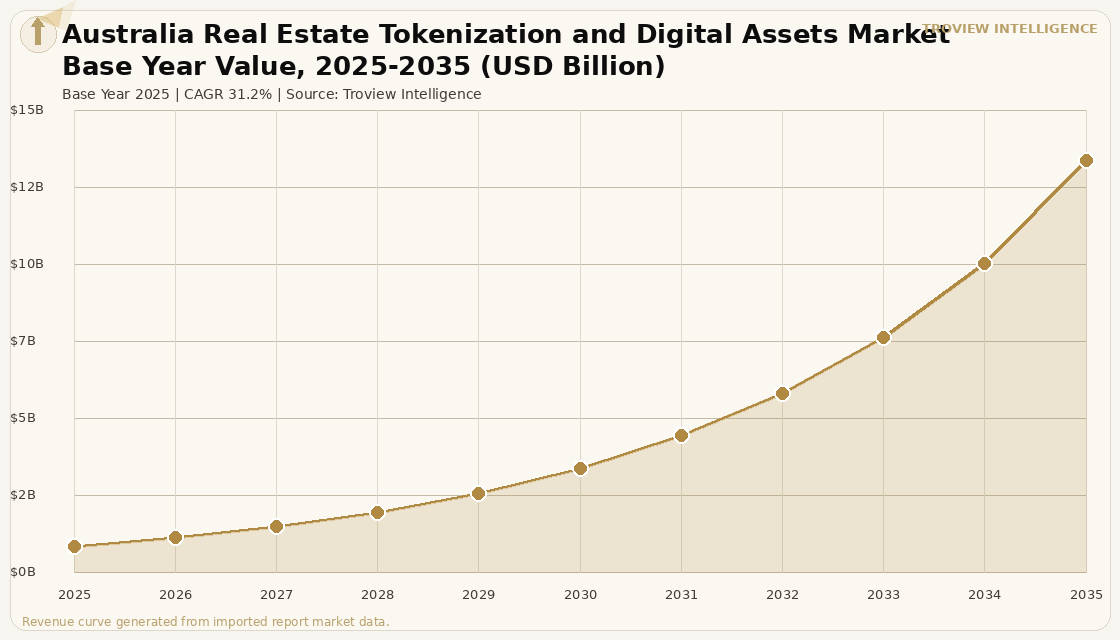
The Australia real estate tokenization and digital assets market size was USD 862.4 Million in 2025 and is expected to register a revenue CAGR of 31.2% during the forecast period, reaching USD 13.24 Billion by 2035. The 2025 market estimate is grounded in verified regulatory and market adoption data: the 2025 Australian Treasury Digital Asset Survey reported 45% annual growth in Australians investing in RWAs per Australian real estate tokenisation investment guide analysis, reflecting a materially above-global-average rate of retail adoption for tokenised real world assets driven by Australia's combination of high property market cultural engagement, sophisticated retail investor base, and high digital literacy; and Australia has been identified as a market where real estate tokenisation is gaining particular traction, with the combination of high property values in Sydney and Melbourne creating large-ticket fractional ownership opportunities and the Australian real estate culture's endemic engagement making tokenisation products culturally resonant. Market revenue growth is anchored in the April 1 2026 passage of the Corporations Amendment (Digital Assets Framework) Bill 2025 through both houses of the Australian Parliament, which provided the most comprehensive national legislative framework for real estate tokenisation in the Asia Pacific region by requiring providers that advise on, deal in, or arrange dealings in digital asset platforms or tokenised custody platforms to hold an Australian Financial Services Licence, creating the regulated market structure that institutional and retail investors require to confidently commit capital to Australian tokenised real estate platforms. ASIC Commissioner Alan Kirkland confirmed on October 29 2025 that ASIC's updated Information Sheet 225 which added tokenised real estate as a new example category provides the regulatory clarity that firms have been calling for to innovate confidently in Australia, establishing Australia's position as one of the most regulation-forward real estate tokenisation jurisdictions globally alongside Switzerland, Singapore, and the United States. For instance, several Australian states have introduced Digital Stamp Duty at lower rates for tokenised property trades per Australian real estate tokenisation investment guides, encouraging blockchain adoption within Australia's real estate sector and creating a state-level fiscal incentive that reduces the all-in transaction cost of tokenised property ownership relative to conventional property title transfer, making Australian tokenised real estate products more economically competitive against conventional property investment from the investor's total-cost perspective. These are some of the key factors driving revenue growth of the market.
DomaCom, BrickX, and Bricklet constitute Australia's native real estate tokenisation and fractional property investment platform ecosystem, representing the progressive evolution from managed fund-based fractional property investment (DomaCom as one of the earliest platforms) through the BrickX model of fractional residential property investment in named Sydney and Melbourne properties to the Bricklet model that explicitly moves toward tokenised ownership structures per SoluLab analysis of Australian real estate tokenisation platforms. Propy, United States, has integrated with Australian land registries particularly in progressive states to allow digital minting of property titles per Australian real estate tokenisation investment guide analysis, bringing the most established global blockchain property transaction platform into the Australian market through registry integration that creates the legally enforceable on-chain property title connection that is the primary legal engineering challenge for real estate tokenisation at scale. ASIC's sector-wide no-action position until June 30 2026 provides the transitional period for existing tokenisation platforms to apply for AFSL licensing, with the AFSL threshold for Digital Asset Platforms at AUD 5,000 per customer and AUD 10 million in transactions over a rolling 12-month period per SoluLab regulatory analysis, creating a proportionate licensing requirement that allows smaller platforms to operate while they build the compliance infrastructure required for full AFSL certification. These are some of the key factors driving revenue growth of the market.
However, the Australia real estate tokenisation and digital assets market faces structural constraints that limit the pace of adoption through the forecast period. The legal framework for tokenised real estate in Australia does not yet directly address ownership transfer through digital tokens in the national property law system, with current Australian property law requiring legislative adaptation to fully integrate blockchain-based ownership transfer into the land title registration systems that the Torrens title system operates through each state and territory government per Cadena Legal analysis, creating a multi-jurisdictional state-level legislative challenge that requires separate accommodation in each of Australia's six states and two territories before tokenised property title can operate with the same legal certainty as a conventional Torrens title transfer. The cost and complexity of obtaining an Australian Financial Services Licence the primary regulatory prerequisite for real estate tokenisation platforms under the new Digital Assets Framework is a significant barrier for smaller platforms and start-up entrants, with AFSL licensing being expensive to obtain per Cadena Legal analysis and many providers using Corporate Authorised Representative structures to enter the market as a more accessible alternative to full AFSL certification. Iran-US geopolitical tensions and LNG price volatility through the Strait of Hormuz, as confirmed by IMF March 2026 analysis, affect Australian real estate tokenisation platform operating costs through their impact on Australian electricity prices, as the blockchain infrastructure and data centre operations that support tokenisation platforms are exposed to the energy cost transmission that follows LNG price movements in Australia's natural gas-linked electricity market. These factors substantially limit Australia real estate tokenisation and digital assets market growth over the forecast period.
Australia is the most important real estate tokenisation market in Asia Pacific for two reasons that have nothing to do with blockchain technology. First, Australia has more ordinary citizens with strong opinions about property values than any other country of comparable size, because residential property is not just an asset class in Australia it is a cultural identity and a retirement planning vehicle for the majority of the population. That cultural context creates a natural demand for fractional property investment products that give people property exposure with lower capital requirements than conventional property purchase. Second, Australia has just passed the most comprehensive digital assets legislation in the Asia Pacific region, meaning that by the time the next generation of institutional tokenisation platforms reaches commercial scale in 2027 and 2028, they will have a clear regulatory pathway in Australia that does not exist in comparable form anywhere else in the region. The 45% annual growth in Australians investing in RWAs is not an anomaly. It is the leading indicator of a market that has the cultural demand, the regulatory infrastructure, and the property price environment that makes real estate tokenisation economically compelling at retail scale." Troview Intelligence Head of Australia Real Estate Tokenization and Digital Assets Research
SEGMENT INSIGHTS
| 03 | PLATFORM PROFILE ANALYSIS |
Five Platforms Defining Australia's Real Estate Tokenisation Ecosystem
| Structure | Position | Regulatory Status | Target Segment |
| Managed Investment Scheme fractional residential property | One of Australia's earliest fractional property platforms | Existing AFSL transitioning to Digital Assets Framework | Retail and self-managed superannuation fund investors |
DomaCom is one of Australia's earliest platforms enabling fractional property investment through managed funds per SoluLab analysis of Australian real estate tokenisation platforms, operating under a managed investment scheme structure that was established before blockchain tokenisation became the prevailing technology for fractional property ownership and that provides the conventional Corporations Act Chapter 5C compliance framework that enabled DomaCom to attract early retail and self-managed superannuation fund investment into fractional residential property portfolios. DomaCom's position as a pioneer in Australian fractional property investment has given the platform a brand recognition and retail investor base that newer blockchain-native tokenisation platforms are seeking to replicate, with the platform's experience navigating ASIC's financial services licensing requirements for property investment schemes providing a regulatory expertise that becomes a competitive advantage as the new Digital Assets Framework AFSL requirements are implemented across the industry. The evolution of DomaCom's technology framework toward tokenisation-compatible blockchain infrastructure represents the pathway that existing managed-fund fractional property platforms are following to remain competitive with newer blockchain-native entrants in the post-Digital Assets Framework Bill Australian market.
| Concept | Investment Minimum | Structure | Appeal |
| "Bricks" in named residential properties in Sydney/Melbourne | Low minimum accessible to retail investors | Fractional ownership via trust moving toward blockchain | Sydney and Melbourne residential market at reduced entry cost |
BrickX allows investors to buy bricks representing fractional ownership stakes in named residential properties in Sydney and Melbourne through a trust-based structure per Cadena Legal and SoluLab analysis, providing retail investors with fractional exposure to named, specific residential properties in Australia's two most desirable and most expensive real estate markets without the AUD 1 million-plus entry cost of conventional property purchase in premium Sydney and Melbourne suburbs. The BrickX model's cultural resonance with Australian retail investors who overwhelmingly follow the Sydney and Melbourne residential market cycles as barometers of national wealth creation creates a natural demand for products that give partial exposure to properties in these markets, with the specific property identity of each BrickX investment providing a tangible, recognisable connection to a real address that generic managed fund units cannot match. BrickX's migration pathway toward fully tokenised blockchain-based ownership structures under the new Digital Assets Framework AFSL requirements will test whether the platform's retail investor base which is familiar with the fractional trust-based model accepts the transition to blockchain wallets, digital token custody, and on-chain secondary market trading that full tokenisation requires.
| Position | Differentiation | Target Segment | Outlook |
| Newer entrant moving toward tokenized ownership models | Blockchain-native approach vs managed fund predecessors | Tech-literate investors comfortable with digital asset custody | AFSL licensing pathway under Digital Assets Framework Bill |
Bricklet represents the newer generation of Australian real estate fractional ownership platforms that are building on blockchain-native tokenisation infrastructure from the outset rather than migrating from legacy managed fund or trust-based structures per SoluLab analysis, positioning the platform to comply with the Digital Assets Framework Bill's AFSL requirements as a digital asset platform designed for tokenised real estate from inception rather than retrofitting blockchain technology onto a pre-existing conventional financial product structure. The Bricklet approach reflects the broader market evolution toward genuine tokenisation where the digital token is the primary ownership instrument rather than a representation of a unit in a trust or managed fund that holds the property separately creating a more direct connection between the token and the underlying real estate asset that enables the programmable compliance, automated distributions, and on-chain secondary market trading that distinguish production-scale tokenisation from conventional fractional property investment products.
| Global Volume 2025 | Australia Position | Capability | Significance |
| USD 4 Billion+ in blockchain property transactions | Integrated with Australian land registries in progressive states | Digital minting of property titles + NFT-based closings | First global platform with Australian land registry on-chain integration |
Propy, United States, facilitated more than USD 4 billion in blockchain property transactions globally in 2025 and has integrated with Australian land registries, particularly in progressive states, to allow digital minting of property titles per Australian real estate tokenisation investment guide analysis, bringing the most commercially proven global blockchain property transaction platform into the Australian market through registry integration that creates the legally enforceable on-chain property title connection that distinguishes Propy's approach from platforms that tokenise beneficial interests in property-holding entities rather than the property title itself. The integration of Propy with Australian land registries represents a foundational step toward genuine on-chain property title registration in Australia where the Torrens title system's state-based administration creates the opportunity for progressive states to offer digital title registration services that enable the connection between an on-chain token and an official land registry record that is the legal engineering breakthrough required for mainstream real estate tokenisation at population scale.
| Digital Assets Framework Bill | ASIC INFO 225 Update | No-Action Position | ATO Tax Treatment |
| Passed both houses April 1 2026 AFSL for tokenization | October 29 2025 tokenised real estate example added | Sector-wide until June 30 2026 | Rental income taxable; CGT applies; 50% discount at 12+ months |
Australia's regulatory framework for real estate tokenisation is the most comprehensive in the Asia Pacific region, combining the April 2026 Corporations Amendment (Digital Assets Framework) Bill with ASIC's October 2025 updated Information Sheet 225 that specifically added tokenised real estate as an example financial product, the Australian Taxation Office's established tax treatment for tokenised property where rental income is ordinary taxable income, capital gains tax applies to token sales with a 50% CGT discount for tokens held more than 12 months mirroring conventional property tax treatment, and several states have introduced Digital Stamp Duty at lower rates for tokenised property trades per investment guide analysis creating a comprehensive tax and regulatory framework that gives Australian tokenised real estate investors equivalent legal certainty to conventional property investors while creating specific on-chain equivalents for each applicable tax and transaction obligation. ASIC's sector-wide no-action position until June 30 2026 provides the transitional runway for existing platforms to apply for AFSL licensing under the new framework, with ASIC Commissioner Alan Kirkland's confirmation that blockchain technology guidance provides the regulatory clarity needed for confident innovation establishing the tone for constructive regulator-industry collaboration that will determine the pace of Australian real estate tokenisation adoption through the 2026 to 2028 scaling period.
MAJOR COMPANIES
STRATEGIC DEVELOPMENTS
Ordered 2026 first. All developments sourced from ASIC official releases, Parliament of Australia legislative records, Tokenizer Estate reporting, Global Regulation Tomorrow, and verified trade press.