By Cluster · By Occupier · By Automation Grade · By Ownership
About 72% of Incheon logistics centres concentrate in three primary clusters the Terminal Logistics Complex, North Port Hinterland, and South Port Hinterland-Aam zones as KKR paid KRW 1 trillion for the Cheongna Logistics Center in South Korea's largest-ever single-asset logistics deal and South Korea's National Pension Service acquired the Arenas Yeongjong Logistics Center eight kilometres from Incheon International Airport, with the facility serving a tenant base including Musinsa, Samsung Logitec, and Thermo Fisher Scientific at 93% occupancy confirming Incheon as the institutional benchmark for automated logistics real estate pricing in Northeast Asia.
MARKET SYNOPSIS
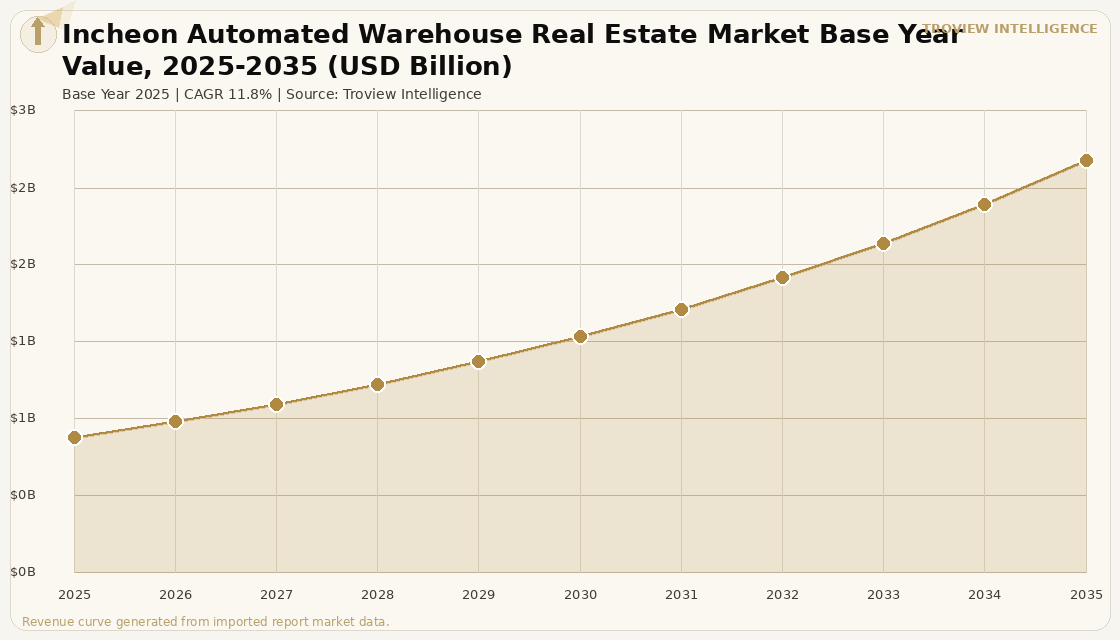
The Incheon automated warehouse real estate market size was USD 812.6 Million in 2025 and is expected to register a revenue CAGR of 11.8% during the forecast period, reaching USD 2.48 Billion by 2035. Incheon is South Korea's primary automated logistics hub, positioned at the intersection of the country's two largest cargo gateways Incheon Port and Incheon International Airport within 40 kilometres of the 26 million-person Seoul Capital Area. About 72% of Incheon's logistics centres are concentrated in three primary clusters: the Incheon Terminal Logistics Complex, the North Port Hinterland Complex, and the South Port Hinterland-Aam Logistics Complex, with 40 logistics companies and two manufacturing companies operating in the airport logistics complex under the Incheon Airport Free Economic Zone's preferential framework per Incheon International Airport Corporation data. The Incheon Free Economic Zone designated 2,093,000 square metres as free trade zone in April 2005, followed by the first airport logistics complex expansion of 922,000 square metres in December 2007 and a second airport logistics complex of 326,000 square metres in April 2020, with KRW 31 billion committed for a large-scale global distribution centre for e-commerce in the Free Economic Zone.
Incheon's automated warehouse real estate market is defined by the convergence of two institutional investment cycles: global private equity acquiring stabilised automated logistics assets at Korean trophy pricing, and South Korean government and corporate capital building new automation infrastructure in the city's expanding logistics zones. KKR acquired the Cheongna Logistics Center for KRW 1 trillion in late 2025, the largest-ever single-asset logistics deal in South Korean history, with the 427,354 square metre 10-storey automated facility fully leased to Coupang and Emart24 per Mingtiandi reporting. The National Pension Service acquired the Arenas Yeongjong Logistics Center near Incheon International Airport in January 2026 for KRW 95.4 billion net proceeds, with 93% occupancy across a multi-tenant base including Musinsa, Samsung Logitec, Qxpress, and Thermo Fisher Scientific, per Mingtiandi reporting. CJ Logistics operates a 165,000 square metre Incheon Global Distribution Centre in Songdo IFEZ with 2,300 staff, the largest single automated logistics employer within the Free Economic Zone. For instance, in 2023, DB Schenker Korea opened its KLC 2 warehouse, a 40,000 square metre facility within the Incheon Free Economic Zone featuring TAPA A and LEED Gold certification and NFPA standards, representing one of the largest single investments in DB Schenker's Asia Pacific history, per DB Schenker company announcement. These are some of the key factors driving revenue growth of the market.
However, the Incheon automated warehouse real estate market faces structural constraints. Water depth at Incheon Port's main navigation channel of 14 to 16 metres limits vessel size, capping the port's ability to accommodate the largest 24,000 TEU ultra-large container vessels that call at deeper competing ports. Qingdao and Rizhao ports in China have captured approximately 18% of Korea-China feeder traffic previously routed through Incheon per Korea International Trade Association analysis, reducing the port cargo throughput base that sustains demand for port-adjacent automated logistics facilities. High-storey automated warehouse development in Incheon's congested port and airport hinterland areas faces permitting complexity as the Free Economic Zone's designated land area is fully committed, limiting new development to the second airport logistics complex and peripheral designated zones. Talent concentration in maritime and port logistics specialists is so acute that a single executive poaching event has triggered policy responses across the public sector, confirming the workforce depth constraint that may limit operational expansion of new automated logistics facilities. These factors substantially limit Incheon automated warehouse real estate market growth over the forecast period.
Incheon is not just South Korea's logistics capital. It is Northeast Asia's institutional benchmark for automated logistics real estate pricing. When KKR pays KRW 1 trillion for a single 427,000 square metre building, the market is telling you two things: first, that Coupang's covenant is the best lease anchor in Korean logistics real estate; and second, that the combination of airport air cargo, seaport container flow, and 26 million Seoul Capital Area consumers creates a locational advantage that no inland Korean market can replicate. The Arenas Yeongjong NPS acquisition is the confirming signal. When the country's largest pension fund follows global private equity into the same city in the same quarter, the thesis is not contrarian. It is consensus." Troview Intelligence Head of Incheon Automated Warehouse Research
SEGMENT INSIGHTS
By Cluster
The Incheon Free Economic Zone clusters adjacent to the airport and port are expected to account for a significantly large revenue share in the Incheon automated warehouse real estate market during the forecast period.
Based on cluster, the Incheon automated warehouse real estate market is segmented into the Incheon Terminal Logistics Complex, North Port Hinterland Complex, South Port Hinterland-Aam Complex, Cheongna IFEZ, Yeongjong Island Airport Zone, and Songdo International Business District. The three primary clusters Terminal, North Port, and South Port-Aam account for 72% of Incheon logistics centre concentration per industry analysis, anchored by the Free Economic Zone's tariff deferral and low-rent incentive framework. Yeongjong Island, where Incheon International Airport is located, is the fastest-growing cluster, with the KRW 31 billion global e-commerce distribution centre under development, the Arenas Yeongjong facility 8 kilometres from the airport, and the second airport logistics complex of 326,000 square metres designated in April 2020 providing the land supply for continued automated warehouse development adjacent to the passenger and cargo terminal.
By Occupier
E-commerce and 3PL occupiers are expected to account for a significantly large revenue share in the Incheon automated warehouse real estate market during the forecast period.
Based on occupier, the Incheon automated warehouse real estate market is segmented into e-commerce and quick commerce platforms, third-party logistics providers, air cargo and freight operators, cold chain pharmaceutical and food distributors, and electronics and manufacturing logistics. E-commerce dominates both investment volume and lease covenant quality, with Coupang anchoring the Cheongna Logistics Center at 427,354 square metres and Emart24 as a co-tenant, confirming that South Korea's two largest convenience commerce operators are the institutional benchmark occupiers for Incheon automated logistics real estate. Third-party logistics providers including CJ Logistics, Lotte Global Logistics, and DB Schenker anchor the port and airport-adjacent clusters, serving multinational clients through the Free Economic Zone's preferential customs and trade framework. Thermo Fisher Scientific's presence in Arenas Yeongjong confirms that cold chain pharmaceutical logistics is an established occupier category alongside e-commerce in Incheon's airport-adjacent automated facilities.
By Ownership Structure
Institutional ownership through private equity and pension funds is expected to account for a significantly large revenue share in the Incheon automated warehouse real estate market during the forecast period.
Based on ownership structure, the Incheon automated warehouse real estate market is segmented into global private equity-owned facilities, domestic pension and institutional fund-owned assets, corporate owner-occupied facilities, and developer-held speculative inventory. Global private equity, represented by KKR's KRW 1 trillion Cheongna acquisition and the preceding KRW 270 billion Hwaseong deal managed through Kreate, has established itself as the dominant acquirer of stabilised automated logistics real estate across the Seoul Capital Area and Incheon. Domestic institutional capital, represented by NPS's Arenas Yeongjong acquisition, is following global private equity into Incheon's airport-adjacent cluster, with the pension fund's transaction confirming that Korean institutional allocators now treat Incheon automated logistics real estate as a core fixed income-substitute investment with long-duration lease income and high-quality occupier covenants.
Cluster Deep-Dives
CHEONGNA / SEOGU IFEZ KKR TROPHY ASSET, LARGEST SINGLE-ASSET DEAL
| KKR Cheongna Acquisition | KRW 1 trillion (late 2025, South Korea's largest logistics deal) | Facility Size | 427,354 m², 10 storeys, 2022-vintage |
| Primary Tenant | Coupang and Emart24 (fully leased) | Location | Incheon Free Economic Zone, 40 km west of Seoul |
The Cheongna IFEZ cluster in Seo-gu Incheon is South Korea's benchmark automated logistics location, validated by KKR's KRW 1 trillion acquisition of the Cheongna Logistics Center in late 2025. The 10-storey, 427,354 square metre facility, built in 2022 and located within the Incheon Free Economic Zone close to both Incheon Port and Incheon International Airport, is fully leased to Coupang and Emart24, providing a dual-covenant lease structure with South Korea's largest e-commerce operator and its largest convenience store chain. The IFEZ framework at Cheongna grants tenants tariff deferral on imported goods, low rent relative to standard Korean industrial park rates, and free trade activity designation that eliminates certain customs procedural delays. The building's 2022 vintage and multi-storey automated format represents the current institutional standard for Korean automated logistics real estate, and the KRW price per square metre implied by the transaction established the reference point for subsequent Incheon automated logistics asset pricing.
YEONGJONG ISLAND AIRPORT ZONE NPS AND ARENAS: AIRPORT-ADJACENT BENCHMARK
| NPS Arenas Acquisition | KRW 95.4 billion net, Jan 2026 | Arenas Yeongjong Occupancy | ~93%, multi-tenant |
| Airport Distance | 8 km from Incheon International Airport cargo terminal | Tenants | Musinsa, Samsung Logitec, Qxpress, Thermo Fisher Scientific |
Yeongjong Island, home to Incheon International Airport, hosts the airport-adjacent automated warehouse cluster that serves air-sea multimodal cargo logistics and e-commerce air express fulfilment. The Arenas Yeongjong Logistics Center, acquired by NPS in January 2026, sits 8 kilometres from the airport cargo terminal and benefits from the Incheon International Airport Expressway connecting the facility to Seoul. Its 93% occupancy with a diversified multi-tenant base including Musinsa, Samsung Logitec, Qxpress, and Thermo Fisher Scientific confirms that airport-adjacent automated logistics space in Incheon attracts a mix of fashion e-commerce, electronics supply chain, express logistics operators, and pharmaceutical cold chain users, providing the occupier diversification that sustains occupancy through individual sector demand cycles. Incheon International Airport processes the second-largest international cargo volumes in the world per airport authority data, providing the airfreight throughput that anchors the air cargo-adjacent portion of the Yeongjong automated logistics cluster's demand.
SONGDO IFEZ (INCHEON INTERNATIONAL BUSINESS DISTRICT) CJ LOGISTICS ANCHOR, GLOBAL DISTRIBUTION
| CJ Logistics Songdo GDC | 165,000 m², 2,300 staff, 450 maritime specialists | Lotte Global Logistics | 98,000 m² at Incheon New Port |
| Songdo Character | Planned smart city, high-specification logistics | RCEP Access | Songdo tenants access USD 25.9 trillion RCEP trade zone |
Songdo International Business District, a planned smart city within the Incheon Free Economic Zone, hosts the premium logistics cluster anchored by CJ Logistics' 165,000 square metre Incheon Global Distribution Centre the largest single automated logistics employer in the Incheon Free Economic Zone. The Songdo GDC employs 2,300 staff including 450 maritime and port logistics specialists who manage cross-border cargo flows through Incheon Port's container terminals adjacent to the district. Lotte Global Logistics maintains a 98,000 square metre complex at Incheon New Port within the Songdo catchment area, serving multinational clients across the RCEP trade zone. DB Schenker Korea's KLC 2 warehouse, 40,000 square metres within the Incheon Free Economic Zone with TAPA A and LEED Gold certification, represents the premium specification standard for international 3PL operators who require verified security certification for high-value electronics and pharmaceutical cargo handling.
| Function | Container freight station, bonded warehouse, 3PL | Port Connectivity | Direct access to Incheon Port container terminals |
| Automation Focus | Cold chain automated storage, cargo processing robotics | Infrastructure | 14-16m navigable channel depth, 150+ global port connections |
The North Port Hinterland Complex serves the container import and export logistics that flow through Incheon Port, which connects to over 150 ports worldwide and handles over 30 million TEUs annually with AI cranes and IoT tracking per port authority operational data. The complex hosts bonded warehouse operators, container freight station facilities, and automated cold chain logistics infrastructure that processes temperature-sensitive food imports and pharmaceutical shipments arriving through Incheon's reefer-capable berths. LX Pantos, the LG Group logistics arm, operates bonded warehouses and Container Freight Station facilities within the port hinterland, serving as a major employer for customs brokerage specialists who process the free trade zone's preferential cargo documentation. The water depth constraint of 14 to 16 metres in Incheon's main navigation channel limits the port to smaller vessel sizes than Busan, but the Yellow Sea crossing times to Shanghai and Qingdao of under 18 hours sustain demand for port-adjacent automated logistics from Korea-China trade flows.