By Automation Type · By Region · By Occupier · By Building Grade
City Spotlights: Incheon · Seoul Capital Area · Busan · Chungcheong Corridor
South Korea leads the world at 631 industrial robots per 10,000 employees per the International Federation of Robotics, eight times the global average, as KKR's KRW 1 trillion acquisition of the Cheongna Logistics Center set a national single-asset record, the National Pension Service acquired the Arenas Yeongjong facility near Incheon Airport, and the government's Fourth Intelligent Robot Basic Plan injects USD 2.24 billion into domestic robotics production through 2028 to raise domestic content to 80% creating the most robotics-dense automated warehouse real estate investment market in Asia.
MARKET SYNOPSIS
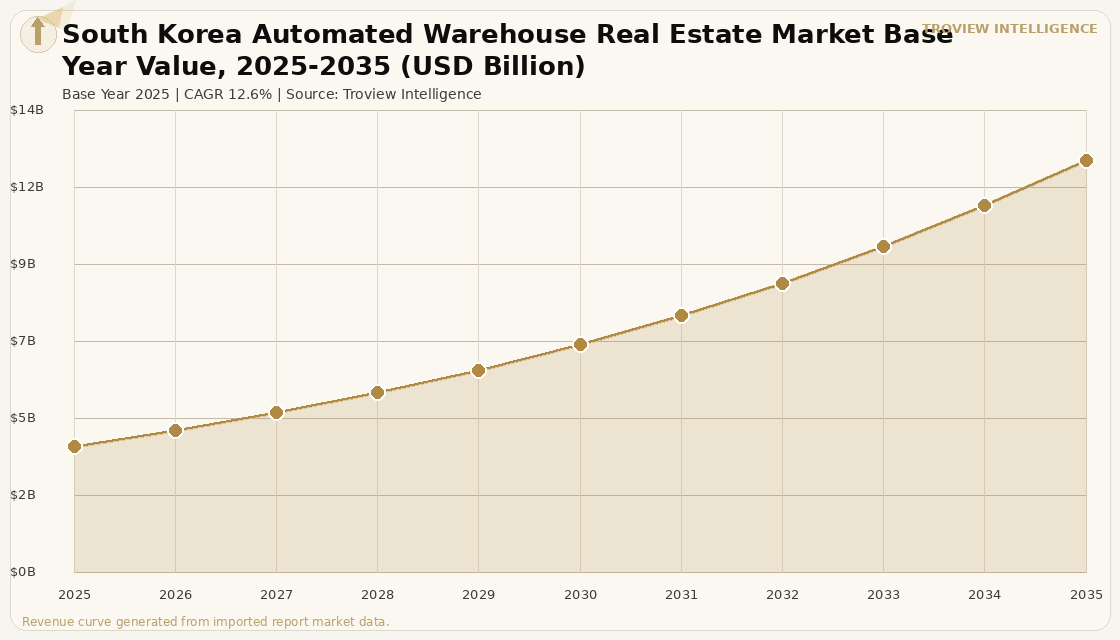
The South Korea automated warehouse real estate market size was USD 3.84 Billion in 2025 and is expected to register a revenue CAGR of 12.6% during the forecast period, reaching USD 12.55 Billion by 2035. South Korea is the world's most robotics-dense industrial economy, with 631 industrial robots per 10,000 employees per the International Federation of Robotics, eight times the global average, creating structural demand for automated warehouse real estate from manufacturing, e-commerce, and logistics occupiers whose operations are built around automation rather than labour-intensive manual processes. The South Korea logistics automation market generated USD 1,457.9 million in hardware, software, and services revenue in 2025 per industry analysis, with hardware accounting for 76.56% of that total, and the market is expected to grow at a 17.2% CAGR through 2033. The Ministry of Land, Infrastructure and Transport allocated USD 44.8 billion for 2025 infrastructure projects including 5G-enabled automated guided vehicles and national smart logistics data platforms, per the Ministry's Smart Logistics Masterplan 2025, confirming that government capital is actively financing the digital and physical infrastructure that automated warehouse real estate requires to operate.
The South Korean automated warehouse real estate market is defined by the co-presence of global institutional capital, domestic logistics conglomerates, and government-backed automation infrastructure investment that collectively create the most active automated logistics deal environment in Asia outside China. KKR's acquisition of the Cheongna Logistics Center from Brookfield Asset Management for KRW 1 trillion in late 2025 was South Korea's largest-ever single-asset logistics deal, with the 427,354 square metre facility fully leased to Coupang and Emart24 per Mingtiandi reporting. The National Pension Service subsequently agreed to acquire the Arenas Yeongjong Logistics Center near Incheon Airport from Straits Trading and IGIS, with Newmark Korea confirming the facility's 93% occupancy and multi-tenant base including Musinsa, Samsung Logitec, and Thermo Fisher Scientific. Coupang, South Korea's largest e-commerce operator, continued to build automated logistics real estate directly, breaking ground on an AI-powered centre in Jecheon in March 2025 with KRW 100 billion of investment per Korea Herald. For instance, in January 2026, CJ Logistics, South Korea, operated a 165,000 square metre Incheon Global Distribution Centre in Songdo IFEZ with 2,300 staff and 450 maritime and port logistics specialists, serving as the largest single automated logistics employer within the Incheon Free Economic Zone and confirming that domestic logistics conglomerates are anchoring automated warehouse demand alongside global e-commerce operators, per publicly available CJ Logistics operational data. These are some of the key factors driving revenue growth of the market.
However, the South Korea automated warehouse real estate market faces structural constraints. Land costs in the Seoul Capital Area, where automated warehouse demand is most concentrated, have risen significantly as residential, commercial, and industrial real estate compete for constrained developable land in the Gyeonggi Province periphery. The specialised construction requirements for high-bay ASRS facilities reinforced foundations, tall structural steel frames, high-voltage power connections carry construction costs substantially above standard Korean warehouse development, extending the development cost recovery period and increasing refinancing risk. Water depth constraints at Incheon Port, where the main navigation channel maintains 14 to 16 metres, limit the size of vessels that can call at the port and create a structural ceiling on cargo throughput growth that constrains the expansion of port-adjacent automated logistics facilities. Competition for air cargo capacity at Incheon International Airport from expanding regional hubs including Narita and Changi creates throughput pressure on the airport-adjacent automated warehouse cluster. These factors substantially limit South Korea automated warehouse real estate market growth over the forecast period.
South Korea's automated warehouse real estate market is the most institutionally sophisticated in Asia. The KKR-Cheongna deal at KRW 1 trillion established a price benchmark for automated logistics assets that confirmed global capital treats Korean automated warehouses as comparable to the best logistics assets in Japan, Australia, and Singapore. The NPS following up with an Incheon airport-adjacent acquisition in the same quarter signals that the country's largest domestic institution shares that view. The government's USD 44.8 billion Smart Logistics Masterplan is not background colour it is underwriting the connectivity and power infrastructure that makes automated warehouse operations viable across locations beyond the traditional Seoul Capital Area cluster." Troview Intelligence Head of South Korea Automated Warehouse Research
SEGMENT INSIGHTS
By Automation Type
ASRS-integrated high-bay warehouses are expected to account for a significantly large revenue share in the South Korea automated warehouse real estate market during the forecast period.
Based on automation type, the South Korea automated warehouse real estate market is segmented into high-bay ASRS-integrated facilities, AMR-enabled semi-automated warehouses, AI-powered smart logistics centres, cold chain automated warehouses, and automation-ready shell buildings. High-bay ASRS facilities dominate investment value per square metre, as South Korea's robotics density and the operational requirements of Coupang, Samsung Logitec, and CJ Logistics drive demand for buildings with 30 to 40 metre clear heights, sub-3 millimetre floor flatness tolerances, and dedicated high-voltage power connections. AI-powered smart logistics centres, represented by Coupang's Jecheon facility and its Daegu fulfilment centre where AGVs bring shelves to workers in a goods-to-person workflow, are the fastest-growing segment as Korean e-commerce platforms integrate machine learning with ASRS and AMR platforms. The Fourth Intelligent Robot Basic Plan targeting 80% domestic robotics content by 2030 will accelerate the deployment of Korean-developed automation platforms into warehouse real estate at cost structures below imported system alternatives.
By Region
The Seoul Capital Area and Incheon are expected to account for a significantly large revenue share in the South Korea automated warehouse real estate market during the forecast period.
Based on region, the South Korea automated warehouse real estate market is segmented into the Seoul Capital Area including Gyeonggi Province and Incheon, the Greater Busan area, the Chungcheong corridor, and other regions. The Seoul Capital Area dominates, serving a consumer base of 26 million residents through automated logistics networks that require proximity to the dense urban population and connectivity to Incheon Port and Incheon International Airport. The Incheon Free Economic Zone specifically concentrates the most premium automated logistics real estate, with 72% of Incheon logistics centres concentrated in three primary clusters adjacent to port and airport infrastructure. The Chungcheong corridor Daejeon, Cheongju, Cheonan is the fastest-growing region, driven by government logistics masterplan investment in central Korean infrastructure and Coupang's Jecheon facility expansion that extends automated e-commerce logistics southward from the capital area.
By Occupier
E-commerce operators led by Coupang are expected to account for a significantly large revenue share in the South Korea automated warehouse real estate market during the forecast period.
Based on occupier, the South Korea automated warehouse real estate market is segmented into e-commerce and quick commerce operators, third-party logistics companies, pharmaceutical and cold chain, electronics manufacturers, and government-supported logistics platforms. Coupang, South Korea's largest e-commerce operator with its Rocket Delivery same-day and next-day service, has been the market's primary demand driver, deploying automated guided vehicles, AI-based logistics technology, and robotics vision systems developed by Seoul-based CMES across its national fulfilment network. CJ Logistics, Lotte Global Logistics, and LX Pantos collectively represent the domestic 3PL sector that builds and leases automated facilities to serve multiple clients across the Seoul Capital Area and regional markets. Samsung Logitec's presence in the Arenas Yeongjong tenant base alongside Thermo Fisher Scientific confirms that electronics and pharmaceutical supply chains coexist with e-commerce in Incheon's automated logistics cluster.
Four Regions Shaping South Korea's Automated Warehouse Market
| KKR Cheongna Acquisition | KRW 1 trillion (South Korea's largest-ever single logistics deal) | NPS Arenas Yeongjong | ~KRW 95.4 billion net proceeds, 93% occupancy |
| CJ Logistics Songdo | 165,000 m², 2,300 staff, Incheon IFEZ anchor | Cluster Concentration | 72% of Incheon logistics centres in 3 primary zones |
Incheon is South Korea's primary automated warehouse real estate market, combining Incheon Port's container throughput, Incheon International Airport's air cargo volumes, and the Incheon Free Economic Zone's incentive framework to create the most logistics-concentrated geography in South Korea. The 40 logistics companies and two manufacturing companies operating in the airport logistics complex are guaranteed free manufacturing, logistics, and trade activities with low rent and tariff deferral benefits per Incheon International Airport Corporation data. About 72% of Incheon logistics centres concentrate in the Incheon Terminal Logistics Complex, North Port Hinterland Complex, and South Port Hinterland-Aam Logistics Complex per industry analysis. KKR's KRW 1 trillion Cheongna acquisition and NPS's Arenas Yeongjong purchase in the same period confirm that both global and domestic institutional investors are simultaneously increasing their Incheon automated logistics real estate allocations.
SEOUL CAPITAL AREA (GYEONGGI PROVINCE) LARGEST CONSUMER MARKET, INLAND LOGISTICS
| Consumer Base | 26 million Seoul Capital Area residents | Key Assets | Hwaseong, Icheon, Yongin, Anseong logistics clusters |
| KKR Hwaseong | KRW 270 billion Logisco Hwaseong (Coupang-leased), Q3 2025 | Connectivity | National Logistics Masterplan expressway network |
The Seoul Capital Area and Gyeonggi Province form South Korea's largest automated warehouse market by number of facilities, serving a 26 million-person consumer base that requires the densest last-mile and fulfilment logistics network in the country. KKR's Q3 2025 acquisition of the Coupang-leased Logisco Hwaseong warehouse for KRW 270 billion preceded its Cheongna acquisition, confirming the firm's strategic accumulation of Coupang-anchored automated logistics assets across the capital area. The Hwaseong, Icheon, and Yongin logistics clusters along Gyeonggi Province's southern expressway corridor are the primary locations for large-format automated fulfilment centres outside the Incheon Free Economic Zone, where land costs are lower than the IFEZ and motorway connectivity provides direct access to Seoul and the national highway network. Quick commerce operators including Baemin and Coupang Eats require dense micro-fulfilment automation infrastructure within or adjacent to Seoul's urban core.
| Role | South Korea's primary container transshipment port | Transshipment Share | 45-50% of throughput does not touch Korean soil |
| Automated Logistics | Port-adjacent automated cold chain and cargo logistics | Key Operator | Lotte Global Logistics Incheon New Port 98,000 m² complex |
Busan is South Korea's primary seaport city and the country's second automated warehouse market, serving both export logistics for South Korean manufacturing and transshipment logistics where 45 to 50% of container throughput moves between vessels without touching Korean soil. The port-adjacent automated logistics cluster in Busan focuses on export-oriented cold chain, automotive parts, and electronics cargo processing rather than the domestic e-commerce fulfilment that dominates the Incheon and Seoul Capital Area markets. Busan's New Port development in Jinhae provides the deep-water berths that Incheon lacks, enabling the largest container vessels to call directly and sustaining demand for automated cargo handling and adjacent bonded warehouse operations. Korean automotive manufacturers including Hyundai and Kia export through Busan's roll-on roll-off terminals, generating demand for automated parts logistics facilities adjacent to the port's vehicle processing infrastructure.
| Coupang Jecheon | KRW 100 billion, AI-powered, 52,800 m², completion Jun 2026 | Government Role | National Logistics Masterplan investment in central Korea |
| Geography | Daejeon, Cheongju, Cheonan, Jecheon logistics corridor | Strategy | Extending automated e-commerce coverage beyond capital area |
The Chungcheong corridor is South Korea's fastest-growing automated warehouse region, driven by Coupang's strategic expansion of its Rocket Delivery network southward from the Seoul Capital Area and by the government's logistics masterplan investment in central Korean transportation infrastructure. Coupang's KRW 100 billion Jecheon AI-powered logistics centre, with completion targeted for June 2026, is the largest single automated warehouse commitment in the region and will serve as the primary fulfilment hub for customers in Chungcheong and Gangwon provinces who currently receive slower delivery than the capital area. The Chungcheong corridor's central position on South Korea's north-south logistics axis, combined with lower land costs than Gyeonggi Province and Incheon, makes it the natural location for the second tier of national automated warehouse network expansion that follows the initial capital area concentration.