By Zone - By Facility Type - By Care Level - By Resident Profile
Zones: Navi Mumbai (Kharghar-Panvel) - Western Suburbs - South Mumbai - Thane - Panvel Corridor
Mumbai Metropolitan Region holds approximately 3.5 million persons aged 60 and above, Primus Senior Living launched Mumbai's first dedicated senior living community at Wadhwa Wise City in Panvel in 2023, Maharashtra has enacted MahaRERA senior living guidelines to standardise developer obligations to senior residents, independent living average ticket sizes range from INR 75 lakh to INR 2.5 crore across Mumbai Metropolitan Region zones, and the MMR's high land values drive organised senior care development toward Navi Mumbai's Kharghar-Panvel-Ulwe corridor where land costs are 60 to 80% below South and Western Mumbai while retaining connectivity to Mumbai's tertiary hospital network.
MARKET SYNOPSIS
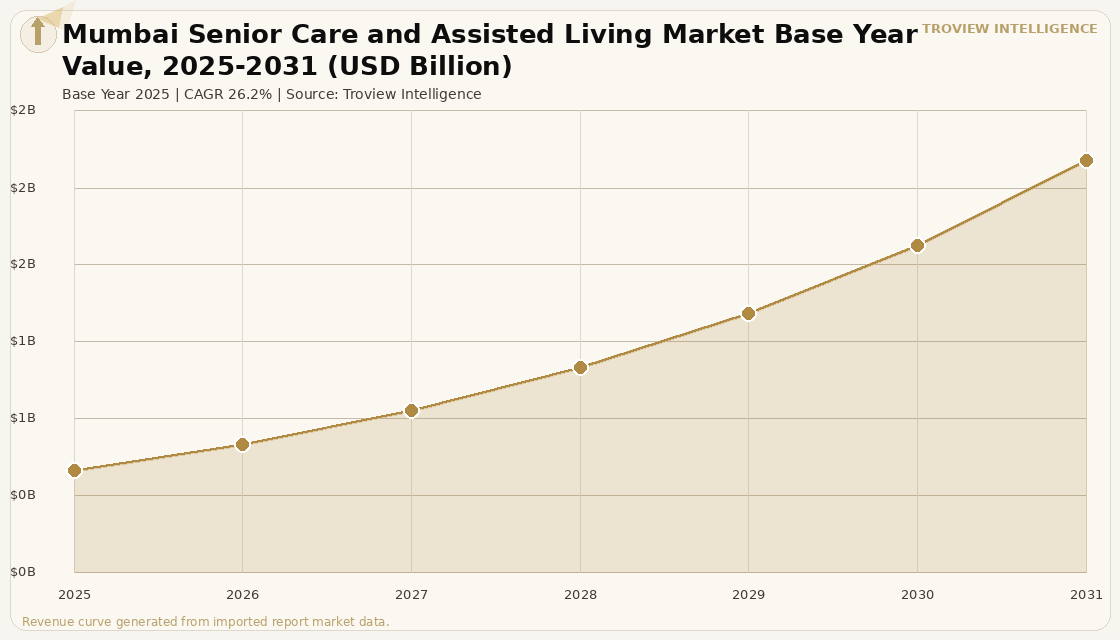
The Mumbai senior care and assisted living market size was USD 0.54 Billion in 2025 and is expected to register a revenue CAGR of 26.2% during the forecast period, reaching USD 2.18 Billion by 2031. Mumbai Metropolitan Region is India's largest urban economy and one of the most under-penetrated senior care markets relative to its affluent elderly population, with approximately 3.5 million persons aged 60 and above across the MMR including Mumbai city, Navi Mumbai, Thane, and extended periurban areas who collectively represent the largest concentration of disposable-income senior citizens of any Indian metro. The MMR's senior care market is characterised by the tension between exceptional demographic demand and the structural land cost constraint that makes large-campus senior living development economically challenging within established Mumbai geographies: plot valuations in Bandra, Andheri, and South Mumbai are among the most expensive in Asia, preventing the 5 to 10-acre campus formats that allow operators to achieve the amenity density and per-key development economics that make senior living investment viable at scale. For instance, in 2023, Primus Senior Living launched Primus Swarna at Wadhwa Wise City in Panvel marketed as Mumbai's first dedicated senior living community integrated within a 200-plus acre township offering 2BHK and 3BHK apartments designed with age-friendly features, 24/7 medical assistance, and community programming within a setting that combines senior living with the wider township's residential, commercial, and institutional infrastructure, targeting Mumbai's NRI parent demographic and affluent retired professionals who require senior-appropriate accommodation with connectivity to the city's medical and social infrastructure. These are some of the key factors driving revenue growth of the market.
Mumbai's senior care market in 2025 is in the early growth phase, with a very small base of organised senior living units relative to the MMR's elderly population, limited to a handful of dedicated senior care facilities and retirement communities concentrated in Navi Mumbai's Kharghar, Panvel, and Ulwe corridors alongside a small number of assisted care and old age homes within the established city boundaries. The market is experiencing rapid institutional interest as multiple national operators Columbia Pacific Communities, Vedaanta, Ashiana, Antara, and Primus have either entered or announced intentions to enter the Mumbai Metropolitan Region, drawn by the city's concentration of HNWI seniors, NRI parent households, and retired professionals from financial services, manufacturing, and pharmaceuticals who represent the premium end of the Indian senior living demand profile. Maharashtra's state government and MahaRERA have enacted model guidelines for senior living housing projects that standardise developer obligations and resident rights, providing a regulatory framework that reduces legal uncertainty for buyers and operators and is accelerating institutional investment into the MMR's senior living development pipeline. The Longitudinal Ageing Study of India confirms that 26.7% of urban elders now live alone, with the greatest momentum of this trend visible in Mumbai, Delhi NCR, and Bengaluru where real estate values and rental costs make multi-generation living increasingly impractical for adult children.
However, the Mumbai senior care and assisted living market faces structural constraints that limit the pace of organised sector supply growth. The Iran-US geopolitical tensions and resulting Strait of Hormuz disruptions, confirmed by the IMF in March 2026 to affect approximately 20% of global seaborne oil and LNG flows, are generating energy cost inflation that increases operating costs for Mumbai senior care facilities whose electricity requirements for air conditioning in Mumbai's tropical and humid climate, elevator systems for mobility-restricted residents, and medical equipment including oxygen systems, monitoring devices, and diagnostic equipment are particularly elevated relative to senior care facilities in cooler northern Indian cities. South Mumbai's high land values effectively preclude large-scale dedicated senior living development in the established island city geography, limiting organised senior care to the affordable campus corridor of Navi Mumbai and the emerging periurban zone along the Panvel-Khopoli highway where proximity to the Mumbai-Pune Expressway provides connectivity to both Mumbai and Pune's medical and social ecosystems without the prohibitive land cost of core Mumbai. The cultural preference for home-based family care among Mumbai's established Marathi, Gujarati, and Sindhi communities where professional senior care is not yet socially normalised for the current elder cohort creates a slower initial adoption curve for organised senior living compared to India's NRI-parent-heavy southern cities, requiring senior living operators to invest significantly in community education and cultural change marketing that extends their sales and pre-leasing timelines. These factors substantially limit Mumbai senior care and assisted living market growth over the forecast period.
TROVIEW ANALYST PERSPECTIVE "Mumbai's senior care market is five years behind Bengaluru and ten years behind the United States, but the demographic pressure is the same. The 3.5 million over-60 MMR residents include a uniquely high-value cohort: retired professionals from financial services, pharmaceuticals, and manufacturing who have benefited from 30 years of Mumbai's economic growth and are now entering retirement with the savings, health insurance coverage, and expectations of care quality that demand professionally managed senior living. The NRI parent segment is even more compelling: Mumbai's diasporic financial sector community in London, New York, and Dubai represents one of the world's largest concentrations of adult children managing aging parents remotely. They are the paying customer and the decision-maker. They will pay INR 1.5 to 2.5 crore for a well-designed, medically supervised senior apartment in Navi Mumbai rather than manage the anxiety of a parent living alone in a South Mumbai flat without 24/7 support. Primus understood this first with Wadhwa Wise City. Columbia Pacific is following. The window for first-mover advantage in Mumbai's organised senior care market is closing." Troview Intelligence Senior Analyst, Mumbai Senior Care Markets
SEGMENT INSIGHTS
Zone Deep-Dives
Navi Mumbai (Kharghar-Panvel-Ulwe) PRIMARY DEVELOPMENT ZONE, PRIMUS SWARNA, MANUSMRUTI
| Primary Operators | Land Cost Advantage | Connectivity | Unit Pricing Range |
| Primus (Wadhwa Wise City), Manusmruti | 60-80% below South and Western Mumbai | Mumbai-Pune Expressway, upcoming metro | INR 75L - INR 1.8 crore |
Navi Mumbai's Kharghar, Panvel, and Ulwe corridor is the primary zone for organised senior care and retirement community development in the Mumbai Metropolitan Region, driven by land costs that are 60 to 80% below established South Mumbai and Western Suburbs localities, large-format integrated township development that allows senior living components within mixed-use communities at viable per-key economics, and connectivity to Mumbai city via the Mumbai-Pune Expressway and the under-development Navi Mumbai Metro extension. Primus Swarna at Wadhwa Wise City in Panvel launched as Mumbai's first dedicated senior living community offers 2BHK and 3BHK apartments within a 200-plus acre integrated township with age-friendly design features, community programming, emergency medical response, and housekeeping services for residents in the 60-plus age group, targeting the MMR's NRI parent and affluent retired professional segments at prices in the INR 75 lakh to INR 1.8 crore range. Manusmruti senior citizens' home in Kharghar, Navi Mumbai is an established assisted care facility offering a home-like environment with outdoor gardens, gymnasium, recreation areas, and proximity to Kharghar's green spaces that provides assisted care for seniors requiring daily support in a community setting demonstrably different from institutional care environments.
Western Suburbs (Andheri-Goregaon-Borivali) DEMAND CONCENTRATION, LAND COST CONSTRAINT, SMALL-FORMAT HOMES
| Elderly Population (Western Suburbs) | Land Cost Challenge | Format | Primary Operators |
| ~900,000 60+ residents (largest suburban zone) | INR 18,000-35,000 per sq ft | Small-format assisted care homes (10-30 beds) | NGO and private trust-run facilities dominant |
The Western Suburbs zone from Andheri to Borivali is Mumbai's most densely populated senior residential area, hosting approximately 900,000 persons aged 60 and above across its residential neighbourhoods, with the highest concentration of middle-class and upper-middle-class Mumbai families who are the primary target demographic for organised senior care. The zone's land costs ranging from INR 18,000 to INR 35,000 per square foot in established Andheri and Goregaon localities preclude large-scale senior living campus development within the Western Suburbs itself, as the economics of INR 4,000 to 6,000 per square foot senior living pricing against INR 18,000 to 35,000 per square foot land costs cannot support viable development without government subsidy or density-related regulatory concessions that Maharashtra has not yet implemented for Western Suburban geographies. The senior care market in the Western Suburbs is served by a combination of small-format assisted care homes with 10 to 30 beds operated by NGOs, trusts, and private operators, and a growing number of home care service providers including Care24 and Portea Medical that deliver medical and personal care to seniors aging in place within their existing residential apartments a care model that avoids the land cost constraint entirely but provides less community programming and social engagement than campus-format senior living.
Thane and Kalyan-Dombivli EMERGING CORRIDOR, AFFORDABLE LAND, TOWNSHIP DEVELOPMENT PIPELINE
| Development Profile | Land Cost Advantage | Population Growth | Senior Care Format |
| Emerging, multiple township projects | INR 8,000-15,000 per sq ft in Thane | One of MMR's fastest-growing nodes | Integrated township senior components |
The Thane and Kalyan-Dombivli corridor is emerging as a secondary senior care development zone in the Mumbai Metropolitan Region, combining land costs of INR 8,000 to 15,000 per square foot that are materially lower than Western Suburbs and South Mumbai while retaining metro and suburban railway connectivity to the broader MMR's employment, medical, and cultural infrastructure. Multiple large-scale integrated townships under development in Thane including Lodha Palava City and various Kalyan-Dombivli townships have begun incorporating senior living components in response to the aging demographic profile of the townships' earliest residential buyers who are now entering the 60 to 75 age cohort. The Thane zone's proximity to the Hiranandani Hospital and Jupiter Hospital in Thane both tertiary-quality private hospitals provides the medical emergency response infrastructure that senior living facilities require for high-confidence operator licensing and resident family peace-of-mind, differentiating Thane from more peripheral MMR development zones where hospital access times exceed 45 minutes during peak traffic.